
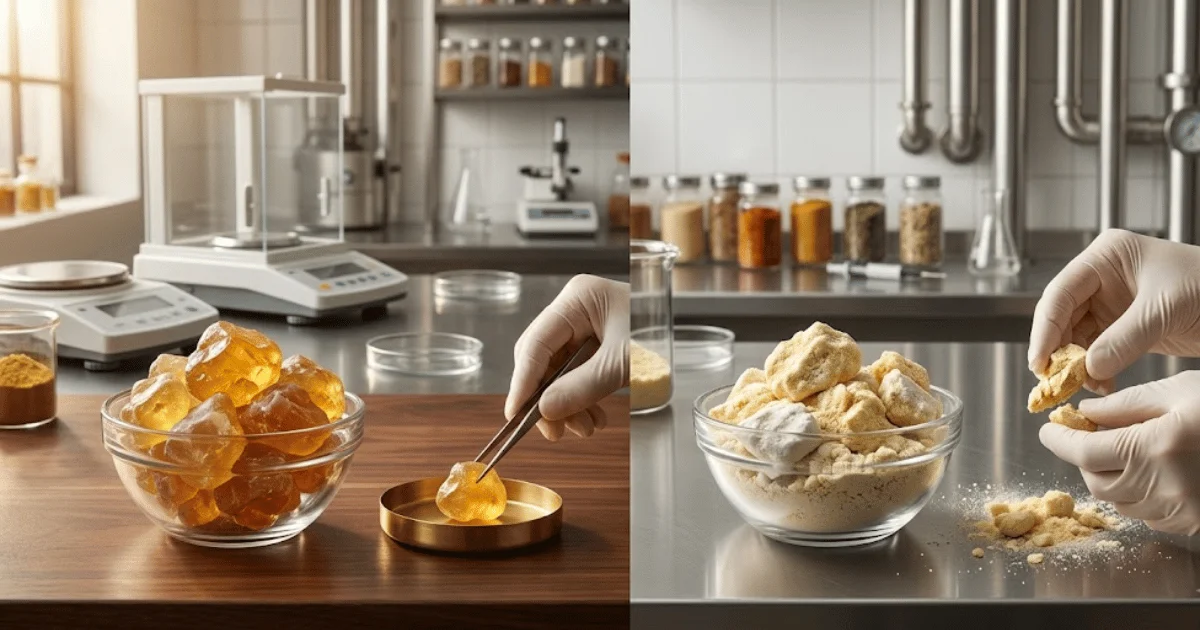
Resin Percentage in Hing is an important consideration when evaluating Asafoetida for commercial food applications. Buyers often compare Hing products based on aroma, appearance, price, formulation, and strength, but resin content can provide additional information about the characteristics of an Asafoetida product.
For households, the practical question may simply be how much Hing to use in a recipe. For food manufacturers, however, the decision is more complex. Ingredient concentration can affect formulation, dosing, sensory performance, consistency, and the economics of large-scale production.
Understanding Resin Percentage in Hing can therefore help procurement teams, food manufacturers, seasoning companies, distributors, wholesalers, and product developers make better-informed purchasing decisions.
What Is Resin in Hing?
Asafoetida is obtained from the oleo-gum-resin of certain Ferula species. The resin fraction contributes significantly to the characteristic aroma and flavor associated with Asafoetida.
Commercial Hing products can differ in composition depending on their formulation and intended application. Pure resin and compounded products are not identical in composition or handling characteristics.
For this reason, resin percentage should always be considered alongside the complete product specification rather than treated as the only measure of quality.
What Does Resin Percentage in Hing Mean?
Resin Percentage in Hing generally refers to the proportion of Asafoetida resin present within a specified product formulation.
A higher resin proportion can indicate a greater contribution from the characteristic Asafoetida resin component, while a lower proportion may indicate that the product contains a greater amount of other formulation components.
However, a higher percentage does not automatically mean that one product is better for every application.
The correct product depends on the intended use, required strength, formulation, dosage, processing conditions, and commercial requirements.
Why Resin Percentage in Hing Matters
Resin Percentage in Hing can influence how an ingredient behaves within a food formulation. The resin component contributes to the characteristic sensory profile of Asafoetida, so differences in composition can affect aroma and flavor performance.
For commercial users, this can influence how much ingredient is required to achieve a desired sensory result.
Understanding the resin content can therefore help manufacturers compare products more intelligently rather than relying only on price per kilogram.
Resin Percentage and Aroma Intensity
Aroma is one of the most important characteristics of Hing. The distinctive smell of Asafoetida is a major reason it is used in traditional cooking and commercial seasoning systems.
The resin component contributes significantly to the characteristic aromatic profile of Asafoetida.
As a result, differences in product composition may influence the aroma intensity experienced during formulation and cooking.
However, aroma intensity can also depend on other factors, including raw material quality, processing, storage, packaging, product age, and the complete formulation.
Therefore, Resin Percentage in Hing should be evaluated together with actual sensory performance.
Resin Percentage and Hing Strength
Hing strength is commonly discussed when comparing different products. Buyers may describe Hing as mild, medium, strong, or highly concentrated depending on the product and application.
Resin percentage can be one factor influencing this perceived strength, but it should not be treated as a universal strength measurement.
Two products with different formulations may perform differently even if their stated resin percentages appear similar.
This is why application testing and technical specifications are valuable for commercial buyers.
Resin Percentage in Hing and Dosing
Ingredient dosing is particularly important in food manufacturing. A seasoning formulation may be designed around a specific sensory target, and changes in ingredient concentration can affect the final product.
If a manufacturer changes from one Hing specification to another, the amount used may need to be evaluated again.
The appropriate dosage depends on the product, desired aroma, other seasoning ingredients, processing conditions, and the characteristics of the Hing being used.
Manufacturers should therefore avoid assuming that the same dosage will produce identical results across different Hing products.
How Resin Percentage Affects Commercial Formulation
Commercial food formulations are usually designed around controlled ingredient specifications. When the characteristics of a key seasoning ingredient change, product developers may need to make formulation adjustments.
Resin Percentage in Hing can therefore become relevant during product development, supplier qualification, and ingredient substitution.
R&D teams may evaluate different Hing specifications to determine:
- Aroma performance
- Flavor contribution
- Required dosage
- Compatibility with other spices
- Performance after processing
- Final product acceptance
This approach provides more useful information than evaluating resin percentage alone.
Resin Percentage in Compound Hing
Compound Hing is formulated to create a more manageable commercial product. It can be easier to measure, blend, store, and use than highly concentrated raw resin.
Because Compound Hing contains other formulation components, resin percentage can be an important specification when comparing different products.
Commercial buyers should review the complete ingredient composition and technical specification before comparing products.
A product with a different formulation may have a different dosing requirement, handling characteristic, and sensory performance.
Higher Resin Percentage Does Not Always Mean Better Hing
This is an important point for buyers.
A higher Resin Percentage in Hing may be desirable for some applications, particularly where stronger Asafoetida characteristics are required. However, stronger is not automatically better.
A retail consumer may prefer a balanced product that is easy to dose. A seasoning manufacturer may require a specific concentration that fits an existing formulation. A food manufacturer may prioritize consistency and repeatability over maximum resin content.
The best Hing is therefore the one that meets the requirements of the intended application.
Resin Percentage and Product Cost
Price comparisons between Hing products can become misleading when buyers look only at the price per kilogram.
A lower-priced product may require a higher dosage, while a more concentrated product may achieve the desired sensory result at a lower inclusion level.
Commercial buyers should therefore consider the cost of the ingredient relative to its actual performance in the final formulation.
A useful purchasing evaluation can include:
- Price per kilogram
- Resin specification
- Recommended application level
- Flavor intensity
- Batch consistency
- Processing performance
- Packaging
- Supply reliability
This gives buyers a more realistic view of total ingredient value.
Importance of Application Testing
Technical specifications are useful, but application testing provides practical evidence of how a Hing product performs.
Food manufacturers can compare different products using controlled trials.
For example, an R&D team can prepare the same food formulation using different Hing samples while keeping all other ingredients and processing conditions unchanged.
The team can then evaluate aroma, flavor, aftertaste, overall balance, and required dosage.
This approach helps determine whether differences in Resin Percentage in Hing translate into meaningful differences in the finished product.
Resin Percentage and Batch Consistency
Consistent product composition is important for manufacturers producing standardized food products.
If the composition of Hing changes significantly between batches, the ingredient may behave differently during formulation.
This can create problems for seasoning manufacturers and food brands that depend on fixed recipes.
Reliable suppliers should therefore maintain defined product specifications and appropriate batch controls.
Why Food Manufacturers Need Clear Hing Specifications
Food manufacturers often purchase ingredients according to technical specifications rather than generic product names.
A clear Hing specification can help procurement and quality teams understand what they are purchasing.
Depending on the product, documentation may include information about:
- Product identity
- Ingredient composition
- Resin specification
- Physical characteristics
- Storage conditions
- Packaging
- Batch identification
- Relevant quality parameters
Clear specifications reduce confusion and make supplier comparison more structured.
Resin Percentage in Hing and Quality Evaluation
Quality evaluation should never depend on one specification alone.
While Resin Percentage in Hing can provide useful information, buyers should also consider aroma, flavor, appearance, consistency, processing characteristics, packaging, and supplier performance.
For commercial applications, a broader quality assessment provides a more reliable picture of ingredient suitability.
This is particularly important when Hing will be used as an ingredient in high-volume food production.
Role of Supplier Reliability
Ingredient specifications are only valuable when suppliers can maintain them consistently.
Food manufacturers should evaluate whether a supplier has reliable raw material sourcing, controlled processing, quality checks, appropriate packaging, and dependable production capacity.
A supplier that provides consistent Hing specifications can help reduce the risk of unexpected formulation changes.
Long-term supply reliability is particularly important for food brands that cannot easily change their ingredient specifications once a product has been commercialized.
Resin Percentage and Export Requirements
Export buyers may have specific technical and documentation requirements for Hing products.
International customers may evaluate composition, specifications, packaging, labelling, shelf-life information, and quality documentation before approving a supplier.
Clear information about Resin Percentage in Hing can therefore form part of the technical discussion between exporters and international buyers.
However, export compliance depends on the destination market and applicable regulations, so buyers should confirm the requirements relevant to their specific market.
How to Compare Hing Products Correctly
Buyers should avoid selecting Hing based on one number or one marketing claim.
A structured comparison should consider:
- Resin percentage
- Product formulation
- Aroma profile
- Flavor intensity
- Recommended dosage
- Batch consistency
- Packaging quality
- Documentation
- Supplier capability
- Application performance
This approach helps buyers identify the product that best fits their actual requirements.
Resin Percentage in Hing for Different Customer Segments
Different buyers may require different product characteristics.
Retail Buyers
Retail consumers generally value convenience, recognizable flavor, easy dosing, packaging, and consistent everyday performance.
Restaurants
Restaurants may prioritize consistent flavor, commercial pack sizes, easy handling, and reliable supply.
Seasoning Manufacturers
Seasoning manufacturers may focus more heavily on aroma strength, formulation compatibility, particle characteristics, batch consistency, and technical specifications.
Food Manufacturers
Industrial food manufacturers may require detailed specifications, application testing, consistent batches, bulk supply, documentation, and dependable delivery.
Export Buyers
Export customers may place additional emphasis on specifications, packaging, documentation, traceability, and destination-market requirements.
This shows why the ideal Resin Percentage in Hing depends on the intended application rather than a universal standard.
Common Mistakes When Evaluating Resin Percentage
One common mistake is assuming that the highest resin percentage automatically represents the highest-quality product.
Another mistake is comparing resin percentage without considering the complete product formulation.
Buyers may also overlook dosage, application performance, batch consistency, packaging, and supplier reliability.
A more complete evaluation provides better purchasing decisions and reduces the risk of selecting an ingredient that does not perform as expected.
Why Resin Percentage Should Be Considered With Sensory Performance
Food is ultimately evaluated through sensory experience. A technical specification can provide valuable information, but the finished product must still deliver the desired aroma and flavor.
This is why Resin Percentage in Hing should be considered alongside sensory evaluation.
For commercial product development, the most useful approach is to combine technical specifications with controlled application trials.
Future Importance of Resin Specifications
As food manufacturing becomes more standardized, technical ingredient specifications are becoming increasingly important.
Food manufacturers want predictable raw materials that can be incorporated into controlled formulations.
This means specifications such as resin content can become increasingly relevant during supplier qualification, product development, procurement, and quality assurance.
Suppliers that provide clear and consistent product specifications can build greater confidence among commercial buyers.
Conclusion
Resin Percentage in Hing can provide valuable information when evaluating Asafoetida products, particularly for commercial food manufacturing and seasoning applications. Resin content can influence aroma contribution, perceived strength, formulation requirements, and purchasing considerations.
However, resin percentage should never be treated as the only measure of Hing quality. Product composition, aroma, flavor performance, batch consistency, processing characteristics, packaging, documentation, and supplier reliability all matter.
For buyers, the best approach is to compare Hing products according to their intended application and evaluate both technical specifications and real-world performance.
RB Industries supplies Asafoetida, Compound Hing, Hing Powder, Hing Granules, and related food ingredients for retailers, wholesalers, distributors, food manufacturers, restaurants, exporters, and FMCG brands seeking consistent commercial Hing solutions.
Frequently Asked Questions
What does resin percentage in Hing mean?
Resin Percentage in Hing refers to the proportion of Asafoetida resin present within a specified Hing product or formulation. It can provide useful information about the product’s composition, but it should be evaluated alongside other quality and performance factors.
Does a higher resin percentage mean better Hing?
Not necessarily. A higher resin percentage may be useful for applications requiring stronger Asafoetida characteristics, but the best product depends on the intended use, formulation, dosage, consistency, and desired sensory profile.
Does resin percentage affect Hing dosage?
It can influence the amount of product required to achieve a particular sensory result. However, dosage also depends on the complete formulation, product type, processing conditions, and the characteristics of the specific Hing product.
Why should food manufacturers check resin percentage?
Food manufacturers can use resin specifications as one part of their ingredient evaluation process. Understanding product composition can help with supplier comparison, formulation development, dosage evaluation, and quality control.
What else should buyers check besides resin percentage?
Buyers should also evaluate aroma, flavor intensity, formulation, batch consistency, physical characteristics, packaging, documentation, supplier reliability, and application performance. A complete evaluation provides a more accurate picture of ingredient suitability.