
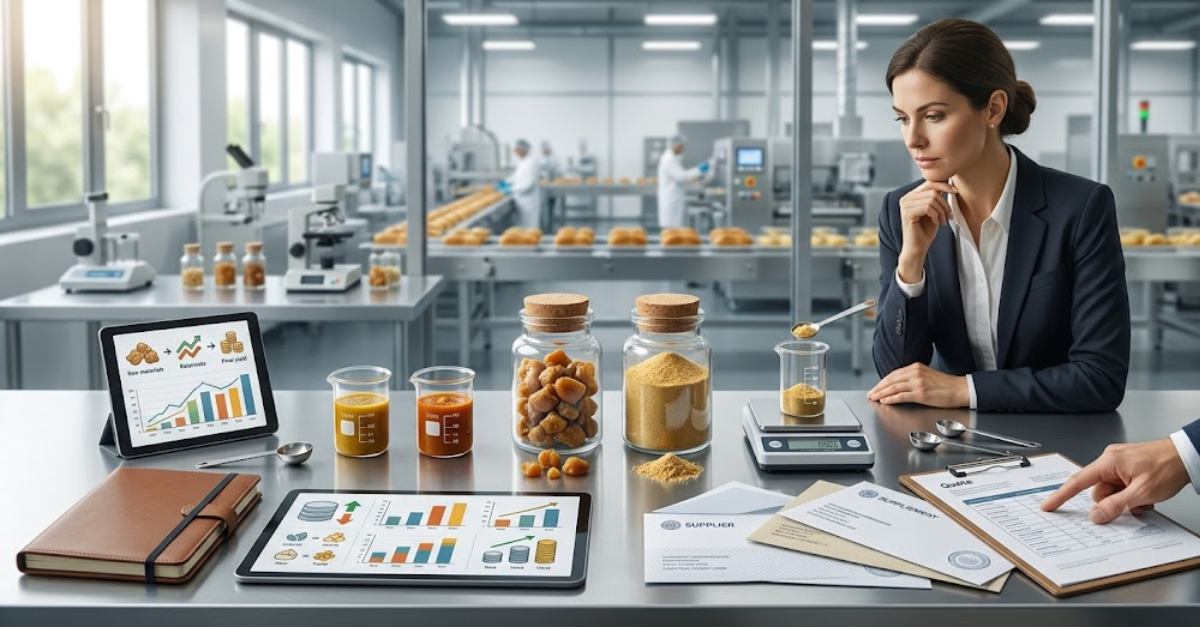
When food manufacturers compare Hing quotations, the lowest price per kilogram can look attractive. However, the cheapest quotation is not always the lowest-cost option for production.
The actual commercial value of Hing depends on how much of the ingredient is required to achieve the desired aroma and flavour in the finished product. Dosage, product strength, formulation, wastage, packaging and batch performance can all influence the final cost.
This is why Hing Cost-in-Use can be more useful than simply comparing the quoted price per kilogram.
What Is Hing Cost-in-Use?
Hing Cost-in-Use is the effective cost of Hing consumed to achieve the required performance in a specific food formulation or production batch.
Instead of asking only, “What is the price per kilogram?”, procurement teams can ask:
- How much Hing does the formulation actually require?
- What quantity is consumed per batch?
- Does the product provide the required aroma at the approved dosage?
- How much material is lost during handling?
- What is the final Hing cost per finished batch?
This approach gives manufacturers a more practical basis for supplier comparison.
Why Price Per Kilogram Can Be Misleading
Two Hing products may have different prices per kilogram but produce similar commercial results at different dosages.
For example, Supplier A may offer a lower price per kilogram, while Supplier B offers a higher price but requires less Hing to achieve the desired flavour profile.
If Supplier B requires substantially less material per batch, its effective production cost may be competitive or even lower.
Therefore, procurement teams should evaluate the relationship between price, dosage and performance instead of looking at the quotation alone.
How to Calculate Hing Cost-in-Use
A simple calculation can help procurement teams move from price comparison to actual production economics.
Hing Cost-in-Use = Hing quantity used per batch × effective Hing cost per unit
For example, suppose a manufacturer pays ₹1,000 per kilogram for one product and uses 1 kilogram across a defined number of production batches. Another product may cost ₹1,200 per kilogram but require only 0.75 kilogram for equivalent flavour performance.
The second product should not automatically be considered more expensive.
The manufacturer should calculate the actual cost required to achieve the approved formulation result.
Step 1: Record the Supplier Price
Start with the actual commercial quotation rather than a general market price.
Record:
- Price per kilogram
- Order quantity
- Packaging format
- Freight or delivery charges
- Applicable taxes
- Any additional commercial charges
This creates the true starting cost for the calculation.
Buyers should compare quotations on an equivalent basis. A quotation that excludes freight or uses a different pack size should not be compared directly with an all-inclusive quotation without adjusting the numbers.
Step 2: Establish the Approved Dosage
The next step is to identify how much Hing is actually required in the formulation.
The dosage should come from controlled product testing rather than a supplier’s general recommendation alone.
R&D teams can test the product at different levels and establish the quantity that delivers the desired result.
Once the dosage has been approved, procurement can use it as the basis for calculating Hing Cost-in-Use.
Step 3: Calculate Cost Per Production Batch
Suppose a manufacturer produces a standard batch of food and uses a defined quantity of Hing.
The calculation can be expressed as:
Cost per batch = Hing quantity used × cost per kilogram
This is more meaningful than looking at the kilogram price alone because it connects the ingredient purchase directly with manufacturing output.
For larger manufacturing operations, the same calculation can be extended to daily, weekly or monthly production.
Step 4: Consider Product Strength and Performance
Hing products can differ in aroma intensity and formulation. Therefore, two products with identical prices may not have identical performance.
A manufacturer should evaluate the quantity required to achieve the same target result.
This does not mean that stronger Hing is automatically better. The correct product is the one that performs appropriately within the manufacturer’s application and approved formulation.
This is one of the most important reasons to calculate Hing Cost-in-Use using actual application data.
Step 5: Include Handling and Wastage
Ingredient economics can also be affected by handling losses.
Wastage may result from:
- Spillage
- Packaging residue
- Incorrect measurement
- Storage problems
- Production handling
- Expired or rejected material
Not every business will experience the same level of loss, so procurement teams should use their own operational data where available.
A product that looks cheaper on paper may not deliver the same economic result if actual usable quantity is lower.
Compare Supplier Quotes on an Equal Basis
A proper supplier comparison should normalize the commercial information first.
| Factor | Supplier A | Supplier B |
|---|---|---|
| Price per kg | Record | Record |
| Approved dosage | Record | Record |
| Cost per batch | Calculate | Calculate |
| Packaging | Compare | Compare |
| Freight | Include | Include |
| Wastage | Estimate | Estimate |
| Supply capability | Evaluate | Evaluate |
This prevents procurement teams from selecting a supplier solely because one number on the quotation appears lower.
Example: Price Per Kg vs Cost Per Batch
Consider two hypothetical Hing products used in the same food application.
| Metric | Supplier A | Supplier B |
|---|---|---|
| Price per kg | ₹900 | ₹1,100 |
| Required dosage | 1.00 kg | 0.75 kg |
| Effective ingredient cost | ₹900 | ₹825 |
In this simplified example, Supplier B has the higher purchase price per kilogram but the lower effective ingredient cost for the tested application.
The figures are illustrative. Actual commercial decisions should always use the manufacturer’s tested dosage and current supplier quotation.
Do Not Use Cost-in-Use Without Product Testing
A calculation is only as reliable as the data behind it.
Manufacturers should not assume that a smaller quantity is always sufficient simply because a supplier describes its product as strong.
The correct dosage should be established through controlled application testing.
R&D and QA teams should confirm the sensory and technical performance before procurement uses that dosage to calculate Hing Cost-in-Use.
Why Formulation Matters
Hing does not perform in isolation. The final effect depends on the food matrix, other ingredients and processing conditions.
A quantity that works well in one formulation may not produce the same result in another.
For example, a Hing dosage approved for a dry seasoning may not automatically transfer to a cooked sauce, ready-to-eat product or snack formulation.
Therefore, cost calculations should always be connected to a defined application.
Consider the Cost of Reformulation
Supplier comparison should also consider what happens if the selected product later changes.
A cheaper ingredient that produces inconsistent results may create additional costs through:
- Recipe adjustments
- Additional testing
- Production trials
- Quality investigations
- Product complaints
- Batch rejection
These costs are difficult to include in a simple kilogram-price comparison, but they can matter significantly for commercial food manufacturers.
This is why Hing Cost-in-Use should be considered alongside consistency and supplier reliability.
How Packaging Can Affect Effective Cost
Packaging is another factor that procurement teams should not overlook.
The appropriate pack size depends on consumption, storage capacity and handling procedures.
A very large pack may provide a lower purchase price but may be inconvenient for a smaller production environment. Conversely, smaller packs may be easier to handle but could carry a higher packaging cost.
The best option depends on actual manufacturing requirements.
Include Freight and Landed Cost
Supplier quotations should also be compared using the appropriate landed cost.
If one quotation includes freight and another does not, the two prices are not directly comparable.
A procurement comparison can therefore record:
- Product price
- Packaging cost
- Freight
- Taxes
- Other applicable charges
The resulting landed cost can then be used in the Hing Cost-in-Use calculation.
How R&D and Procurement Should Work Together
Cost-in-use analysis works best when R&D and procurement share information.
R&D can provide the approved dosage and application-performance data. Procurement can provide supplier quotations, MOQ, packaging and delivery costs.
Together, they can determine which option provides the best combination of technical performance and commercial value.
This avoids a common problem where procurement selects the lowest quotation before the actual formulation performance has been validated.
When Should Manufacturers Recalculate Cost-in-Use?
The calculation should be reviewed when an important commercial or technical variable changes.
Examples include:
- Supplier price changes
- Hing product changes
- Dosage changes
- Formulation changes
- Packaging changes
- Freight changes
- Major production-volume changes
Regular review keeps the procurement comparison relevant.
Common Mistakes When Comparing Hing Quotes
Choosing the Lowest Price Per Kg
A low kilogram price does not automatically mean the lowest production cost.
Ignoring Dosage
The amount used per batch directly affects ingredient cost.
Comparing Different Product Forms
Powder, granules, resin and compounded products may not be directly comparable without considering their application and dosage.
Ignoring Freight
Different delivery terms can change the effective landed cost.
Using Unverified Dosage Claims
Dosage should be established through appropriate product testing.
Ignoring Consistency
A product that performs well in one batch but varies significantly later can create additional operational costs.
Hing Cost-in-Use Comparison Checklist
- Record the actual supplier quotation.
- Normalize freight and applicable charges.
- Confirm the exact Hing product and format.
- Test the product in the target formulation.
- Approve the required dosage.
- Calculate cost per production batch.
- Consider practical wastage.
- Evaluate packaging and handling.
- Review supplier consistency.
- Consider supply reliability.
- Compare the total commercial picture.
Conclusion
Hing Cost-in-Use gives food manufacturers a more practical way to compare supplier quotations than price per kilogram alone.
The calculation connects the supplier quotation with actual formulation dosage, production volume and ingredient performance. It can therefore help procurement teams identify genuine value rather than simply selecting the lowest headline price.
The strongest approach is to combine R&D testing with procurement analysis. First establish the product’s performance and approved dosage. Then calculate the effective cost using the complete commercial quotation.
For manufacturers purchasing Hing regularly, this approach can support better supplier decisions, more accurate product costing and stronger long-term procurement planning.
Frequently Asked Questions
What is Hing Cost-in-Use?
Hing Cost-in-Use is the effective cost of Hing consumed to achieve the required performance in a specific food formulation or production batch.
Is price per kg enough to compare Hing suppliers?
No. Price per kilogram is only one factor. Manufacturers should also consider dosage, formulation performance, freight, packaging, wastage and supply reliability.
How do you calculate Hing cost per batch?
Multiply the quantity of Hing used in the batch by the effective cost per kilogram, using the actual approved dosage and commercial quotation.
Why can a more expensive Hing product have a lower production cost?
A higher-priced product may require a lower dosage to achieve the same tested result. The effective cost should therefore be calculated using actual application data.
Should freight be included when comparing Hing quotations?
Yes. If quotations have different delivery terms, freight and other applicable charges should be normalized before comparing effective costs.
When should manufacturers recalculate Hing Cost-in-Use?
The calculation should be reviewed when supplier prices, dosage, formulation, packaging, freight or other important commercial variables change.
Need Help Comparing Hing for Commercial Production?
RB Industries supplies Asafoetida, Compound Hing, Hing Powder and Hing Granules for food manufacturers, FMCG businesses, restaurants, spice companies and bulk buyers.
If you are comparing Hing samples or supplier quotations, share your application, approximate dosage, required quantity and packaging requirement. The product can then be evaluated based on actual commercial use rather than price per kilogram alone.
Contact RB Industries for Hing samples, specifications and bulk supply quotations.


