
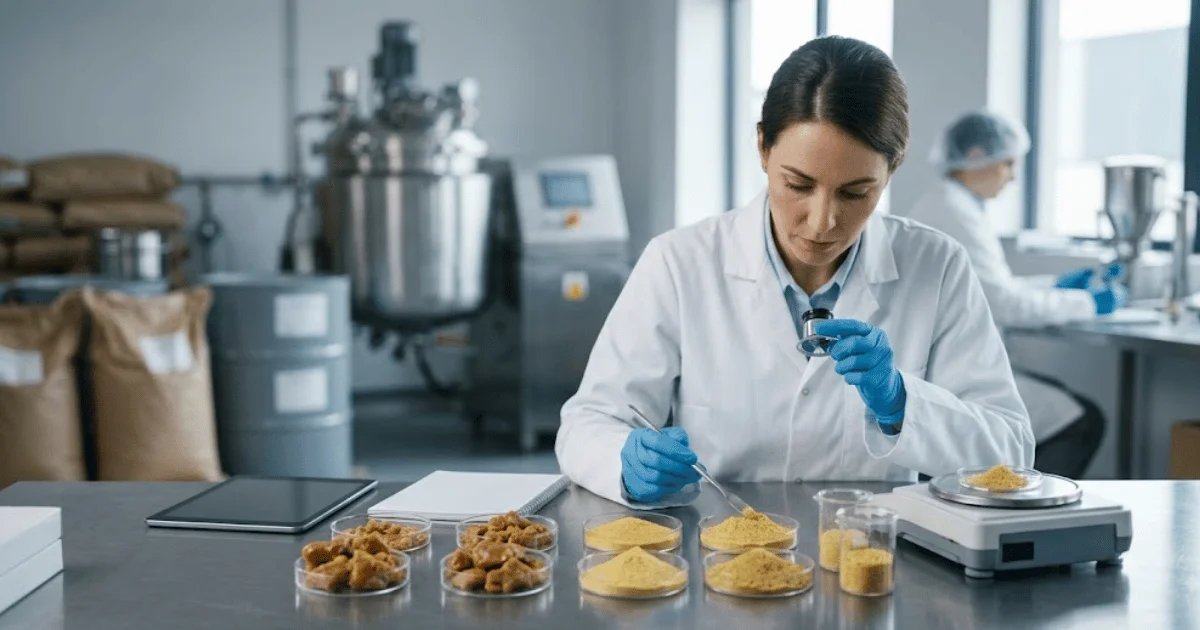
Hing Supplier Evaluation is an important step for food manufacturers, seasoning companies, restaurants, distributors, wholesalers, FMCG brands, and exporters that depend on consistent Asafoetida supply. Choosing a Hing supplier based only on price can create problems later when product quality, batch consistency, documentation, production capacity, or delivery reliability does not meet expectations.
For commercial buyers, the right supplier must provide more than a product sample. The supplier should be capable of delivering the agreed specification consistently across repeated orders while supporting the buyer’s quality, production, packaging, and supply-chain requirements.
A structured Hing Supplier Evaluation process helps procurement and quality teams compare suppliers objectively before approving them for regular or bulk purchasing.
What Is Hing Supplier Evaluation?
Hing Supplier Evaluation is the process of assessing a Hing manufacturer or supplier before establishing a commercial purchasing relationship.
The evaluation normally considers several areas rather than focusing on one product characteristic.
Depending on the buyer’s requirements, the evaluation can include:
- Product quality
- Ingredient specifications
- Sample performance
- Batch consistency
- Manufacturing capability
- Production capacity
- Quality assurance
- Documentation
- Packaging
- Delivery capability
- Commercial reliability
- Customer support
This approach helps buyers determine whether a supplier is suitable for a short-term purchase or a long-term supply relationship.
Why Hing Supplier Evaluation Matters
Hing Supplier Evaluation matters because food manufacturers often build their formulations around defined ingredient characteristics.
If the Hing supplied in one batch performs differently from the previous batch, the finished food product may also change. Differences in aroma, flavor intensity, particle characteristics, moisture, or formulation can affect production results.
A supplier that provides a good sample but cannot maintain consistent quality later creates a significant procurement risk.
Therefore, buyers should evaluate the supplier’s complete capability rather than approving a supplier based on a single sample.
Start With the Exact Product Requirement
A good Hing Supplier Evaluation process should begin with a clear understanding of what the buyer actually needs.
Different customers may require different Hing products and specifications.
For example, a buyer may need:
- Compound Hing
- Hing Powder
- Hing Granules
- Bulk Hing
- Retail-ready Hing
- Private-label Hing
- Application-specific Hing
The buyer should define the intended application, required format, pack size, expected order volume, quality requirements, and delivery expectations before comparing suppliers.
This prevents suppliers from being compared against unclear or inconsistent requirements.
Evaluate the Hing Product Sample
Product sampling is usually one of the first practical stages of Hing Supplier Evaluation.
A sample allows the buyer’s quality and product-development teams to evaluate whether the ingredient is suitable for the intended application.
Depending on the product, evaluation can include:
- Appearance
- Aroma
- Flavor
- Texture
- Particle characteristics
- Colour
- Packaging
- Application performance
For food manufacturers, it is often more useful to test Hing inside the actual formulation rather than evaluating it only as a standalone ingredient.
Check the Product Specification
A professional Hing Supplier Evaluation should include a comparison between the buyer’s required specification and the supplier’s product specification.
The product name alone does not provide enough information for commercial procurement.
Buyers should understand the relevant characteristics of the product and confirm that the supplier can consistently meet the agreed requirements.
Depending on the Hing product, the specification may cover:
- Product composition
- Resin-related specifications
- Physical characteristics
- Moisture-related parameters
- Particle size
- Packaging
- Storage requirements
- Relevant quality parameters
A clear specification provides a reference point for future purchasing and quality checks.
Assess Batch Consistency
Batch consistency should be a major part of Hing Supplier Evaluation, particularly when the buyer plans to purchase regularly.
A single high-quality sample does not prove that every future batch will perform the same way.
Buyers should therefore consider the supplier’s ability to maintain consistent product characteristics across production batches.
This is especially important for seasoning companies and food manufacturers because their recipes may be standardized around specific ingredient performance.
Consistency reduces the need for repeated formulation adjustments and helps protect the sensory profile of the finished product.
Evaluate Manufacturing Capability
A supplier’s manufacturing capability is another important part of Hing Supplier Evaluation.
Food manufacturers should understand whether the supplier operates a suitable production facility and whether its manufacturing processes can support the required product specifications.
Relevant considerations may include:
- Production infrastructure
- Processing capability
- Blending capability
- Grinding or granulation capability
- Packaging capability
- Quality-control systems
- Production capacity
The supplier should be capable of supporting the buyer not only during the first order but also as demand grows.
Check Production Capacity Before Approval
Production capacity is often overlooked during Hing Supplier Evaluation.
A supplier may provide excellent product quality but struggle to fulfil larger or recurring orders.
For food manufacturers, this can create production delays and force emergency purchases from alternative suppliers.
Buyers should therefore discuss expected order volumes, production lead times, peak-season requirements, minimum order quantities, and future scalability.
A reliable supplier should communicate clearly about what it can realistically supply.
Evaluate Quality Assurance Systems
A strong Hing Supplier Evaluation should examine how the supplier manages quality throughout its operations.
Quality assurance should begin with raw material sourcing and continue through processing, packaging, storage, and dispatch.
Buyers can ask how the supplier manages:
- Raw material inspection
- Production controls
- Batch identification
- Quality checks
- Packaging inspection
- Storage
- Traceability
- Customer complaints
A supplier with structured quality processes is generally better positioned to support consistent commercial supply.
Review Documentation
Documentation should form part of every serious Hing Supplier Evaluation process.
Commercial buyers may require product specifications, batch information, Certificates of Analysis, invoices, packing information, and other relevant records depending on the application and market.
The objective is not simply to collect documents. Buyers should verify that the information is clear, relevant, and connected to the product being supplied.
Good documentation also helps procurement, quality, production, and regulatory teams communicate more effectively.
Evaluate Certificate of Analysis Practices
A Certificate of Analysis, or COA, can provide useful batch-specific information when it is part of an appropriate quality system.
During Hing Supplier Evaluation, buyers should understand how the supplier handles COAs and whether the documentation corresponds to the relevant batch.
Buyers should also understand which parameters are tested and whether they match the agreed product specification.
A COA should support the quality process rather than replace supplier qualification and physical product evaluation.
Check Raw Material Sourcing
The quality of finished Hing depends significantly on the raw material entering the manufacturing process.
Asafoetida is a natural agricultural-derived ingredient, so raw material characteristics can vary.
A responsible Hing Supplier Evaluation should therefore consider how the supplier manages raw material sourcing and incoming inspection.
Buyers can ask whether raw materials are evaluated against defined criteria and how variation is managed before production.
This can provide useful insight into the supplier’s ability to maintain consistent finished products.
Evaluate Packaging Quality
Packaging should not be treated as a minor purchasing detail.
Hing is strongly aromatic, and suitable packaging can help protect the product during transportation and storage.
During Hing Supplier Evaluation, buyers should consider whether the packaging is appropriate for:
- Product characteristics
- Storage duration
- Transportation conditions
- Order quantity
- Domestic distribution
- International shipment
Commercial buyers should also check pack sizes, labelling, batch identification, sealing, and overall packaging integrity.
Assess Storage and Inventory Management
A supplier’s warehouse and inventory practices can also affect supply reliability.
During Hing Supplier Evaluation, buyers should consider whether finished products are stored under suitable conditions and whether batches are properly identified.
Good inventory management helps suppliers fulfil orders accurately and maintain traceability.
It can also reduce the risk of avoidable damage or deterioration during storage.
Check Lead Times and Delivery Reliability
A product that meets every quality requirement but arrives late can still create problems for a food manufacturer.
Delivery performance should therefore be included in Hing Supplier Evaluation.
Buyers should discuss:
- Typical lead times
- Production schedules
- Dispatch timelines
- Transport arrangements
- Minimum order quantities
- Recurring order planning
- Urgent order capabilities
Clear communication about delivery expectations helps both parties plan production and inventory more effectively.
Evaluate Communication and Responsiveness
Supplier communication becomes increasingly important as the relationship becomes more complex.
A professional Hing Supplier Evaluation should therefore consider how quickly and accurately a supplier responds to technical, commercial, and quality questions.
Good communication is particularly valuable when a buyer needs a specification change, new packaging format, additional documentation, or an urgent production discussion.
A supplier that communicates clearly can reduce unnecessary delays throughout the purchasing process.
Consider Customization Capability
Some food manufacturers require standard Hing products, while others may need specific formats or packaging arrangements.
During Hing Supplier Evaluation, buyers should determine whether the supplier can support legitimate customization requirements.
Potential requirements can include:
- Different pack sizes
- Bulk packaging
- Private-label packaging
- Specific product formats
- Customer-specific specifications
Customization capability can be particularly valuable for FMCG brands, distributors, and food manufacturers developing specialized products.
Compare Price Correctly
Price is important, but it should not dominate the entire Hing Supplier Evaluation process.
A lower purchase price may not represent better value if the product requires higher dosage, produces inconsistent results, creates production problems, or arrives late.
Buyers should evaluate total commercial value rather than simply comparing the price per kilogram.
Total value can include:
- Product performance
- Consistency
- Dosage efficiency
- Packaging
- Documentation
- Delivery reliability
- Technical support
- Supply continuity
This provides a more realistic basis for supplier comparison.
Conduct a Trial Order
A trial order can be a useful stage before approving a supplier for larger recurring volumes.
During Hing Supplier Evaluation, the buyer can use a smaller commercial order to assess the supplier’s actual performance.
The trial can reveal whether the supplier delivers:
- The approved product
- The expected packaging
- Correct documentation
- Accurate quantities
- Expected delivery timelines
- Consistent product quality
A successful trial order provides stronger evidence than a sample alone.
Red Flags During Hing Supplier Evaluation
Buyers should also identify warning signs during Hing Supplier Evaluation.
Potential red flags include:
- Unclear product specifications
- Inconsistent samples
- Unwillingness to provide basic documentation
- Unclear manufacturing information
- Unrealistically low pricing
- Repeated delivery delays
- Poor communication
- Inability to support required volumes
- Frequent unexplained product changes
One issue does not automatically disqualify a supplier, but repeated problems should be investigated before approval.
Create a Supplier Scorecard
A supplier scorecard can make Hing Supplier Evaluation more objective.
Procurement and quality teams can assign scores to different areas such as:
- Product quality
- Consistency
- Manufacturing capability
- Documentation
- Packaging
- Price
- Delivery
- Communication
- Technical support
- Scalability
This allows multiple suppliers to be compared using the same criteria.
Short-Term Supplier vs Long-Term Partner
There is a significant difference between buying Hing once and building a long-term ingredient supply relationship.
A short-term buyer may prioritize price and immediate availability. A long-term food manufacturer needs consistency, capacity, documentation, communication, and supply continuity.
A strong Hing Supplier Evaluation should therefore consider the buyer’s expected relationship length.
If the supplier will support an important product line for several years, supplier capability becomes much more important than a small difference in initial pricing.
Questions to Ask a Hing Supplier
Before final approval, procurement teams can ask suppliers questions such as:
- What Hing products do you manufacture?
- What product specifications are available?
- How is batch consistency maintained?
- What packaging formats are available?
- Can you supply recurring bulk orders?
- What documentation can you provide?
- How are raw materials controlled?
- What are your typical lead times?
- Can you support private-label requirements?
- Can you provide product samples for application testing?
The quality of the supplier’s answers can provide useful information about its commercial readiness.
When Should a Hing Supplier Be Approved?
A supplier should be approved only when it satisfies the buyer’s defined quality, commercial, and supply requirements.
Successful Hing Supplier Evaluation should provide evidence that the supplier can deliver the required product consistently and support the buyer’s expected order volumes.
Approval should ideally follow sample evaluation, specification review, quality assessment, commercial review, and where appropriate, a successful trial order.
Why Manufacturer Relationships Matter
Working directly with an established Hing manufacturer can provide buyers with greater visibility into production, product specifications, packaging, and supply capacity.
For recurring B2B purchases, a direct manufacturing relationship can also make communication easier when the buyer needs technical information or customized requirements.
This is particularly valuable for food manufacturers, distributors, exporters, and FMCG companies with regular procurement needs.
Hing Supplier Evaluation for Different Buyers
Food Manufacturers
Food manufacturers should prioritize consistency, specifications, application performance, documentation, production capacity, and supply continuity.
Seasoning Companies
Seasoning companies should pay particular attention to aroma, flavor intensity, particle characteristics, blending performance, and batch consistency.
Restaurants and Foodservice Businesses
Restaurants may prioritize ease of use, commercial packaging, consistent flavor, availability, and dependable delivery.
Distributors and Wholesalers
Distributors and wholesalers may focus on pricing, pack sizes, supply capacity, packaging, shelf stability, and supplier reliability.
Export Buyers
Export buyers should additionally consider documentation, packaging, traceability, logistics, destination-market requirements, and the supplier’s experience with international shipments.
Why Consistent Hing Supply Creates Business Value
A dependable supplier can provide value beyond the ingredient itself.
Consistent Hing supply helps manufacturers maintain stable formulations, plan production, reduce emergency purchases, and protect product quality.
Over time, this can make supplier reliability an important competitive advantage for both the manufacturer and its customers.
Conclusion
Hing Supplier Evaluation should be treated as a structured procurement and quality process rather than a simple price comparison. Food manufacturers and commercial buyers need to evaluate the product, specification, batch consistency, manufacturing capability, documentation, packaging, delivery performance, communication, and long-term supply capacity.
A good sample is only the beginning. The real test is whether a supplier can consistently deliver the approved product at the required quality and volume over time.
For businesses purchasing Hing regularly, the right supplier can reduce formulation variability, simplify procurement, improve supply planning, and support long-term product quality.
RB Industries manufactures and supplies Asafoetida, Compound Hing, Hing Powder, and Hing Granules for food manufacturers, restaurants, wholesalers, distributors, exporters, retailers, and FMCG brands. Businesses can evaluate product specifications, samples, packaging requirements, and commercial supply options according to their application.
Frequently Asked Questions
What is Hing Supplier Evaluation?
Hing Supplier Evaluation is the process of assessing a Hing manufacturer or supplier before approving them for commercial purchasing. It can include product quality, specifications, samples, consistency, manufacturing capacity, documentation, packaging, delivery, and supplier reliability.
What should food manufacturers check before approving a Hing supplier?
Food manufacturers should check product specifications, sample performance, batch consistency, quality systems, documentation, manufacturing capacity, packaging, lead times, delivery reliability, and the supplier’s ability to support recurring orders.
Is price the most important factor when selecting a Hing supplier?
No. Price is important, but it should be evaluated alongside product performance, consistency, dosage, documentation, delivery reliability, packaging, and supply continuity. The lowest price does not necessarily provide the lowest total procurement cost.
Why is batch consistency important when buying Hing?
Batch consistency helps food manufacturers reproduce the same flavor and aroma profile across production cycles. Significant variation can force manufacturers to adjust formulations or create inconsistencies in finished products.
Should a food manufacturer conduct a trial order before approving a Hing supplier?
A trial order can be highly useful because it allows the buyer to evaluate actual product quality, packaging, documentation, delivery performance, and order fulfilment before committing to larger recurring purchases.