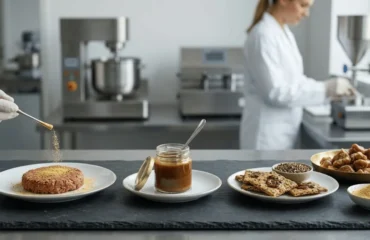
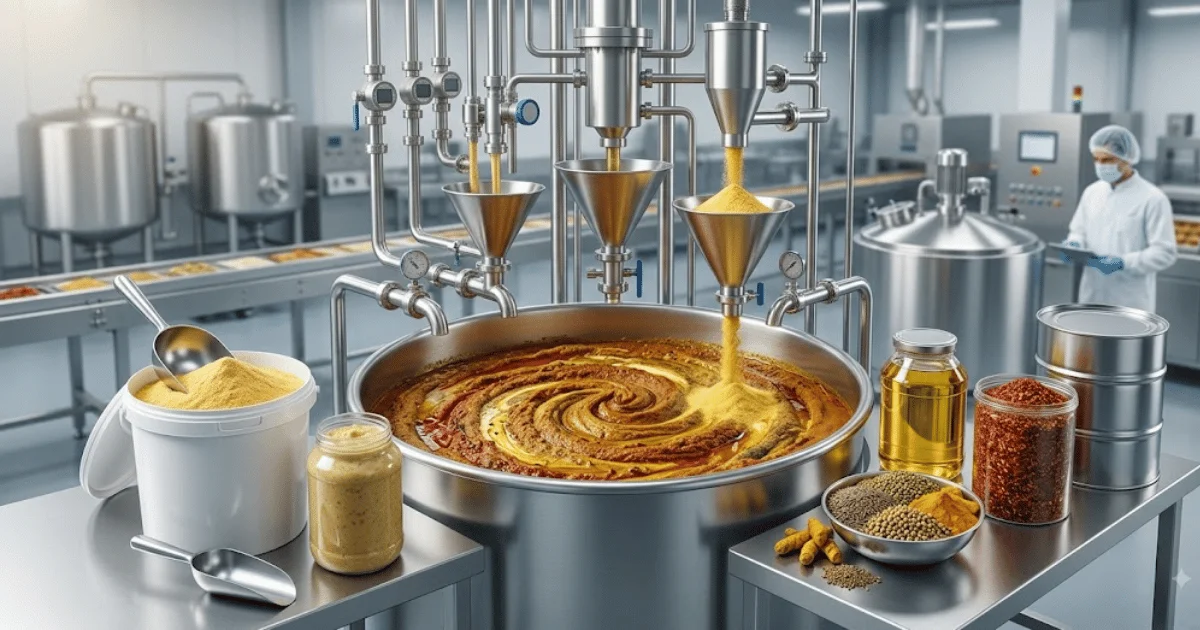
Flavor Layering Using Hing is a practical food-development technique in which Asafoetida becomes one component of a broader flavor profile rather than the dominant taste of the finished product. Hing has a powerful aromatic character, so food developers can use a small quantity to create a specific sensory layer while other ingredients provide freshness, warmth, heat, sweetness, acidity, or deeper savory notes.
This approach is particularly useful for food manufacturers developing seasoning blends, snacks, ready-to-cook products, instant foods, regional flavor systems, and other commercial formulations.
The goal of Flavor Layering Using Hing is not simply to make a product smell more strongly of Hing. The objective is to create a balanced flavor architecture in which Hing supports the identity of the finished food.
What Is Flavor Layering?
Flavor layering is the process of combining different ingredients so that each contributes a distinct sensory role to the final product.
Instead of asking whether one ingredient tastes good by itself, food developers consider how several ingredients interact.
A seasoning system may contain ingredients that provide:
- Initial aroma
- Warm spice notes
- Savory depth
- Heat
- Acidity
- Sweetness
- Aftertaste
When these elements are balanced correctly, the finished product can feel more complex and complete.
Flavor Layering Using Hing applies this principle by giving Asafoetida a defined role within that larger flavor structure.
Why Hing Works Well in Flavor Layering
Hing has a highly distinctive aromatic profile and can influence the sensory character of a formulation even at a relatively low inclusion level.
This makes it useful when a product developer wants to introduce a recognizable savory or aromatic dimension without adding a large quantity of another bulk ingredient.
Hing can work alongside cumin, coriander, chili, black pepper, ginger, turmeric, fenugreek, salt, and other seasoning ingredients.
The key is to determine what role Hing should play before deciding how much to add.
Hing Should Not Dominate the Flavor Profile
One of the most important principles of Flavor Layering Using Hing is balance.
Because Hing is potent, excessive use can overwhelm other ingredients.
A successful formulation often uses Hing as a supporting layer rather than making it the first and strongest sensation.
The desired result is usually a seasoning profile in which consumers experience the overall flavor first and recognize Hing as part of the background complexity.
Understanding Flavor Layers
Food R&D teams can think about a seasoning profile in several broad layers.
Top Layer
The top layer is often the first aroma perceived by the consumer.
Fresh herbs, citrus notes, certain spices, and highly volatile aromatic compounds can contribute to this initial impression.
Middle Layer
The middle layer provides the main character of the seasoning.
Cumin, coriander, ginger, and other spices can contribute to this part of the profile.
Base Layer
The base layer provides depth and persistence.
Depending on the product, ingredients such as roasted spices, savory components, fats, or other flavor ingredients may contribute to this part of the experience.
Flavor Layering Using Hing can position Hing between these sensory roles depending on the formulation and processing method.
Hing as an Aromatic Bridge
One useful way to understand Hing is as an aromatic bridge between different seasoning components.
For example, a formulation containing cumin, coriander, chili, and turmeric may have strong individual spice notes.
A carefully controlled amount of Hing can help connect these notes into a more integrated savory profile.
The purpose is not necessarily to identify Hing separately. Instead, it can help the overall seasoning feel more complete.
Flavor Layering Using Hing and Cumin
Cumin and Hing are commonly associated in Indian seasoning systems.
Cumin contributes an earthy, warm, and recognizable spice note, while Hing can provide an additional aromatic and savory dimension.
When combined correctly, the two can create a more rounded seasoning profile than either ingredient might produce alone.
However, the correct ratio depends on the product and target sensory profile.
Flavor Layering Using Hing and Coriander
Coriander can provide a lighter aromatic and citrus-like spice character.
Hing can add depth underneath that brighter note.
This creates an example of how contrasting sensory characteristics can work together.
The formulation team can adjust both ingredients until the desired relationship is achieved.
Flavor Layering Using Hing and Chili
Chili provides heat and often contributes a strong visual and flavor identity.
Hing can support the savory background of a chili-based seasoning without competing directly with its heat.
This can be useful in snack seasonings, namkeen, spice blends, and other savory products.
The important point is to keep Hing within a controlled range so that the heat and primary flavor remain clear.
Flavor Layering Using Hing and Black Pepper
Black pepper provides pungency and warmth.
Hing can add a different type of aromatic intensity, allowing product developers to create multiple dimensions of pungency rather than relying entirely on chili.
This can be useful when developing complex savory profiles.
Flavor Layering Using Hing and Ginger
Ginger contributes warmth and a characteristic fresh-spicy aroma.
Hing can provide a deeper savory layer underneath it.
This combination can be particularly useful in formulations inspired by traditional Indian cooking.
The final balance depends on whether the desired product profile is fresh, warm, spicy, savory, or heavily aromatic.
Flavor Layering Using Hing and Turmeric
Turmeric contributes colour and an earthy spice character.
Because turmeric does not provide the same type of intense aroma as Hing, the two ingredients can occupy different sensory roles within a seasoning system.
This allows the product developer to build both visual identity and aromatic complexity.
Hing as a Background Flavor
One of the most effective applications of Flavor Layering Using Hing is using it as a background flavor.
A background flavor should support the main sensory identity without becoming distracting.
For example, a packaged dal seasoning may primarily communicate lentil, cumin, chili, and coriander characteristics while Hing quietly strengthens the overall savory impression.
This type of formulation requires careful dosage control.
Why Dosage Changes Flavor Architecture
Dosage is one of the most important variables when developing a Hing-containing formulation.
At a low level, Hing may contribute subtle aromatic depth.
At a moderate level, its identity may become more noticeable.
At an excessive level, it can dominate the entire profile.
Therefore, Flavor Layering Using Hing should always involve dosage trials rather than relying on a single predetermined inclusion rate.
Build a Dosage Ladder
A practical R&D approach is to create several formulation samples with increasing Hing levels.
For example, a development team could compare:
- Low Hing inclusion
- Low-to-medium inclusion
- Medium inclusion
- Higher inclusion
The exact percentages should be determined through application-specific trials.
Evaluators can then compare aroma intensity, flavor balance, aftertaste, and overall product acceptance.
Flavor Layering and the Food Matrix
Hing does not behave identically in every food.
The surrounding food matrix can influence how aroma and flavor are released and perceived.
Important variables can include:
- Moisture
- Fat
- Salt
- Acidity
- Starch
- Protein
- Cooking temperature
- Processing time
For this reason, Flavor Layering Using Hing should be tested inside the actual target product rather than evaluated only as a dry ingredient.
Why Fat Can Influence Hing Flavor
Hing is traditionally used in tempering with oil or ghee.
Fat can act as a medium for distributing aromatic compounds during cooking.
In commercial formulations, the presence of fat can similarly influence aroma release and the way Hing interacts with other seasoning ingredients.
This is one reason a Hing seasoning can perform differently in a dry snack than in a cooked curry or ready-to-eat product.
Flavor Layering in Dry Seasonings
Dry seasoning systems require careful control of ingredient distribution.
When Hing is included in a powdered seasoning, it needs to distribute consistently throughout the blend.
If the particle sizes or densities differ significantly, segregation can occur during handling or transportation.
This can cause uneven seasoning and inconsistent sensory results.
Flavor Layering in Snack Products
Snacks are a strong application for layered flavor systems because consumers often expect multiple sensory characteristics from a single bite.
A snack seasoning may combine saltiness, heat, acidity, roasted notes, herbs, and aromatic spices.
Flavor Layering Using Hing can add a distinctive savory background to this structure.
The challenge is ensuring that Hing supports the intended flavor rather than becoming the primary aroma.
Flavor Layering in Ready-to-Eat Foods
Ready-to-eat products need seasoning systems that remain consistent through processing and storage.
Hing can be incorporated into seasoning formulations for products such as packaged curries, dal-based foods, snack mixes, and other prepared foods.
The final formulation should be evaluated after the complete production process because cooking and storage can change the sensory balance.
Flavor Layering in Ready-to-Cook Foods
Ready-to-cook products present a different development challenge.
The seasoning may remain in a dry or semi-dry state until the consumer prepares the product.
R&D teams therefore need to evaluate how Hing behaves after hydration and cooking.
A formulation that smells excellent in its dry state may produce a different aroma after preparation.
Flavor Layering in Instant Food Products
Instant foods rely on carefully engineered seasoning systems because consumers expect quick preparation without losing flavor quality.
Hing can be used as one component in such systems where the target profile calls for an Indian-inspired savory character.
Product developers should evaluate aroma release after rehydration and heating.
Flavor Layering in Spice Blends
Spice blends are natural candidates for Flavor Layering Using Hing.
A commercial blend can combine several ingredients with different sensory functions.
For example:
- Hing for aromatic depth
- Cumin for earthiness
- Coriander for freshness
- Chili for heat
- Turmeric for earthy spice and colour
- Black pepper for pungency
- Salt for overall seasoning
The final blend should be evaluated as one complete system.
Flavor Layering Is Not Simply Mixing More Spices
Adding more ingredients does not automatically create a better flavor.
Every additional component changes the sensory balance.
Too many strong ingredients can create a crowded flavor profile where individual notes become difficult to distinguish.
Effective Flavor Layering Using Hing therefore requires restraint and purpose.
Define the Role of Hing Before Formulation
Before adding Hing, the R&D team should define what it is supposed to accomplish.
Possible roles include:
- Add aromatic depth
- Strengthen savory perception
- Support a traditional flavor profile
- Connect multiple spice notes
- Provide a recognizable regional character
- Create a subtle background aroma
Once the role is defined, the dosage and formulation can be optimized around that objective.
Flavor Layering and Regional Food Profiles
Regional Indian cuisines provide many examples of complex flavor layering.
Different combinations of spices create recognizable culinary identities even when the basic ingredients overlap.
Hing can become one part of these regional flavor architectures.
For commercial food manufacturers, this creates opportunities to develop products inspired by regional cuisines while adapting them to modern formats.
Hing in Gujarati-Inspired Flavor Profiles
Gujarati cuisine includes many preparations where Hing contributes to the seasoning profile.
When developing packaged foods inspired by Gujarati flavors, manufacturers can use Hing as part of a broader combination of spices and ingredients.
The goal should be to reproduce the overall sensory character rather than making Hing the dominant note.
Hing in Maharashtrian-Inspired Flavor Profiles
Maharashtrian food includes diverse seasoning traditions and regional flavor combinations.
Hing can contribute aromatic depth in suitable formulations.
Commercial developers should research the specific regional profile they are attempting to recreate rather than using a generic “Indian flavor” formula.
Hing in South Indian-Inspired Flavor Profiles
South Indian seasoning systems often involve combinations of mustard, curry leaves, cumin, chilies, lentils, and other spices.
Hing can occupy a supporting aromatic role in suitable products.
The correct formulation depends on the target food and the specific regional profile being developed.
Flavor Layering and Aroma Release
Flavor layering is influenced not only by which ingredients are present but also by when and how their aroma compounds are released.
Some ingredients provide immediate top notes, while others emerge gradually during chewing or after swallowing.
Hing can contribute strongly to the aromatic dimension, making processing sequence important.
This is particularly relevant when the product undergoes heating.
Why Processing Sequence Matters
Adding the same ingredients at different stages can produce different sensory results.
In traditional cooking, Hing may be added to hot fat during tempering.
In industrial production, it may instead be incorporated into a dry seasoning blend or added at a specific processing stage.
R&D teams should therefore test not only dosage but also addition sequence.
Flavor Layering Using Hing in Industrial Formulation
Commercial product development requires repeatability.
A formulation must work across repeated batches rather than only in a laboratory sample.
This means the development team must consider:
- Ingredient specifications
- Dosage accuracy
- Mixing conditions
- Processing temperature
- Batch size
- Storage
- Packaging
These factors can influence the final flavor profile.
Why Ingredient Consistency Matters
Hing is an aroma-active ingredient, so variation between supply batches can affect the finished product.
A formulation developed around one sensory profile may perform differently if a replacement ingredient has substantially different aroma intensity or composition.
For this reason, manufacturers should establish clear ingredient specifications and supplier controls.
Choosing the Right Hing Format
Commercial Hing is available in different forms, including Compound Hing, Hing Powder, and Hing Granules.
The best choice depends on the application.
Factors to consider include:
- Dosage
- Mixing method
- Particle size
- Processing equipment
- Packaging
- Desired sensory performance
Flavor Layering Using Hing should therefore begin with the application requirement rather than a generic assumption that one Hing format fits every product.
Compound Hing in Flavor Layering
Compound Hing can be useful in commercial seasoning systems where a controlled formulation and convenient handling are required.
Because Compound Hing is a formulated product, developers should review its complete composition and specification before incorporating it into a new product.
Application trials can then determine the appropriate dosage and sensory contribution.
Hing Powder in Flavor Layering
Hing Powder can provide convenient dispersion in many dry formulations.
Its fine particle size can help distribute the ingredient through a seasoning blend when the formulation and mixing process are properly designed.
However, powder handling, dust control, moisture exposure, and packaging should also be considered.
Hing Granules in Flavor Layering
Hing Granules can offer different handling and physical characteristics compared with fine powder.
The suitability of granules depends on the product and mixing process.
R&D teams should test whether the granules distribute evenly and deliver the desired aroma release within the finished product.
Sensory Evaluation of Layered Flavor
A layered flavor system should be evaluated using structured sensory testing.
Evaluators can assess:
- Initial aroma
- First taste
- Mid-palate development
- Spice intensity
- Hing perception
- Aftertaste
- Overall balance
This helps the R&D team determine whether Hing is supporting the intended flavor architecture.
Ask the Right Sensory Question
Instead of asking only, “Can you taste the Hing?”, developers should ask more useful questions.
For example:
- Does the Hing improve overall aroma?
- Does it make the seasoning feel deeper?
- Does it compete with the main flavor?
- Is the aftertaste clean?
- Does the product remain balanced?
These questions provide more actionable information during formulation.
Consumer Testing and Flavor Layering
Expert sensory panels can identify technical differences, but consumer testing may be needed to determine market acceptance.
A product that food scientists consider technically balanced may not automatically appeal to the target consumer.
Consumer testing can therefore help determine whether the layered flavor profile is recognizable, enjoyable, and appropriate for the target market.
Common Mistakes in Flavor Layering Using Hing
Several mistakes can reduce the quality of a Hing-based formulation.
- Using too much Hing
- Adding Hing without defining its sensory role
- Testing only the raw ingredient
- Ignoring the food matrix
- Failing to test addition sequence
- Comparing suppliers only by price
- Ignoring batch-to-batch variation
- Skipping pilot production
A structured development process can reduce these risks.
Why More Hing Does Not Mean More Flavor
One of the most important lessons in Flavor Layering Using Hing is that stronger does not necessarily mean better.
Once Hing becomes dominant, it can hide other carefully developed flavor notes.
The best formulation is usually the one where all major components work together.
For a commercial product, subtlety can be more valuable than maximum intensity.
Flavor Layering and Cost Optimization
Layering can also influence formulation economics.
Because Hing is highly aromatic, a small inclusion level may produce a meaningful sensory contribution.
However, developers should not assume that increasing or reducing Hing automatically lowers product cost.
The correct approach is to evaluate cost-in-use alongside sensory performance.
Flavor Layering and Product Differentiation
Distinctive flavor profiles can help food brands differentiate products in crowded markets.
Hing can contribute a recognizable Indian culinary identity when used appropriately.
This can be particularly useful for products inspired by regional cuisines or traditional spice combinations.
However, differentiation should come from the complete flavor concept rather than relying on Hing alone.
Flavor Layering for Export Products
International food products may require different levels of Hing depending on consumer familiarity with the ingredient.
A flavor profile that feels traditional to an Indian consumer may appear intense to someone encountering Hing for the first time.
Export-oriented product development should therefore consider target-market sensory preferences.
Why Application-Specific Formulation Matters
The same Hing ingredient can behave differently in a dry snack seasoning, wet curry, instant meal, frozen product, or spice blend.
Consequently, there is no universal “best” dosage for every food.
Application-specific testing remains essential.
Scaling Flavor Layering from Lab to Factory
Once the formulation is finalized in the laboratory, it needs to be translated into a repeatable manufacturing process.
Scale-up can introduce differences in:
- Mixing efficiency
- Ingredient distribution
- Processing time
- Temperature
- Batch size
- Packaging
Production trials help identify these differences before commercial launch.
Role of Food R&D Teams
R&D teams are responsible for converting flavor concepts into reproducible formulations.
For Flavor Layering Using Hing, this may involve multiple rounds of prototype development.
The team can adjust Hing concentration, supporting spices, processing conditions, and the order of ingredient addition until the desired profile is achieved.
Role of Ingredient Suppliers
Ingredient suppliers can support R&D teams by providing consistent product specifications and suitable commercial formats.
For Hing, useful supplier information can include:
- Product composition
- Physical form
- Aroma characteristics
- Batch information
- Packaging
- Storage recommendations
- Available commercial quantities
Clear technical information can make product-development trials more efficient.
How RB Industries Supports Commercial Hing Applications
RB Industries manufactures and supplies Asafoetida products including Compound Hing, Hing Powder, and Hing Granules for food manufacturers, seasoning companies, restaurants, wholesalers, distributors, exporters, and FMCG brands.
For businesses developing new products, the appropriate Hing format should be selected according to the formulation, processing method, desired sensory profile, dosage requirements, and production volume.
Application trials can help determine how a particular Hing product contributes to the complete flavor architecture before moving to regular commercial supply.
Future of Flavor Layering Using Hing
Modern food development is moving toward increasingly precise flavor systems.
Food companies are combining traditional ingredients with modern processing, sensory science, and application-specific formulations.
This creates opportunities for Hing to become part of more sophisticated flavor architectures rather than being treated only as a traditional spice.
As manufacturers develop regional, plant-based, convenient, and internationally inspired foods, controlled Flavor Layering Using Hing can become an increasingly useful formulation approach.
Practical Framework for Flavor Layering Using Hing
A food manufacturer can use a simple development sequence:
- Define the target flavor profile.
- Identify the role Hing should play.
- Select the appropriate Hing format.
- Create several dosage levels.
- Combine Hing with supporting spices.
- Test the complete formulation.
- Evaluate aroma and flavor balance.
- Conduct pilot production.
- Confirm commercial specifications.
- Validate consistency before launch.
This process helps turn a traditional ingredient into a controlled commercial flavor component.
Conclusion
Flavor Layering Using Hing is about using Asafoetida strategically rather than simply increasing its quantity. Because Hing has a powerful aromatic identity, it can contribute a valuable layer of savory depth when combined with spices such as cumin, coriander, chili, black pepper, ginger, and turmeric.
The strongest formulations treat Hing as part of a complete sensory architecture. Product developers need to consider dosage, food matrix, processing sequence, particle size, physical form, supplier consistency, and consumer expectations.
For commercial food manufacturers, the goal is not to make Hing the loudest ingredient. The goal is to make the entire product taste more complete, balanced, and distinctive.
RB Industries supplies Asafoetida, Compound Hing, Hing Powder, and Hing Granules for commercial food applications. Businesses developing seasoning systems, snacks, ready-to-cook foods, FMCG products, and regional flavor concepts can evaluate Hing according to their specific formulation and production requirements.
Frequently Asked Questions
What is Flavor Layering Using Hing?
Flavor Layering Using Hing means incorporating Asafoetida as one component of a broader flavor profile. Hing can provide aromatic and savory depth while other ingredients contribute heat, freshness, earthiness, acidity, sweetness, or additional spice notes.
Why should Hing be used in small quantities?
Hing has a strong aromatic character and can influence a food’s sensory profile at low inclusion levels. Using too much can overpower other ingredients, so R&D teams normally test several dosage levels to find the right balance.
Which spices work well with Hing?
Hing can work with many spices, including cumin, coriander, chili, black pepper, ginger, and turmeric. The best combination depends on the target flavor profile and the food application.
Can Flavor Layering Using Hing be used in commercial food products?
Yes. Food manufacturers can incorporate Hing into seasoning systems, snacks, ready-to-eat products, ready-to-cook foods, instant meals, spice blends, and other formulations. Commercial application testing is important to establish dosage and processing performance.
Does the same Hing dosage work for every food product?
No. The food matrix, processing conditions, supporting ingredients, desired sensory profile, and Hing formulation can all affect the final result. Dosage should therefore be established through application-specific trials.