
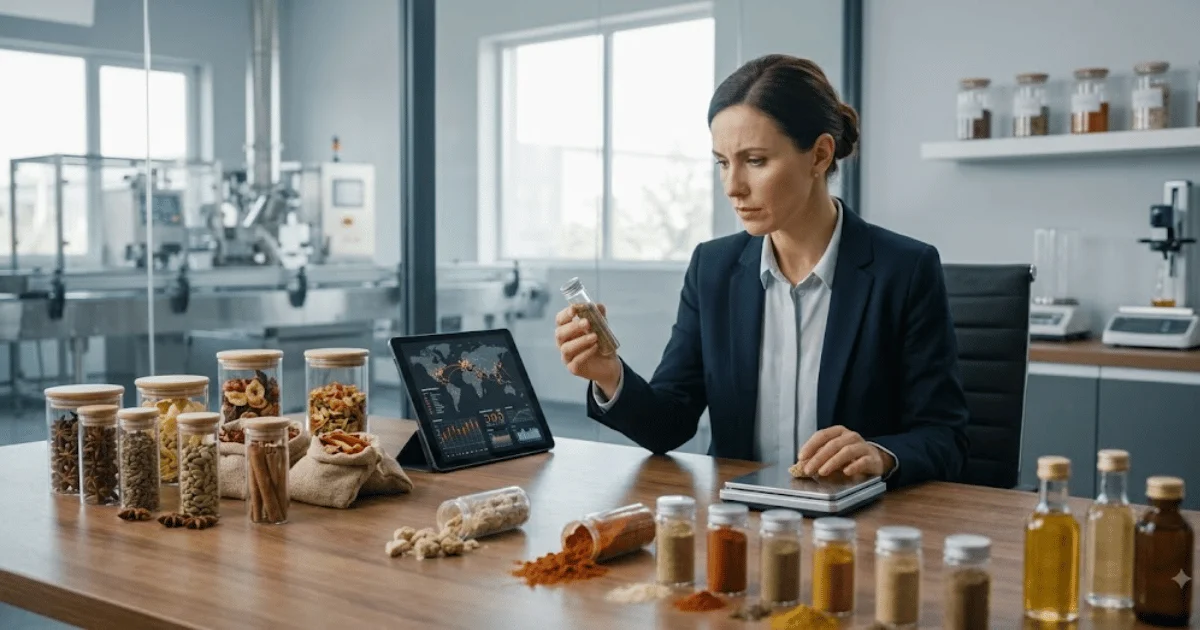
Challenges in Ingredient Sourcing can affect everything from product development and production planning to food quality, pricing, and customer delivery. For food manufacturers, sourcing an ingredient is not simply a matter of finding a supplier and negotiating a price. The supplier must also provide consistent material, reliable availability, appropriate documentation, suitable packaging, and the capacity to support production as demand changes.
These challenges become more important when manufacturers work with natural ingredients such as spices, herbs, botanical materials, and Asafoetida. Natural raw materials can vary according to origin, harvest conditions, supply availability, processing, and market demand.
Understanding Challenges in Ingredient Sourcing helps food companies build more reliable procurement strategies and reduce avoidable supply-chain problems.
What Is Ingredient Sourcing?
Ingredient sourcing is the process through which a food company identifies, evaluates, qualifies, purchases, and manages the ingredients required for its products.
The process can involve several departments, including:
- Procurement
- Research and development
- Quality assurance
- Production
- Supply chain
- Regulatory teams
- Finance
For a small food business, sourcing may involve a direct relationship with a supplier. For a large manufacturer, it can involve formal supplier qualification, contracts, specifications, audits, forecasting, testing, and long-term supply agreements.
Why Ingredient Sourcing Is More Complicated Than It Looks
A food ingredient may appear to be a simple commodity, but several variables can influence its commercial availability and performance.
A sourcing team may need to consider:
- Raw-material availability
- Supplier capacity
- Product quality
- Price stability
- Origin
- Seasonality
- Transportation
- Storage
- Documentation
- Regulatory requirements
This means Challenges in Ingredient Sourcing can develop at almost every stage between the original raw material and the finished food product.
Challenge 1: Finding a Consistent Raw Material Supply
One of the biggest sourcing challenges is maintaining a reliable supply of raw materials.
Natural ingredients are not always available in exactly the same quantities throughout the year.
Weather, harvest conditions, agricultural output, geopolitical conditions, transportation, and market demand can all influence availability.
For manufacturers, the objective is not simply to buy an ingredient once. It is to establish a supply relationship capable of supporting repeated production.
Challenge 2: Natural Ingredient Variability
Natural ingredients can vary from batch to batch.
Factors such as botanical source, geographic origin, harvest conditions, storage, and processing can influence physical and sensory characteristics.
This is particularly relevant to spices and botanical ingredients.
Challenges in Ingredient Sourcing therefore include finding suppliers that can convert naturally variable raw materials into commercially consistent finished ingredients.
Challenge 3: Maintaining Quality Across Batches
A food company may approve an ingredient based on a particular sample or specification.
The challenge begins when subsequent shipments arrive.
If the sensory or physical characteristics change significantly, the ingredient may behave differently in the final formulation.
For Hing, changes in aroma intensity, physical form, composition, or other product characteristics can affect the finished food.
Challenge 4: Supplier Qualification
Choosing a supplier requires more than comparing quotations.
Food manufacturers may evaluate:
- Manufacturing capability
- Quality systems
- Product specifications
- Documentation
- Production capacity
- Lead times
- Packaging
- Traceability
- Commercial reliability
Supplier qualification can take time, especially for ingredients that become critical to a large product portfolio.
Challenge 5: Price Fluctuations
Ingredient prices can change due to supply and demand conditions.
Natural raw materials can be particularly sensitive to changes in agricultural output, availability, transportation costs, currency movements, and market demand.
A procurement team therefore needs to distinguish between a temporary price movement and a structural change in the supply market.
For long-term food production, purchasing decisions based entirely on short-term price can create unnecessary risk.
Challenge 6: Comparing Supplier Prices Correctly
Two suppliers may quote different prices for products that appear similar.
However, the quoted price does not always represent the complete procurement cost.
Companies should also consider:
- Dosage requirements
- Product concentration
- Packaging
- Freight
- Testing
- Lead time
- Minimum order quantity
- Storage requirements
This is why cost-in-use and total procurement cost can be more useful than price per kilogram alone.
Challenge 7: Minimum Order Quantities
Suppliers may establish minimum order quantities based on production economics, packaging formats, or customer requirements.
A large food manufacturer may have no difficulty meeting a high minimum order quantity.
A smaller brand or new product developer may need only a few kilograms during the testing stage.
Flexible supply arrangements can therefore become an important consideration during product development.
Challenge 8: Supporting Product Development Quantities
New products often begin with laboratory-scale trials.
The quantity required during development may be very small compared with the quantity required after commercialization.
A supplier that can support both development samples and commercial orders can make the transition easier.
This is particularly useful for food manufacturers testing new Hing applications.
Challenge 9: Scaling Supply After Product Launch
A successful product launch can rapidly increase ingredient demand.
This creates a different type of sourcing challenge.
The supplier may need to move from small sample quantities to regular bulk deliveries without changing the agreed product characteristics.
Therefore, Challenges in Ingredient Sourcing do not disappear after supplier approval. They can become more important as production scales.
Challenge 10: Seasonal Availability
Some natural ingredients are affected by seasonal production patterns.
Even when an ingredient is available throughout the year, the conditions under which raw material is sourced may change over time.
Procurement teams should understand whether an ingredient has seasonal supply risks and plan inventory accordingly.
For natural spice ingredients, this can be an important part of annual purchasing strategy.
Challenge 11: Geographic Concentration of Supply
Some ingredients depend heavily on specific geographic regions.
When supply is concentrated in a small number of locations, disruptions in those regions can affect global availability.
Food companies may therefore evaluate whether they have sufficient supplier diversification.
However, diversification should not automatically mean buying from multiple suppliers without qualification. Each additional source needs appropriate evaluation.
Challenge 12: Raw Material Origin
Origin can influence the characteristics of natural ingredients.
Different growing regions may produce raw materials with different physical and chemical profiles.
For food manufacturers, origin can therefore be relevant to both quality management and supply planning.
When sourcing Hing, buyers may need to understand the origin and nature of the Asafoetida raw material used by the supplier.
Challenge 13: Transportation and Logistics
An ingredient can be high quality at the supplier’s facility but still face problems during transportation.
Logistics can involve:
- Transit time
- Freight availability
- Packaging protection
- Temperature exposure
- Moisture exposure
- Loading and unloading
- Customs procedures for exports
These factors become increasingly important when ingredients are shipped across long distances.
Challenge 14: Packaging During Transportation
Packaging must protect the ingredient throughout its expected supply chain.
For aromatic ingredients such as Hing, packaging can also influence aroma retention.
Suitable packaging can help protect against unnecessary exposure to air, moisture, contamination, and physical damage.
Packaging requirements should therefore be considered during sourcing rather than after the supplier has already been selected.
Challenge 15: Storage Requirements
Ingredient sourcing and storage are closely connected.
A food company needs to know how an ingredient should be stored after delivery.
Relevant factors can include:
- Temperature
- Humidity
- Light exposure
- Container closure
- Stock rotation
- Warehouse hygiene
Poor storage can reduce the value of even a high-quality ingredient.
Challenge 16: Documentation Gaps
Food manufacturers increasingly require reliable technical and regulatory documentation from suppliers.
Depending on the product and market, buyers may request:
- Product specifications
- Ingredient declarations
- Certificate of Analysis
- Allergen information
- Technical data
- Country-of-origin information
- Relevant certifications
- Storage information
Incomplete or inconsistent documentation can delay supplier approval and purchasing.
Challenge 17: Regulatory Requirements
Food ingredients must meet the requirements applicable to the market in which they are used.
These requirements can differ according to country, product category, ingredient composition, and intended use.
Export-oriented food manufacturers may therefore face additional documentation and compliance requirements.
Procurement teams should involve quality and regulatory specialists when necessary rather than treating compliance as a purely purchasing issue.
Challenge 18: Traceability
Traceability allows a company to identify where an ingredient came from and which production lots were used in finished products.
This becomes important when investigating quality issues, complaints, or recalls.
Strong traceability can connect:
- Raw material
- Supplier
- Production batch
- Finished product
- Customer shipment
For food manufacturers, traceability is therefore an important part of responsible ingredient sourcing.
Challenge 19: Supplier Capacity
A supplier may be able to deliver a small order but struggle to support a major increase in demand.
Procurement teams should therefore evaluate realistic production capacity before committing a critical ingredient to a supplier.
Capacity discussions can include:
- Current production volume
- Available manufacturing lines
- Raw-material access
- Lead time
- Peak-season capacity
- Expansion capability
This can reduce the risk of supply shortages after a product becomes successful.
Challenge 20: Long Lead Times
Some ingredients require longer lead times because of sourcing, processing, packaging, transportation, or import requirements.
Long lead times can create problems when a food company relies on just-in-time inventory.
Procurement teams may need to balance inventory cost against supply continuity.
Challenge 21: Forecasting Demand
Supplier planning becomes easier when buyers provide realistic demand forecasts.
However, forecasting food demand can be difficult.
New products, seasonal promotions, changing consumer preferences, and unexpected market growth can all create demand fluctuations.
Regular communication between buyers and suppliers can help reduce surprises.
Challenge 22: Emergency Procurement
Unexpected ingredient shortages can force manufacturers to purchase from alternative suppliers quickly.
Emergency sourcing creates additional risk because there may not be enough time for a complete qualification process.
For critical ingredients, companies can reduce this risk by maintaining pre-qualified alternative suppliers.
Challenge 23: Supplier Dependency
Relying heavily on a single supplier can create supply continuity risk.
However, using multiple suppliers also creates management complexity.
The right strategy depends on the importance of the ingredient, supply-market structure, product specifications, and cost.
For strategically important ingredients, dual sourcing can sometimes provide additional resilience when both suppliers have been properly qualified.
Challenge 24: Quality Versus Availability
One of the difficult decisions in sourcing occurs when the preferred ingredient becomes temporarily unavailable.
A company may have to decide whether to:
- Wait for the preferred supplier
- Use an approved alternative
- Reformulate
- Reduce production
- Delay a product launch
These decisions should be based on documented risk assessments rather than rushed purchasing decisions.
Challenge 25: Supplier Substitution
Changing suppliers can affect the final product even when both suppliers sell the same ingredient category.
Natural ingredients can have different sensory and physical characteristics.
For Hing, a change in aroma intensity or formulation can become noticeable in the finished food.
Supplier substitution should therefore be treated as a controlled change rather than a simple purchasing decision.
Challenge 26: Maintaining Product Consistency During Supplier Changes
If a company changes its Hing supplier, R&D and quality teams may need to conduct comparative trials.
These trials can evaluate:
- Raw-material aroma
- Dosage
- Finished-product flavor
- Processing behavior
- Batch consistency
The objective is to confirm that the new ingredient does not create an unacceptable change in the finished product.
Challenge 27: Supplier Communication
Good communication is often underestimated in ingredient sourcing.
Suppliers and buyers need to communicate about:
- Forecasts
- Order quantities
- Lead times
- Specifications
- Quality issues
- Packaging
- Delivery schedules
Poor communication can create problems even when both sides have technically capable operations.
Challenge 28: Quality Complaints
When an ingredient does not meet expectations, the supplier needs to investigate the issue.
A professional complaint process should identify the problem, determine the likely cause, and establish appropriate corrective action.
For food companies, supplier responsiveness can be an important part of long-term sourcing decisions.
Challenge 29: Hidden Procurement Costs
The purchase price does not always represent the total cost of sourcing.
Additional costs may include:
- Freight
- Testing
- Warehousing
- Quality inspection
- Inventory holding
- Rejected material
- Emergency purchasing
- Production downtime
A proper sourcing strategy considers the complete cost of ownership.
Challenge 30: Balancing Inventory and Freshness
Holding large inventories can protect against shortages, but it also increases storage costs and ties up working capital.
For some ingredients, excessive storage may also affect sensory or physical characteristics.
Procurement teams therefore need to determine an appropriate inventory strategy based on shelf life, demand predictability, lead time, and supply risk.
Challenges in Sourcing Hing
Challenges in Ingredient Sourcing become particularly interesting when applied to Asafoetida because Hing is a natural botanical ingredient with a distinctive sensory profile.
Commercial Hing sourcing can involve evaluating:
- Raw Asafoetida availability
- Product composition
- Aroma profile
- Physical form
- Processing quality
- Batch consistency
- Packaging
- Supplier capacity
- Documentation
The right sourcing strategy depends on whether the buyer needs Hing for retail, food manufacturing, foodservice, seasoning production, export, or another application.
Why Raw Asafoetida Sourcing Matters
The quality of the finished Hing product begins with the quality and suitability of the raw material.
Raw Asafoetida can vary in characteristics depending on botanical source, origin, harvesting, storage, and other factors.
Manufacturers therefore need appropriate raw-material controls before the material enters processing.
This creates a direct link between raw-material sourcing and finished-product consistency.
Supplier Sourcing for Compound Hing
Compound Hing requires additional consideration because the finished product is formulated rather than being simply raw resin.
Buyers should understand the product composition and specification before selecting a supplier.
The commercial objective is to achieve consistent performance in the intended application while maintaining appropriate cost and supply reliability.
Sourcing Hing for Food Manufacturers
Food manufacturers may purchase Hing in quantities very different from retail consumers.
A commercial buyer may require:
- Bulk packaging
- Specific physical forms
- Defined specifications
- Regular supply
- Application samples
- Technical documentation
- Consistent batch performance
This makes B2B sourcing significantly different from purchasing a small retail pack.
Sourcing Hing for Seasoning Manufacturers
Seasoning manufacturers may use Hing as one component of a broader formulation.
In this case, the supplier needs to provide a product that performs consistently when blended with other powdered or granular ingredients.
Particle size, aroma intensity, dispersion, and packaging can therefore become important sourcing considerations.
Sourcing Hing for Export
Export-oriented buyers may face additional requirements relating to documentation, packaging, logistics, customs, and destination-market compliance.
The supplier must be capable of supporting these requirements consistently.
Export sourcing should therefore be planned around the complete supply chain rather than only the ingredient price.
How Food Companies Can Reduce Sourcing Risk
Companies cannot eliminate every sourcing risk, but they can manage it systematically.
Useful strategies include:
- Qualifying multiple suppliers where appropriate
- Maintaining clear specifications
- Monitoring supplier performance
- Using realistic demand forecasts
- Maintaining appropriate safety stock
- Conducting periodic quality checks
- Reviewing supplier capacity
- Maintaining traceability
- Documenting approved alternatives
The right combination depends on the importance and risk profile of each ingredient.
Build a Supplier Qualification Process
A formal supplier qualification process can reduce uncertainty.
The process may include:
- Supplier identification
- Initial screening
- Sample evaluation
- Technical documentation review
- Application testing
- Quality assessment
- Commercial evaluation
- Pilot production
- Approval
- Ongoing monitoring
This creates a repeatable framework for sourcing decisions.
Use Approved Supplier Lists
An approved supplier list can help procurement teams avoid emergency purchases from unqualified sources.
For critical ingredients, the list can include primary and secondary suppliers that have already completed the required evaluation process.
This provides greater flexibility when market conditions change.
Maintain Clear Ingredient Specifications
Specifications provide a shared reference between the buyer and supplier.
They should clearly describe the characteristics that matter for the intended application.
Overly vague specifications make quality disputes harder to resolve, while unnecessarily complex specifications can create administrative burden.
The best specifications focus on meaningful product requirements.
Monitor Supplier Performance
Supplier performance can be measured using practical indicators such as:
- On-time delivery
- Specification compliance
- Batch consistency
- Complaint frequency
- Corrective-action response
- Documentation accuracy
Regular monitoring allows procurement teams to identify trends before they become serious supply problems.
Why Long-Term Supplier Relationships Matter
Strong supplier relationships can improve communication and planning.
A supplier that understands a customer’s forecast, product specifications, and quality expectations can often support the business more effectively.
Long-term relationships can also make it easier to discuss demand increases, packaging changes, product development, and supply planning.
Technology in Ingredient Sourcing
Modern food companies increasingly use digital procurement and quality systems to manage ingredient information.
These systems can help track:
- Supplier records
- Specifications
- Certificates
- Purchase orders
- Lot numbers
- Quality results
- Supplier performance
Better data visibility can improve sourcing decisions and traceability.
Future of Ingredient Sourcing
Ingredient sourcing is becoming more strategic as food manufacturers face increasing expectations around quality, traceability, supply continuity, and responsible procurement.
Companies are likely to place greater emphasis on supplier transparency, digital documentation, predictive demand planning, risk monitoring, and diversified supply strategies.
For natural ingredients such as Hing, the ability to combine reliable sourcing with consistent processing will remain important.
Why Ingredient Sourcing Matters to Product Development
R&D teams often focus on creating the best formulation.
However, a formulation is only commercially useful if the ingredients can be sourced consistently at an acceptable cost.
This means sourcing should be considered during product development rather than only after the recipe has been finalized.
Early supplier involvement can identify potential availability, cost, or specification problems before launch.
Why Procurement and R&D Should Collaborate
Procurement knows the supply market, while R&D understands formulation requirements.
When these teams work separately, the company can end up with a technically excellent formulation that is difficult or expensive to source.
Collaboration helps ensure that the selected ingredient is both technically suitable and commercially realistic.
RB Industries and Reliable Hing Supply
RB Industries manufactures and supplies Asafoetida, Compound Hing, Hing Powder, and Hing Granules for food manufacturers, seasoning companies, restaurants, wholesalers, distributors, exporters, retailers, and FMCG brands.
For businesses sourcing Hing commercially, supplier evaluation should consider the intended application, product composition, physical form, quality requirements, packaging, order volume, and expected supply frequency.
A reliable sourcing relationship should provide more than a competitive quotation. It should support consistent product quality, clear communication, appropriate documentation, and the ability to meet commercial requirements as demand changes.
Conclusion
Challenges in Ingredient Sourcing can influence food manufacturing at every stage, from product development and supplier qualification to production, inventory planning, and customer delivery. Natural ingredients can create additional complexity because their availability and characteristics may vary according to origin, season, raw-material conditions, and processing.
Food companies can reduce these risks by defining clear specifications, evaluating suppliers carefully, conducting application trials, monitoring quality, maintaining appropriate inventory, planning demand, and developing reliable supplier relationships.
For Hing sourcing, the same principles become especially important because aroma, formulation, physical form, and batch consistency can directly influence the finished food product.
RB Industries supplies Asafoetida, Compound Hing, Hing Powder, and Hing Granules for commercial food applications and bulk requirements. Food manufacturers, seasoning companies, distributors, exporters, restaurants, and FMCG brands can select the appropriate Hing format according to their application and supply needs.
Frequently Asked Questions
What are the main Challenges in Ingredient Sourcing?
Challenges in Ingredient Sourcing can include inconsistent raw-material availability, quality variation, price fluctuations, supplier capacity, logistics, documentation, regulatory requirements, long lead times, and supply continuity. The importance of each challenge depends on the ingredient and manufacturing application.
Why is sourcing natural food ingredients difficult?
Natural ingredients can vary because of botanical source, geographic origin, harvest conditions, weather, storage, and processing. Food manufacturers therefore need reliable suppliers and defined specifications to maintain consistent commercial performance.
How can food manufacturers reduce ingredient sourcing risk?
Companies can reduce risk through supplier qualification, approved supplier lists, clear specifications, appropriate inventory planning, supplier monitoring, alternative sourcing, and regular quality evaluation. Critical ingredients may require additional continuity planning.
What should companies consider when sourcing Hing?
Buyers should consider product composition, aroma profile, physical form, batch consistency, dosage requirements, packaging, documentation, supplier capacity, lead time, and commercial quantity. The correct criteria depend on whether Hing is being used for retail, food manufacturing, foodservice, seasoning, or export.
Is the cheapest ingredient always the best sourcing option?
No. A lower purchase price can be offset by higher dosage, inconsistent quality, additional testing, poor delivery reliability, or production problems. Food manufacturers should evaluate total cost and commercial performance rather than price per kilogram alone.