
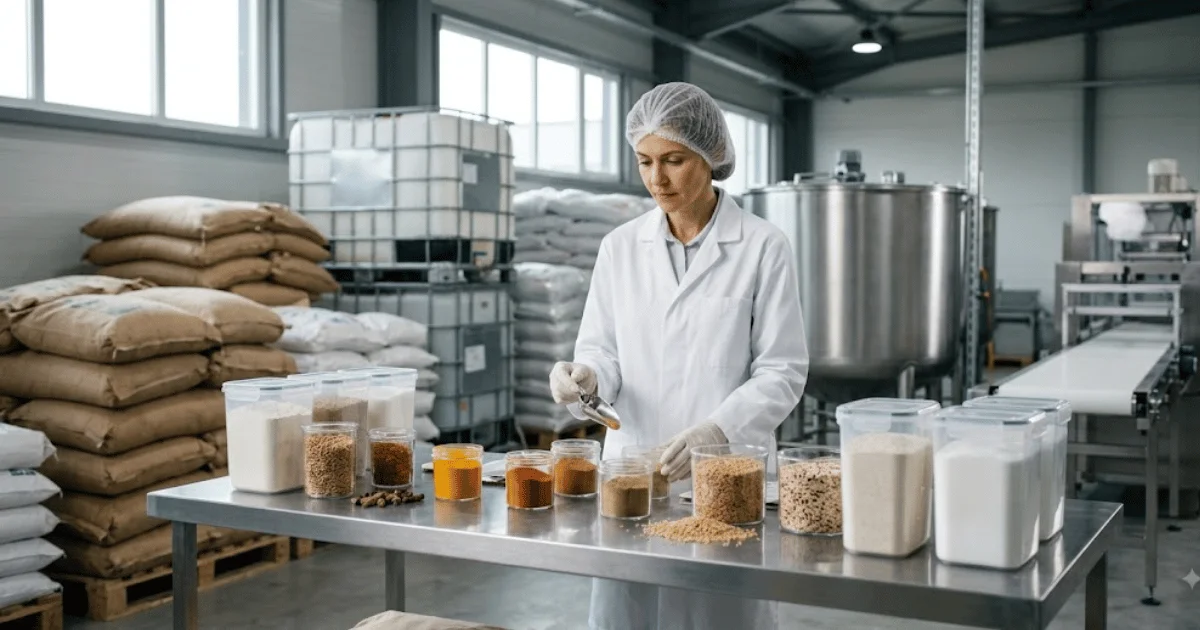
Selecting Ingredients for Scale requires a different approach from choosing ingredients for a laboratory prototype. An ingredient may perform perfectly in a small R&D batch and still create problems when the same formulation moves into pilot production or a full-scale factory.
At commercial scale, food manufacturers must consider much more than flavor. Ingredient availability, batch consistency, dosing accuracy, mixing behavior, processing compatibility, packaging, cost-in-use, storage, supplier capacity, and long-term supply continuity can all influence whether an ingredient is commercially viable.
This makes Selecting Ingredients for Scale an important part of food product development. The best ingredient is not simply the one that produces the best laboratory sample. It is the one that can continue delivering the required performance when production increases significantly.
What Does Selecting Ingredients for Scale Mean?
Selecting Ingredients for Scale means evaluating an ingredient not only for its performance in product development but also for its ability to support repeatable commercial manufacturing.
A laboratory team may need only a few hundred grams of an ingredient.
A commercial factory may need hundreds of kilograms or several tonnes every month.
The ingredient and supplier therefore need to perform across a much larger operating environment.
Scale changes the questions that food manufacturers need to ask.
Why Laboratory Success Does Not Guarantee Commercial Success
A small formulation trial is controlled and relatively simple.
The R&D team may carefully weigh every ingredient, manually mix the formulation, prepare the product, and evaluate the result.
Commercial production introduces automated equipment, larger batches, different mixing times, longer handling periods, transportation, storage, and multiple production operators.
An ingredient that works perfectly in the laboratory may behave differently under these conditions.
The Difference Between Prototype and Production Ingredients
During early development, R&D teams often focus primarily on sensory performance.
Once a product moves toward commercialization, additional requirements become important.
These can include:
- Consistent supply
- Defined specifications
- Commercial pricing
- Reliable packaging
- Production capacity
- Batch consistency
- Regulatory documentation
- Storage stability
This is why Selecting Ingredients for Scale should begin before the final formulation is locked.
Step 1: Define the Commercial Application
The first step is to understand exactly where the ingredient will be used.
A seasoning ingredient may behave differently in:
- Snack products
- Ready-to-eat foods
- Ready-to-cook products
- Instant meals
- Spice blends
- Frozen foods
- Foodservice products
The intended application determines which ingredient characteristics matter most.
Step 2: Estimate Future Ingredient Demand
One of the biggest mistakes in product development is choosing an ingredient without considering future demand.
A new product may initially require only a small quantity for testing.
After launch, however, monthly requirements can increase rapidly.
Before approving an ingredient, manufacturers should estimate expected demand at different production stages.
This is an essential part of Selecting Ingredients for Scale.
Prototype Quantity Versus Commercial Quantity
Consider a simple example.
A food company may use 500 grams of Hing while developing a product.
Once the product reaches commercial production, the same formulation could require 500 kilograms every month.
The supplier must therefore demonstrate that the ingredient can be supplied consistently at the larger volume.
Prototype availability alone does not prove commercial scalability.
Step 3: Evaluate Supplier Production Capacity
Supplier capacity becomes increasingly important as production grows.
Food companies should understand whether the supplier can support:
- Laboratory samples
- Pilot batches
- Initial commercial orders
- Regular production
- Seasonal demand increases
- Large recurring orders
A supplier should ideally be evaluated against the customer’s expected growth rather than only the current order quantity.
Step 4: Check Raw Material Availability
Supplier capacity is only one part of the equation.
The supplier must also have reliable access to the raw materials required to manufacture the ingredient.
This is particularly important for natural ingredients.
Raw-material availability can be influenced by seasonality, origin, harvest conditions, market demand, logistics, and other supply-chain factors.
Step 5: Evaluate Batch Consistency
Commercial production depends on repeatability.
If the ingredient changes significantly from one batch to another, the finished food can also change.
This is particularly important when an ingredient contributes a strong sensory characteristic.
For Hing, differences in aroma intensity, formulation, particle characteristics, or other product properties can affect the final product.
Therefore, Selecting Ingredients for Scale requires evidence that the supplier can maintain consistent product characteristics over repeated production.
Step 6: Establish a Clear Specification
A commercial ingredient should have clearly defined specifications.
Depending on the product, these may cover:
- Product identity
- Composition
- Physical form
- Colour
- Aroma
- Particle size
- Moisture-related parameters
- Microbiological requirements
- Packaging
The specification creates a shared reference between the food manufacturer and supplier.
Step 7: Test More Than One Commercial Lot
One successful sample does not establish long-term consistency.
Where appropriate, R&D and quality teams should evaluate multiple production lots.
This provides a better indication of normal supplier variation.
It also helps identify whether the approved formulation depends too heavily on one specific sample.
Step 8: Evaluate Cost at Commercial Volume
Ingredient economics can change as production scales.
Suppliers may offer different pricing structures for larger quantities, but the total cost should still be evaluated carefully.
Manufacturers should consider:
- Price per kilogram
- Required dosage
- Packaging
- Freight
- Storage
- Testing
- Inventory requirements
The goal is to understand the real cost of using the ingredient at commercial scale.
Cost-in-Use Is More Important Than Price Alone
An ingredient with a lower purchase price is not automatically more economical.
If it requires a higher dosage to achieve the same sensory performance, its actual cost in the finished product may be higher.
This is particularly relevant to highly aroma-active ingredients such as Hing.
Selecting Ingredients for Scale therefore requires cost-in-use analysis rather than simple price comparison.
Step 9: Evaluate Dosing Accuracy
An ingredient may be used at a very low inclusion level but still have a major impact on the final product.
This makes dosing accuracy important.
At factory scale, ingredients may be added automatically through feeders, weighing systems, or premixing processes.
The ingredient needs to behave consistently within those systems.
Hing and Low-Level Dosing
Hing is often used in relatively small quantities because of its strong aroma.
This creates a special scale-up consideration.
If a formulation requires a very small amount of Hing relative to the total batch size, the manufacturer must ensure that the ingredient is distributed evenly.
Premixing or controlled dosing may be useful depending on the production process.
Step 10: Evaluate Mixing Behavior
Ingredients need to distribute evenly throughout commercial batches.
Mixing performance can be affected by:
- Particle size
- Particle density
- Moisture
- Flow characteristics
- Mixing time
- Equipment design
An ingredient that mixes easily in a laboratory bowl may require additional process optimization in an industrial blender.
Why Particle Size Matters at Scale
Particle size can influence both handling and distribution.
If an ingredient is significantly finer or coarser than the surrounding materials, segregation can occur during mixing, conveying, or packaging.
This can result in inconsistent ingredient distribution.
For powdered Hing applications, particle-size compatibility should therefore be considered during product development.
Step 11: Evaluate Flow Properties
Commercial production equipment often relies on consistent material flow.
Ingredients that bridge, clump, or stick can create problems in hoppers and feeders.
For powdered products, flow characteristics can become particularly important.
Compound Hing is often designed to improve handling compared with raw resin, but the specific product still needs to be tested within the intended equipment.
Step 12: Evaluate Moisture Sensitivity
Moisture can influence powdered ingredients in several ways.
It can contribute to:
- Clumping
- Poor flow
- Changes in texture
- Packaging problems
- Reduced handling performance
Manufacturers should consider both the ingredient formulation and the production environment.
This is particularly important in humid operating conditions.
Step 13: Test Processing Compatibility
The ingredient should be tested under the actual processing conditions that will be used commercially.
These conditions may include:
- Heating
- Dry mixing
- Wet mixing
- Frying
- Baking
- Extrusion
- Rehydration
Processing can change aroma, flavour, physical structure, and ingredient interactions.
Why Hing Needs Application-Specific Testing
Hing can behave differently depending on the food matrix and processing conditions.
A product used in a dry seasoning blend may perform differently from the same ingredient used in a cooked dal product.
The correct dosage and processing conditions should therefore be established through application-specific trials.
Step 14: Evaluate Packaging at Scale
Commercial packaging must protect the ingredient through storage, transportation, and repeated handling.
For aroma-sensitive ingredients, packaging can also influence sensory retention.
Important considerations may include:
- Barrier properties
- Seal integrity
- Inner liners
- Container size
- Handling requirements
- Storage conditions
The packaging that works for a laboratory sample may not be appropriate for bulk commercial supply.
Step 15: Evaluate Storage Requirements
Scaling production also means increasing inventory.
A manufacturer may store much larger quantities of an ingredient than during R&D.
Therefore, the company needs to understand how the ingredient should be stored and how its characteristics may change during the expected storage period.
Warehouse conditions should be considered during supplier qualification.
Step 16: Evaluate Shelf-Life Performance
The ingredient should maintain its required characteristics throughout the expected storage period.
For Hing, aroma retention can be particularly important because volatile components contribute strongly to its sensory identity.
Appropriate packaging and storage conditions can help protect the ingredient.
Commercial shelf-life requirements should be established according to the specific product.
Step 17: Evaluate Supplier Lead Time
Large-scale manufacturing cannot depend on unpredictable ingredient delivery.
Procurement teams should understand:
- Normal lead time
- Peak-season lead time
- Minimum order quantity
- Production scheduling
- Dispatch timelines
Long lead times may require additional inventory planning.
Step 18: Plan for Demand Growth
A successful product can grow faster than expected.
If ingredient demand suddenly doubles or triples, the supplier needs to be able to respond.
Food manufacturers should therefore discuss potential growth scenarios with suppliers before commercial launch.
This is one of the most overlooked elements of Selecting Ingredients for Scale.
Step 19: Evaluate Alternative Supply Options
For critical ingredients, manufacturers may consider whether an alternative supplier can be qualified.
This does not mean switching suppliers regularly.
It means having a contingency option if the primary supply is disrupted.
Alternative suppliers should be technically qualified before they are needed.
Step 20: Evaluate Regulatory and Documentation Requirements
Commercial production often requires more detailed documentation than laboratory development.
Depending on the market and ingredient, buyers may need:
- Product specifications
- Ingredient declarations
- Certificate of Analysis
- Allergen information
- Country-of-origin details
- Relevant certifications
- Storage information
Documentation should be reviewed before commercial approval rather than after the first large shipment.
Step 21: Pilot Production Before Full Launch
Pilot production provides an important bridge between laboratory development and full-scale manufacturing.
It allows the company to test:
- Mixing
- Dosing
- Processing
- Equipment compatibility
- Batch consistency
- Packaging
Pilot production can reveal issues that remain invisible during laboratory trials.
Why Pilot Batches Matter
Suppose a seasoning performs perfectly in a 5 kg laboratory batch.
When the company produces 500 kg, the mixing time, ingredient distribution, temperature profile, and handling conditions may all change.
Pilot production helps identify these differences before the product reaches full commercial scale.
Step 22: Validate Commercial Batch Uniformity
Large batches require reliable uniformity.
If the ingredient is not distributed evenly, different portions of the batch may produce different sensory results.
This can be particularly problematic when a strong ingredient such as Hing is used at a low dosage.
Process validation should therefore confirm that the formulation remains consistent throughout the batch.
Step 23: Evaluate Production-Line Handling
An ingredient can pass laboratory testing and still create operational problems.
Production teams may need to evaluate:
- Feeder performance
- Hopper flow
- Dust generation
- Equipment cleaning
- Transfer behavior
- Packaging-line performance
This practical information is essential when selecting an ingredient for large-scale manufacturing.
Step 24: Evaluate Cleaning Requirements
Strongly aromatic ingredients can influence production environments.
Equipment cleaning may need to account for residual aroma or powder accumulation.
Manufacturers should evaluate cleaning requirements during pilot production rather than discovering them after full-scale launch.
Step 25: Consider Cross-Product Production
Factories often manufacture multiple products using the same equipment.
An ingredient with a strong aroma may create additional considerations when production changes from one product to another.
Production sequencing and cleaning procedures may therefore need to be evaluated.
This is another reason why Selecting Ingredients for Scale is broader than simply evaluating ingredient quality.
Step 26: Evaluate Supplier Quality Systems
The supplier’s quality system becomes increasingly important as purchase volumes increase.
Manufacturers may evaluate whether the supplier has suitable controls for:
- Raw-material inspection
- Batch processing
- Finished-product testing
- Traceability
- Packaging
- Complaint handling
The stronger the supplier’s process controls, the easier it is to maintain consistent commercial supply.
Step 27: Review Sample-to-Bulk Consistency
One of the most important scale-up questions is simple:
Does the commercial batch match the approved sample?
The answer should be supported by actual evidence rather than assumptions.
For Hing, this can include sensory comparison, specification review, and application testing.
Step 28: Evaluate Cost After Scale-Up
Production economics can change when the ingredient is purchased in larger quantities.
Bulk purchasing may reduce unit cost, but it may also increase inventory and storage requirements.
Manufacturers should calculate the complete commercial economics.
The right ingredient is the one that provides the required performance at a sustainable total cost.
Step 29: Build a Commercial Ingredient Scorecard
Companies can make scale-up decisions more objective by using an ingredient scorecard.
Possible categories include:
- Sensory performance
- Technical performance
- Cost-in-use
- Supply capacity
- Batch consistency
- Documentation
- Processing compatibility
- Packaging
- Supplier reliability
Each category can be weighted according to the importance of the ingredient to the final product.
Why Ingredient Scalability Should Be Evaluated Early
It is expensive to discover supply or manufacturing problems after a product has already been launched.
Early evaluation allows the R&D team to identify whether the chosen ingredient can realistically support commercial demand.
This can prevent costly reformulation later.
How Scaling Affects Hing Selection
Hing provides a useful example of why scale changes ingredient requirements.
A food manufacturer may choose a Hing product because it performs well in a laboratory seasoning.
At commercial scale, the company then needs to ensure that the same product can be supplied consistently, mixed evenly, dosed accurately, stored appropriately, and delivered at the required volume.
This makes Selecting Ingredients for Scale particularly relevant to Hing-based food applications.
Selecting the Right Hing Format for Scale
Commercial Hing can be available in forms such as:
- Compound Hing
- Hing Powder
- Hing Granules
- Raw Hing Resin
Each format can have different handling and application characteristics.
The right format depends on the production process, formulation, dosing method, desired sensory profile, and commercial requirements.
Compound Hing for Large-Scale Production
Compound Hing can be useful in commercial food production because its formulation is designed to make Hing easier to handle, measure, blend, and use.
However, buyers should review the specific composition and specification of the product.
Commercial performance should be confirmed through application testing rather than assumed from the product category alone.
Hing Powder for Scale
Hing Powder can integrate efficiently into dry seasoning systems when particle characteristics are compatible with the other ingredients.
Because powder can disperse quickly, manufacturers should pay attention to dust control, mixing uniformity, moisture protection, and dosing accuracy.
Hing Granules for Scale
Hing Granules may provide different handling characteristics from fine powder.
Granules can be evaluated for flow, dosing, mixing, and aroma release according to the application.
They may be useful where manufacturers prefer a different physical format for production handling.
Why Supplier Capacity Matters for Hing
A successful food product can create significant recurring demand for Hing.
The supplier must therefore be able to support the required quantity without compromising agreed specifications.
Buyers should discuss expected monthly volumes, growth plans, packaging formats, and lead times before commercial approval.
Why Long-Term Supply Planning Matters
Ingredient sourcing becomes more strategic when an ingredient is used in a successful product.
The manufacturer may need to forecast demand several months ahead and coordinate purchasing with production schedules.
A supplier that understands these requirements can help create a more stable supply relationship.
What Food Manufacturers Should Ask Before Approval
Before approving an ingredient for commercial scale, buyers can ask:
- Can you supply our expected annual volume?
- What is your normal lead time?
- What happens during demand spikes?
- How consistent are your production batches?
- Can you provide commercial samples?
- Can you support our required packaging?
- What documentation is available?
- How do you handle quality deviations?
- Can the product specification be maintained as volume increases?
These questions can reveal risks before they become production problems.
Common Mistakes When Selecting Ingredients for Scale
Several mistakes can create unnecessary scale-up problems.
- Choosing only on laboratory flavor
- Choosing only on purchase price
- Ignoring supplier capacity
- Skipping pilot production
- Failing to test multiple lots
- Ignoring particle-size compatibility
- Not checking commercial packaging
- Ignoring storage requirements
- Approving an ingredient before forecasting demand
These mistakes are avoidable when scalability is considered early.
Scale-Up Requires Collaboration
Ingredient selection should not be owned by one department.
R&D, procurement, quality, production, finance, and supply-chain teams may all contribute to the final decision.
R&D determines whether the ingredient works.
Procurement determines whether it can be sourced economically.
Quality determines whether it can be controlled consistently.
Production determines whether it works operationally.
Supply-chain teams determine whether it can support ongoing demand.
Why Supplier Involvement Can Help
Ingredient suppliers can provide useful information during scale-up.
They may help customers understand:
- Available product formats
- Bulk packaging
- Typical lead times
- Storage requirements
- Application characteristics
- Commercial supply capacity
Early supplier communication can reduce surprises later in the development process.
Future of Ingredient Selection for Scale
Food manufacturers are increasingly looking at ingredients through a complete lifecycle perspective.
Instead of asking only whether an ingredient works, companies increasingly need to understand whether it can be sourced, processed, stored, manufactured, and supplied reliably over the entire life of a product.
Natural ingredients such as Hing will continue to require careful evaluation because their biological origin creates additional supply and consistency considerations.
RB Industries and Commercial Hing Supply
RB Industries manufactures and supplies Asafoetida, Compound Hing, Hing Powder, and Hing Granules for food manufacturers, seasoning companies, restaurants, wholesalers, distributors, exporters, retailers, and FMCG brands.
For businesses moving from product development to commercial manufacturing, Hing selection should consider the complete application: desired aroma profile, physical format, dosage, mixing method, packaging, storage, expected order volume, and supply frequency.
Application trials and commercial samples can help buyers confirm that the selected product performs as expected before entering regular bulk supply.
Conclusion
Selecting Ingredients for Scale means looking beyond the laboratory prototype and asking whether an ingredient can survive the realities of commercial production. Supply availability, batch consistency, dosing accuracy, mixing behavior, processing compatibility, packaging, cost-in-use, documentation, supplier capacity, and long-term reliability all become important when a product moves toward full-scale manufacturing.
Hing demonstrates this clearly. A small amount can have a significant sensory impact, but commercial manufacturers still need to ensure that the selected Hing product can be supplied consistently, distributed uniformly, stored correctly, and incorporated into the production process at the required volume.
The best ingredient for a prototype is not always the best ingredient for a factory. Food companies that evaluate scalability early can reduce reformulation risk, improve production reliability, and build stronger supplier relationships.
RB Industries supplies Asafoetida, Compound Hing, Hing Powder, and Hing Granules for commercial food applications and bulk requirements. Manufacturers can evaluate the appropriate Hing format according to their formulation, production process, sensory requirements, packaging needs, and expected scale.
Frequently Asked Questions
What does Selecting Ingredients for Scale mean?
Selecting Ingredients for Scale means choosing ingredients that can deliver consistent technical and sensory performance not only during laboratory development but also during pilot and full-scale commercial production.
Why can an ingredient that works in R&D fail during production?
Commercial production introduces larger batch sizes, automated equipment, different mixing conditions, longer storage periods, and greater supply requirements. An ingredient may therefore behave differently when production moves from a small prototype to factory scale.
What should food companies consider when selecting ingredients for scale?
Companies should consider quality, consistency, supplier capacity, cost-in-use, dosing, particle size, processing compatibility, packaging, storage, documentation, lead time, and long-term supply reliability.
Why is supplier capacity important when scaling a food product?
A supplier may be able to provide development samples but struggle to meet the much larger quantities required after launch. Evaluating production capacity and future supply capability before approval helps reduce this risk.
How should Hing be selected for large-scale food production?
Manufacturers should evaluate the Hing format, composition, aroma profile, dosage, particle characteristics, mixing performance, packaging, storage, supplier consistency, and commercial availability. Application and pilot trials should confirm that the selected product works under actual production conditions.


