
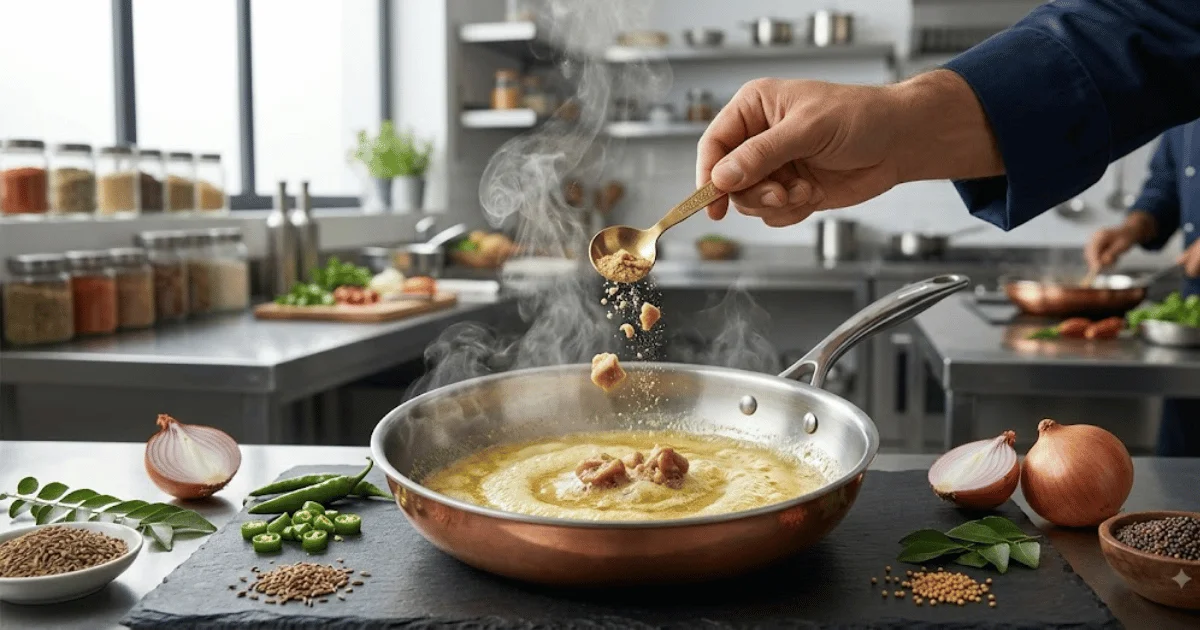
The Flavor Release Mechanism of Hing explains why a very small amount of Asafoetida can create a noticeable aroma and savory character in food. Hing behaves differently from many ordinary spices because its distinctive sensory impact depends heavily on volatile aromatic compounds and how they are released during cooking, mixing, and food processing.
The same Hing can therefore produce different sensory results depending on whether it is added to hot oil, a wet curry, a dry seasoning blend, or a processed food formulation. Temperature, fat, moisture, particle size, dosage, cooking time, and the surrounding food matrix can all influence how the aroma is released.
Understanding this mechanism is useful not only for home cooking but also for food manufacturers, seasoning companies, restaurants, R&D teams, and commercial ingredient buyers.
What Is the Flavor Release Mechanism of Hing?
The Flavor Release Mechanism of Hing describes how the aromatic components of Asafoetida become available to the senses after the ingredient is added to food.
Several stages can influence this process:
- The Hing is dispersed into the food system.
- Heat or moisture interacts with the ingredient.
- Aromatic compounds are released.
- Those compounds move through the food matrix.
- The aroma reaches the nose and mouth.
- Cooking transforms the overall sensory profile.
The final perception is therefore the result of both the ingredient and the conditions surrounding it.
Why Hing Has Such a Strong Aroma
Asafoetida contains volatile compounds responsible for its characteristic pungent aroma.
These compounds can become noticeable even when Hing is used in very small quantities.
That is why a small pinch can influence an entire dish.
However, strong raw aroma does not mean that the ingredient should be used in large quantities. The objective is to release the right amount of aroma and integrate it into the food.
Why Hing Is Usually Used in Tiny Quantities
Hing has a highly concentrated sensory profile compared with many common spices.
Using too much can overpower other ingredients and create an excessively pungent result.
The small dosage also makes the release mechanism important. A tiny quantity needs to distribute efficiently throughout the food to create the desired sensory effect.
Heat Activates the Aroma Experience
Heat is one of the most important factors affecting Hing aroma release.
When Hing encounters heat, its volatile aromatic components become more readily noticeable.
This is particularly obvious during traditional tempering, where Hing is added to heated oil or ghee.
The result is a rapid release of aroma that can then spread through the dish.
Why Hing Is Added to Hot Oil
Hot oil provides an efficient environment for distributing a small amount of Hing.
The fat helps disperse the ingredient while heat encourages aromatic release.
This combination can create a rapid aroma impact.
However, excessive heat can produce undesirable sensory results, so controlled temperature remains important.
The Role of Fat in Hing Flavor Release
Fat can act as an important medium for aromatic ingredients.
When Hing is introduced into oil or ghee, it can spread through the heated fat before being incorporated into the rest of the food.
This helps explain why Hing is traditionally associated with tempering.
The fat does not simply “activate” Hing. It also helps distribute the ingredient through the food system.
Why Ghee and Oil Can Produce Different Results
Different fats have different sensory characteristics and physical properties.
Oil and ghee can therefore influence the overall perception of a Hing-containing dish differently.
The Hing itself may be identical, but the surrounding fat system can change how the final aroma is experienced.
Moisture Also Influences Flavor Release
Hing behaves differently in dry and wet food systems.
When incorporated into a moist food such as dal, curry, or sauce, the aromatic compounds interact with water and the other ingredients present in the formulation.
This can produce a different release pattern from dry seasoning applications.
Hing in Dry Food Systems
Dry seasoning blends have relatively little free moisture.
In these systems, particle size, mixing efficiency, packaging, and later consumer preparation can strongly influence aroma release.
The aroma may become more noticeable when the seasoning is added to a moist or heated food.
Hing in Wet Food Systems
In wet foods, Hing can be distributed through the liquid or semi-liquid matrix.
Cooking temperature and mixing determine how evenly the ingredient is incorporated.
The final aroma depends on the complete food system rather than Hing alone.
Particle Size and Flavor Release
Particle size can influence how quickly an ingredient disperses and interacts with the food.
Fine Hing Powder can distribute differently from Hing Granules.
This does not mean one format is universally better. The appropriate format depends on the production process and desired release characteristics.
Hing Powder and Aroma Distribution
Fine powder can disperse quickly when properly incorporated into a food or seasoning system.
This can be useful when uniform distribution is important.
However, powder can also create handling and dust-management considerations during commercial production.
Hing Granules and Controlled Handling
Hing Granules provide a different physical format.
The larger particle structure can influence flow, handling, dosing, and dispersion.
Food manufacturers should select granules when their physical characteristics fit the production process and target application.
Compound Hing and Flavor Release
Compound Hing is formulated using Asafoetida and other ingredients or carriers according to the product specification.
Because of this formulation, its release characteristics can differ from highly concentrated raw Asafoetida.
This can be advantageous when manufacturers require easier dosing and predictable distribution.
Why Dosage Changes Flavor Release
Dosage directly influences the amount of aromatic material entering the food.
However, increasing dosage does not always produce a proportionally better result.
Once the desired sensory threshold has been reached, additional Hing may make the aroma too strong and disrupt the flavor balance.
Flavor Threshold and Hing
Every aromatic ingredient has a concentration at which its presence becomes noticeable.
Hing can reach a noticeable sensory impact at a very low inclusion level.
This is one reason it is valuable in formulations where a small quantity can contribute a distinctive character.
Cooking Stage Matters
When Hing is added can be just as important as how much is added.
Adding it early in a long cooking process exposes it to heat for a longer period.
Adding it at a later stage can preserve a different aroma profile.
The correct timing depends on the recipe and desired sensory outcome.
Why Hing Is Commonly Used During Tempering
Tempering creates a short, controlled period of intense aroma release.
Hing is added to hot oil or ghee, allowing its aroma to develop before the seasoned fat is incorporated into the food.
This technique provides efficient distribution of a very small quantity.
What Happens If Hing Is Heated Too Long?
Prolonged or excessive heating can change the sensory profile.
Instead of producing a balanced aroma, the ingredient may develop harsh or burnt notes.
This is why controlled heating is more important than simply using higher temperatures.
The Role of the Food Matrix
Hing does not release aroma into an empty environment.
It interacts with the other components of the food.
Important factors can include:
- Fat
- Water
- Salt
- Acidity
- Starch
- Protein
- Other spices
- Cooking temperature
These factors can change how the final aroma is perceived.
Why Fat-Rich Foods Can Behave Differently
Fat can influence the distribution and perception of aromatic compounds.
A Hing-containing food with a higher fat content can therefore produce a different sensory experience from a low-fat formulation.
Food manufacturers should test Hing in the actual recipe rather than assuming identical performance across different products.
Why Acidity Matters
Acidic ingredients can influence the overall flavor balance of a food.
When Hing is combined with acidic components, the final sensory impression may differ from a neutral formulation.
The ingredient should therefore be evaluated within the complete recipe.
Why Salt and Spices Matter
Hing is usually part of a larger seasoning system.
Salt, chilli, cumin, coriander, garlic, ginger, herbs, and other spices can alter how its aroma is perceived.
A formulation should therefore be evaluated as a complete sensory system.
Flavor Release During Mixing
Mixing helps distribute Hing throughout the food.
Uniform distribution is especially important when the inclusion level is very low.
In commercial manufacturing, poor mixing can create uneven flavor distribution even when the ingredient itself is high quality.
Why Industrial Mixing Matters
Large-scale food production requires controlled mixing conditions.
Factors such as mixer design, batch size, mixing time, ingredient order, and particle characteristics can influence distribution.
For Hing, proper dispersion is essential because even small concentration differences can be noticeable.
Ingredient Order Can Influence Flavor
Food manufacturers often add ingredients at defined stages of production.
The order in which Hing enters the formulation can affect its exposure to heat, moisture, fat, and other components.
Changing the ingredient addition point may therefore change the final sensory profile.
Hing in Seasoning Blends
In dry seasoning blends, Hing may be combined with several other aromatic ingredients.
The objective is to create a consistent blend in which Hing contributes its characteristic note without dominating the formulation.
Particle size and mixing uniformity become particularly important.
Hing in Ready-to-Eat Foods
Ready-to-eat products can expose Hing to multiple stages of processing.
The ingredient may be mixed, heated, cooled, packaged, and stored before the consumer opens the product.
Therefore, R&D teams should evaluate both immediate aroma release and longer-term aroma retention.
Hing in Ready-to-Cook Products
Ready-to-cook products may contain Hing in a dry seasoning system that is later heated by the consumer.
The manufacturer must consider both factory processing and final preparation.
The best ingredient format may be one that survives manufacturing while still releasing the desired aroma during final cooking.
Flavor Release During Frying
Frying creates a high-temperature environment.
If Hing is exposed directly to frying temperatures for an extended period, its sensory characteristics can change.
For some products, incorporating Hing into a post-frying seasoning may provide a different aroma profile.
The correct approach depends on the product-development objective.
Flavor Release During Baking
Baking involves sustained thermal exposure.
Hing incorporated into a baked formulation may therefore experience a different release and retention pattern compared with Hing added during a short tempering step.
Application testing is important when developing baked products containing Hing.
Flavor Release During Extrusion
Extrusion can combine heat, pressure, moisture, and mechanical energy.
These conditions can significantly affect aromatic ingredients.
Manufacturers developing extruded snacks should therefore test Hing under actual or closely simulated production conditions.
Why Aroma Release and Aroma Retention Are Different
Release describes how aroma becomes available during processing or consumption.
Retention describes how much of the desirable aroma remains available after processing and storage.
A good Hing formulation needs to perform appropriately across both stages.
Immediate Aroma Versus Final Flavor
The first aroma noticed when opening a product may not be identical to the flavor experienced after eating it.
Hing contributes to both aroma perception and overall flavor balance.
Food developers should therefore evaluate the complete sensory experience rather than relying only on the initial smell.
Why Mouthfeel Can Change Flavor Perception
Flavor perception is influenced by the physical characteristics of food.
A creamy sauce, dry snack, crispy product, and liquid soup can all present the same aromatic ingredient differently.
This is another reason why the food matrix matters when evaluating Hing.
Flavor Release and Storage
Flavor release does not end when manufacturing is complete.
During storage, packaging, temperature, moisture, and air exposure can influence aroma retention.
For commercial food products, shelf-life testing should therefore include sensory evaluation where appropriate.
Why Packaging Matters
Hing is highly aromatic, so packaging must help protect the product and manage aroma transfer.
Appropriate packaging can also help limit unnecessary exposure to moisture and air.
For bulk buyers, packaging should be selected according to the product format, storage conditions, transportation requirements, and intended use.
Flavor Release and Freshness
Freshness can influence the sensory performance of aromatic ingredients.
If Hing has been exposed to unsuitable storage conditions, its aroma may become weaker or less characteristic.
This means that ingredient quality and storage management work together.
How Food Manufacturers Can Evaluate Hing Flavor Release
A practical application trial can compare different Hing samples under identical conditions.
The R&D team can measure:
- Initial aroma
- Aroma after heating
- Flavor intensity
- Flavor balance
- Aftertaste
- Storage performance
Testing multiple dosage levels can also help identify the optimal inclusion rate.
Why a Control Batch Is Useful
A control batch without Hing provides a baseline for comparison.
The R&D team can then determine how much the ingredient changes the aroma and flavor of the finished product.
This makes sensory evaluation more objective.
Why Application Testing Beats Smelling the Raw Powder
The raw aroma of Hing is not necessarily representative of the final sensory experience.
Cooking transforms the ingredient.
Therefore, smelling a powder directly from its container can provide useful information about the raw material but cannot predict every aspect of finished-product performance.
Choosing the Right Hing Format
The correct format depends on the production system.
Food manufacturers can compare:
- Asafoetida resin
- Compound Hing
- Hing Powder
- Hing Granules
Each format can provide different handling, dosing, dispersion, and sensory characteristics.
Why Concentration Matters
Highly concentrated Hing products require careful dosing.
Compound products may provide easier handling where larger quantities need to be distributed throughout a formulation.
The choice should be based on the target sensory profile and production requirements.
Flavor Release and Cost-in-Use
The most economical ingredient is not necessarily the one with the lowest price per kilogram.
A more concentrated product may require a lower dosage, while a formulated product may provide easier and more consistent dosing.
Food manufacturers should calculate cost-in-use after confirming sensory performance.
Common Mistakes in Hing Flavor Development
- Judging the product only by raw aroma
- Using too much Hing
- Applying excessive heat
- Ignoring the food matrix
- Testing only one dosage
- Ignoring particle size
- Failing to test storage performance
- Changing the ingredient addition stage without testing
Controlled trials can reduce these problems.
How R&D Teams Can Optimize Hing Flavor Release
- Define the target sensory profile.
- Select suitable Hing formats.
- Review product specifications.
- Test multiple inclusion levels.
- Control temperature and processing time.
- Test the ingredient in the complete food matrix.
- Conduct sensory evaluation.
- Evaluate finished-product storage.
- Calculate cost-in-use.
- Approve the final ingredient specification.
This approach turns Hing selection from a simple purchasing decision into a controlled formulation process.
Why Flavor Release Matters to Commercial Buyers
For a food manufacturer, the value of Hing depends on what happens after the ingredient enters production.
A supplier may provide a strong-smelling raw material, but the manufacturer needs consistent performance in the finished product.
Application-specific testing can therefore provide a much better basis for supplier selection.
Flavor Release Mechanism of Hing in Modern Food Manufacturing
Modern food products can involve multiple processing stages, making flavor release increasingly important.
Hing may need to survive blending, heating, cooling, packaging, and storage before producing the desired aroma when the consumer prepares or eats the product.
This creates opportunities for suppliers that can support food manufacturers with appropriate product formats and technical information.
RB Industries and Hing for Food Applications
RB Industries manufactures and supplies Asafoetida, Compound Hing, Hing Powder, and Hing Granules for food manufacturers, seasoning companies, restaurants, wholesalers, distributors, exporters, retailers, and FMCG brands.
For commercial applications, the right Hing product should be selected according to the food matrix, processing method, desired aroma profile, dosage, physical format, packaging, storage conditions, and production volume.
Food manufacturers can evaluate samples in their own formulations before approving a product for regular commercial supply.
Conclusion
The Flavor Release Mechanism of Hing depends on much more than simply adding the ingredient to food. Heat, fat, moisture, particle size, dosage, cooking stage, mixing, and the surrounding food matrix all influence how the characteristic aroma and flavor become noticeable.
This explains why the same Hing product can behave differently in a tempering application, dry seasoning blend, ready-to-eat meal, snack, sauce, or industrial formulation. The raw aroma provides useful information, but finished-product testing gives a much clearer picture of performance.
For food manufacturers, the most reliable approach is to evaluate Hing under actual processing conditions and establish the correct dosage, addition stage, physical format, and storage conditions. This helps create a consistent sensory profile while avoiding unnecessary ingredient costs.
RB Industries supplies Asafoetida, Compound Hing, Hing Powder, and Hing Granules for commercial food applications. Manufacturers, seasoning companies, distributors, exporters, restaurants, and FMCG brands can discuss their formulation and bulk requirements to identify a suitable Hing product.
Frequently Asked Questions
What is the Flavor Release Mechanism of Hing?
The Flavor Release Mechanism of Hing describes how its aromatic components become available during cooking, mixing, processing, and consumption. Heat, fat, moisture, particle size, dosage, and the food matrix all influence the final sensory result.
Why does Hing release so much aroma when added to hot oil?
Heat encourages the release of Hing’s volatile aromatic components, while oil helps distribute the ingredient through the food system. This combination creates the rapid aroma impact associated with traditional tempering.
Does more Hing always create more flavor?
Not necessarily. Increasing Hing can eventually make a formulation overly pungent or unbalanced, so manufacturers should establish the optimum dosage through application and sensory testing.
Does particle size affect Hing flavor release?
Yes. Powder and granules can disperse and interact with food differently. The best format depends on the desired release characteristics, mixing equipment, dosage system, and application.
How can food manufacturers test Hing flavor release?
Manufacturers can compare different Hing samples and dosage levels under controlled processing conditions. Sensory evaluation should then be performed on the finished product rather than relying only on the raw ingredient’s aroma.