
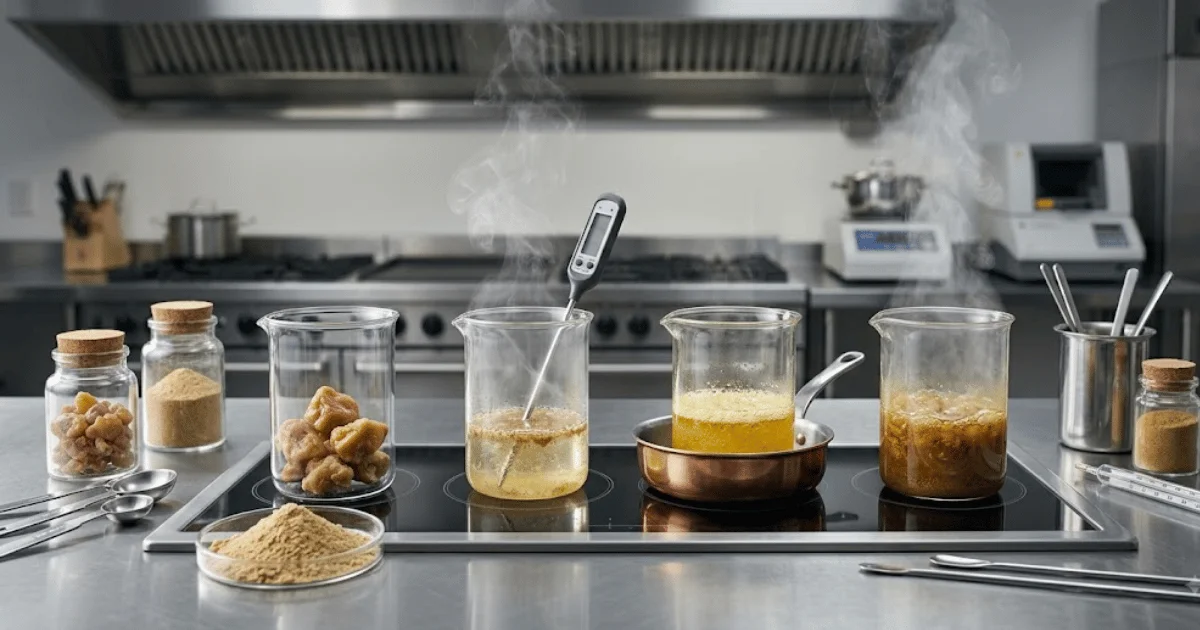
The Effect of Temperature on Hing is important because Asafoetida is a highly aromatic ingredient whose sensory behavior changes depending on how it is heated, stored, mixed, and processed. The temperature used during cooking can influence aroma release, flavor development, and the final sensory balance of a dish.
However, temperature does not affect Hing in only one way. Short controlled heating during tempering can help transform its sharp raw aroma into a warmer cooked character, while excessive heat or prolonged exposure can produce undesirable results. Temperature during storage and transportation also matters because repeated exposure to unsuitable conditions can affect product quality over time.
For food manufacturers, restaurants, seasoning companies, distributors, exporters, and home cooks, understanding the Effect of Temperature on Hing can help improve consistency and reduce avoidable flavor problems.
Why Temperature Matters for Hing
Hing contains volatile aromatic components that contribute strongly to its characteristic smell and flavor.
Temperature influences how quickly these aromatic components become noticeable and how the ingredient behaves within a food system.
This is why Hing added to cool food does not necessarily produce the same result as Hing briefly bloomed in warm fat.
The objective is not to use the highest possible temperature. The objective is to use the appropriate temperature for the application.
What Happens to Hing When It Is Heated?
Heating can change the sensory experience of Hing.
The raw ingredient has an intense, pungent aroma. Controlled cooking can transform this sharp character into a more integrated savory note.
At the same time, excessive heating can create harsh or burnt sensory characteristics.
Therefore, both temperature and exposure time need to be considered.
Temperature and Aroma Release
As temperature increases, volatile aromatic components can become more readily noticeable.
This is one reason Hing can produce a rapid aroma burst when introduced into heated oil or ghee.
The release is particularly noticeable because Hing is normally used in very small quantities.
Why High Temperature Is Not Always Better
A common mistake is assuming that stronger heat will produce stronger or better Hing flavor.
That is not necessarily true.
Excessive heat can cause the ingredient to develop a harsh or burnt profile rather than the desired warm and savory character.
Controlled heating is more useful than simply increasing temperature.
Temperature and Cooking Time Work Together
Temperature should never be considered independently from exposure time.
A brief exposure to a higher temperature may produce a different result from a long exposure to moderate heat.
Food manufacturers and chefs should therefore consider both variables when developing Hing applications.
The Effect of Temperature on Hing During Tempering
Tempering is one of the clearest examples of how temperature affects Hing.
Oil or ghee is heated first, and Hing is generally introduced in a controlled manner rather than left exposed to intense heat for an extended period.
Existing RB Industries guidance recommends lowering the flame before adding Hing and using it near the end of the tempering sequence to reduce the risk of scorching. :contentReference[oaicite:1]{index=1}
Why Hing Is Added Near the End of Tadka
Hing is highly aromatic and reacts quickly to heat.
Adding it after the main tempering spices have released their aroma gives the ingredient a short exposure period.
This can help develop the desired cooked character without unnecessarily exposing Hing to prolonged high heat.
Off-Flame Blooming and Temperature Control
One practical approach is to move the pan away from direct heat before adding Hing.
This reduces the intensity of the thermal exposure while allowing the heated fat to help release the aroma.
The exact technique depends on the dish, cookware, oil, and Hing formulation.
What Happens If Hing Gets Too Hot?
Excessive heat can cause Hing to develop an unpleasant sensory profile.
Possible signs include:
- Harsh aroma
- Burnt notes
- Bitter aftertaste
- Overly sharp flavor
- Loss of the desired aromatic balance
If these characteristics appear repeatedly, temperature and exposure time should be reviewed.
Why Burning Hing Creates a Different Flavor
Hing is intended to contribute a distinctive aromatic layer rather than dominate the entire dish.
When the ingredient is scorched, the resulting sensory profile can move away from the warm savory character expected from properly cooked Hing.
This is why controlled heat is an important part of Hing preparation.
Temperature and Different Cooking Fats
Oil and ghee can both be used with Hing, but they contribute different sensory characteristics.
Ghee can provide a richer and rounder background, while neutral oils can allow the Hing profile to remain more prominent.
The cooking temperature still needs to be controlled regardless of the fat used.
Does Ghee Change the Effect of Temperature on Hing?
The fat itself can influence how heat is transferred and how the aroma is perceived.
Therefore, the same Hing may produce a somewhat different sensory experience when prepared in different fats.
For commercial product development, the ingredient should be evaluated in the actual fat system used in the recipe.
Temperature and Moisture in Hing
Temperature can interact with moisture to influence Hing performance.
In dry products, temperature can affect aroma release and storage stability.
In wet foods, temperature interacts with water, fat, starch, proteins, acids, and other ingredients.
This makes the food matrix an important part of temperature evaluation.
Temperature in Dry Seasoning Systems
Dry seasoning blends can experience temperature changes during manufacturing, packaging, transportation, and storage.
Hing used in these systems needs to retain suitable aroma and physical properties throughout the supply chain.
Packaging and storage conditions therefore become important alongside processing temperature.
Temperature in Wet Food Products
Wet foods such as sauces, gravies, and ready-to-eat meals expose Hing to moisture as well as heat.
The final sensory result depends on how the ingredient is incorporated and how long the food is processed.
Testing the complete food matrix provides more useful information than testing Hing alone.
Effect of Temperature on Hing Powder
Hing Powder can release aroma quickly when exposed to heat.
Its fine particle structure can also allow rapid dispersion in suitable food systems.
However, the powder should be protected from excessive heat and moisture during storage.
Effect of Temperature on Hing Granules
Hing Granules have a different physical structure from powder.
Their larger particles can influence how quickly the ingredient disperses and interacts with the food system.
Manufacturers should evaluate the granule format under actual processing conditions.
Effect of Temperature on Compound Hing
Compound Hing is a formulated product and can contain Asafoetida along with other ingredients or carriers according to its specification.
Its thermal behavior therefore depends on the complete formulation.
Food manufacturers should not assume that every Compound Hing product responds identically to temperature.
Why Compound Hing Requires Application Testing
Two Compound Hing products can have different compositions and physical characteristics.
As a result, the same processing temperature may produce different sensory outcomes.
Application trials are the best way to establish suitable processing conditions for a specific formulation.
Effect of Temperature on Asafoetida Resin
Asafoetida resin is a highly concentrated aromatic material.
Its strong sensory profile means that temperature and dosage need to be carefully controlled during use.
Very small quantities can create a significant aroma impact.
Temperature and Dosage Are Connected
Temperature can influence how quickly aroma becomes noticeable, while dosage determines how much aromatic material is introduced.
Increasing both temperature and dosage at the same time can make a formulation unnecessarily intense.
Manufacturers should optimize these variables independently during product development.
Why More Heat Cannot Compensate for Weak Hing
If a Hing product appears weak, simply increasing temperature may not solve the problem.
The underlying issue could be product concentration, freshness, storage, formulation, or batch consistency.
Using excessive heat as a corrective measure can instead create harsh flavor.
Temperature and Hing Freshness
Freshness is important for aromatic ingredients.
Hing exposed to unsuitable storage temperatures for extended periods may experience changes in sensory performance.
Proper storage helps protect the ingredient before it reaches the cooking or manufacturing stage.
Storage Temperature for Hing
Hing should generally be stored according to the supplier’s specified conditions and protected from unnecessary heat, direct sunlight, and moisture.
Existing RB Industries storage guidance emphasizes protecting Hing from air, heat, moisture, and light to help maintain aroma and physical quality. :contentReference[oaicite:2]{index=2}
The exact storage requirements can vary by product format and packaging.
Why Temperature Fluctuations Matter
Repeated movement between hot and cool environments can create unnecessary stress on packaged food ingredients.
Stable storage conditions are generally preferable to repeated temperature fluctuations.
This is particularly relevant for distributors and exporters managing longer supply chains.
Temperature During Transportation
Transportation can expose Hing to changing environmental conditions.
High temperatures inside vehicles, shipping containers, or warehouses can affect sensitive aromatic ingredients.
Appropriate packaging and logistics planning can help reduce unnecessary exposure.
Temperature and International Shipping
Export shipments can spend considerable time in transit.
Temperature conditions can vary between the origin country, transit locations, destination warehouses, and final storage facilities.
Exporters should therefore consider climate, packaging, transit time, and storage conditions when planning commercial shipments.
Effect of Temperature on Hing During Frying
Frying exposes ingredients to relatively intense thermal conditions.
If Hing is incorporated before frying, its aroma may experience prolonged heat exposure.
In some applications, adding Hing through a seasoning system after frying may produce a different sensory result.
The best method depends on the target product.
Effect of Temperature on Hing During Baking
Baking exposes food ingredients to sustained heat over a longer period.
Hing incorporated into a baked formulation may therefore experience different aroma release and retention compared with a short tempering process.
R&D teams should evaluate both immediate and finished-product sensory performance.
Effect of Temperature on Hing During Roasting
Roasting can create strong thermal exposure and can significantly change aromatic ingredients.
If Hing is used in a roasted product, the formulation should be tested to determine whether the desired aroma survives the process.
Direct high-temperature exposure may not always be the best approach.
Effect of Temperature on Hing During Extrusion
Extrusion combines several variables, including heat, pressure, moisture, and mechanical energy.
These conditions can significantly influence aromatic ingredients.
Manufacturers developing extruded snacks should therefore conduct controlled application trials using the actual production conditions wherever practical.
Temperature During Mixing
Mixing is another stage where temperature can matter.
Some food manufacturing processes involve warm or heated ingredients during blending.
If Hing is added at this stage, the manufacturer should consider how long it remains exposed to the elevated temperature.
Ingredient Addition Temperature Matters
The point at which Hing enters a production process can change its final sensory contribution.
Adding it before a long heating step can produce a different result from adding it after the main thermal treatment.
Food R&D teams should test ingredient addition points rather than assuming that one method works for every product.
Temperature and Flavor Release
Temperature and flavor release are closely connected.
Higher temperatures can increase the availability of volatile aromatic components, but the final sensory result depends on exposure time and the surrounding food system.
This is why controlled heating is more useful than maximum heating.
Temperature and Aroma Retention Are Different
Aroma release refers to aromatic compounds becoming available for perception.
Aroma retention refers to how much of the desired sensory character remains after processing and storage.
A process can produce a strong immediate aroma while still losing important aroma characteristics later.
Manufacturers should evaluate both stages.
Immediate Aroma Versus Final Product Aroma
A Hing sample may smell powerful immediately after heating.
However, the finished food may show a different aroma after cooling, packaging, and storage.
For commercial product development, final-product testing is therefore essential.
Temperature and Shelf Life
Temperature can influence ingredient and finished-product stability during storage.
Higher or fluctuating storage temperatures can increase the risk of sensory changes over time.
Manufacturers should consider temperature as part of their shelf-life evaluation.
Why Shelf-Life Testing Matters
A food product should not be evaluated only immediately after manufacturing.
If Hing contributes significantly to the product’s aroma, changes during storage may affect consumer perception.
Periodic sensory evaluation can help identify such changes.
Temperature and Packaging
Packaging helps protect Hing from environmental conditions.
However, packaging should be selected according to the product, expected storage temperature, transportation conditions, and market requirements.
Good packaging cannot completely compensate for inappropriate storage conditions.
Temperature and Air Exposure
Opening a Hing container in a hot environment can expose the ingredient to both heat and air.
Repeated exposure can affect aromatic quality over time.
Commercial handling procedures should therefore minimize unnecessary opening and reseal containers promptly.
Temperature and Moisture Absorption
Temperature fluctuations can interact with humidity and condensation.
Moisture can affect the physical properties of powdered and granulated Hing, including clumping and flow.
Dry, stable storage conditions help reduce these problems.
Temperature in Food Manufacturing Quality Control
Food manufacturers can include temperature conditions in their ingredient and process specifications.
Useful records can include:
- Storage temperature
- Processing temperature
- Heating time
- Ingredient addition point
- Cooling conditions
- Finished-product storage conditions
Documenting these variables makes sensory troubleshooting easier.
How R&D Teams Should Study Temperature Effects
A controlled trial can compare several temperature conditions while keeping other variables constant.
For example, the team can maintain the same Hing batch, dosage, oil, recipe, and cooking time while changing the temperature.
This helps isolate the effect of temperature.
A Practical Temperature Trial for Hing
- Select one approved Hing sample.
- Measure an identical dosage for every trial.
- Use the same food matrix.
- Use the same cooking fat.
- Change only the temperature.
- Maintain controlled exposure time.
- Evaluate aroma immediately.
- Evaluate the finished food after cooking.
- Record sensory differences.
This creates a more useful basis for process optimization.
Why Temperature Trials Should Include Time
Temperature alone does not fully describe thermal exposure.
Two batches processed at the same temperature can produce different results if one remains exposed for much longer.
For this reason, R&D teams should record both temperature and exposure duration.
Temperature and Food Matrix
The same Hing temperature exposure can behave differently in different foods.
A dry snack, oily seasoning, liquid dal, thick sauce, and frozen meal have different physical environments.
Temperature testing should therefore be performed in the intended product whenever possible.
Temperature and Fat-Based Applications
Fat can help distribute Hing and influence aroma release.
Oil temperature therefore becomes an important variable in tempering and seasoning applications.
Controlled heating helps balance aroma release with the risk of scorching.
Temperature and Water-Based Applications
Water-based foods can create a different release environment.
Hing added directly to a liquid may not produce the same immediate aroma as Hing bloomed in fat.
This is one reason traditional tempering remains effective for many applications.
Effect of Temperature on Hing in Ready-to-Eat Foods
Ready-to-eat foods may undergo cooking, mixing, cooling, packaging, and storage.
Hing can experience multiple temperature changes during this process.
Manufacturers should evaluate the ingredient across the complete processing chain.
Effect of Temperature on Hing in Ready-to-Cook Foods
Ready-to-cook products require the ingredient to survive commercial storage and then perform during final consumer preparation.
The temperature profile therefore includes both factory processing and consumer cooking.
Application testing should consider both stages.
Effect of Temperature on Hing in Snack Seasonings
Snack seasoning is often applied after the primary cooking process.
This can reduce direct thermal exposure to the Hing but introduces other considerations such as seasoning adhesion, packaging, moisture, and storage.
The best approach depends on the product design.
Temperature and Compound Hing in Seasonings
Compound Hing can be incorporated into dry seasoning systems.
Manufacturers should evaluate how the formulation behaves during blending and any subsequent thermal processing.
Because Compound Hing formulations differ, the supplier specification should guide application testing.
Common Temperature-Related Hing Problems
- Burnt aroma
- Bitter aftertaste
- Harsh pungency
- Reduced aroma after prolonged heating
- Weak aroma after poor storage
- Clumping after moisture exposure
- Batch-to-batch sensory variation
Not every problem is caused by temperature alone, so troubleshooting should consider the complete process.
How to Prevent Heat-Related Hing Problems
- Use the correct dosage.
- Control cooking temperature.
- Limit unnecessary exposure time.
- Add Hing at the appropriate processing stage.
- Use suitable fat where required.
- Store Hing away from excessive heat.
- Protect packaging from direct sunlight.
- Test the ingredient in the actual formulation.
Why Temperature Control Supports Flavor Consistency
Consistent temperature conditions help produce more predictable sensory results.
If one production batch receives significantly more heat than another, the same Hing dosage may produce different aroma characteristics.
Process control is therefore important for commercial food manufacturing.
Temperature Control and Batch-to-Batch Consistency
Ingredient consistency alone cannot guarantee finished-product consistency.
The manufacturing process must also remain controlled.
For Hing-containing products, temperature, mixing, dosage, and ingredient addition order can all influence the final result.
Why Food Manufacturers Should Not Guess Temperature
Traditional cooking knowledge provides useful starting points, but industrial manufacturing requires controlled validation.
Equipment, batch size, formulation, residence time, and processing conditions can vary considerably.
Manufacturers should therefore establish their own validated process parameters.
Temperature and Supplier Selection
When selecting Hing, buyers should consider how the ingredient performs under their actual process conditions.
A supplier’s product specification and application guidance can help narrow the options, but the final decision should be supported by product trials.
Questions Food Manufacturers Should Ask About Hing
- What Hing format is suitable for the application?
- What is the product composition?
- How does the product perform during heating?
- What storage conditions are recommended?
- What packaging is available?
- Can samples be provided?
- Can the supplier support recurring production volumes?
- What documentation is available?
These questions help connect ingredient quality with actual manufacturing requirements.
Why Application Trials Matter More Than Generic Temperature Claims
There is no single temperature that can be described as the universally correct temperature for every Hing application.
A temperature suitable for a short tempering step may not be appropriate for baking, extrusion, frying, or long-duration industrial processing.
Application-specific testing is therefore essential.
Effect of Temperature on Hing: Practical Takeaway
The key principle is simple: Hing needs controlled heat, not maximum heat.
Short, appropriate heating can help develop its characteristic cooked aroma, while excessive temperature or prolonged exposure can produce undesirable sensory changes.
During storage, stable and suitable conditions help preserve the ingredient before it reaches the cooking or manufacturing stage.
RB Industries and Hing for Temperature-Sensitive Applications
RB Industries manufactures and supplies Asafoetida, Compound Hing, Hing Powder, and Hing Granules for food manufacturers, seasoning companies, restaurants, wholesalers, distributors, exporters, retailers, and FMCG brands.
For commercial applications, the appropriate Hing should be selected according to the food matrix, desired aroma profile, dosage, processing temperature, exposure time, physical format, packaging, storage conditions, and production volume.
Manufacturers can evaluate samples under their actual processing conditions before approving a product for regular commercial supply.
Conclusion
The Effect of Temperature on Hing extends from the moment the ingredient is stored to the moment it reaches the finished food. Heat can accelerate aroma release and help transform the raw pungency of Hing into a more integrated cooked character, but excessive temperature or prolonged exposure can create harsh, burnt, or unbalanced sensory results.
Temperature also matters during storage, transportation, blending, frying, baking, extrusion, and finished-product shelf life. The correct condition depends on the product format and application, which is why there is no universal “best temperature” for every Hing product.
For food manufacturers, the most reliable approach is controlled application testing. Keep the Hing dosage, food matrix, cooking fat, and processing time consistent while evaluating temperature changes. This helps identify the conditions that deliver the desired aroma and flavor without unnecessary thermal exposure.
RB Industries supplies Asafoetida, Compound Hing, Hing Powder, and Hing Granules for commercial food applications. Food manufacturers, seasoning companies, distributors, exporters, restaurants, and FMCG brands can discuss their formulation and bulk requirements to identify a suitable Hing product for their processing conditions.
Frequently Asked Questions
What is the Effect of Temperature on Hing?
The Effect of Temperature on Hing includes changes in aroma release, flavor development, and sensory performance. Controlled heating can help develop the desired cooked aroma, while excessive heat or prolonged exposure can produce harsh or burnt characteristics.
Does high temperature make Hing more flavorful?
Not necessarily. Higher temperature can increase aroma release, but excessive heat can damage the desired sensory balance. Hing generally performs best when temperature and exposure time are controlled for the specific application.
Why does Hing become bitter when cooked?
Excessive heat, prolonged exposure, or an unsuitable cooking stage can contribute to bitterness or harshness. Reducing the heat, shortening the exposure, and controlling the dosage can help prevent these problems.
Does temperature affect Compound Hing?
Yes. Compound Hing is a formulated product, so its response to heat depends on its specific composition and application. Food manufacturers should test the actual product under their intended processing conditions.
How should Hing be protected from temperature during storage?
Hing should generally be stored according to the manufacturer’s recommended conditions and protected from unnecessary heat, direct sunlight, and moisture. Stable storage conditions can help preserve aroma and physical quality.