
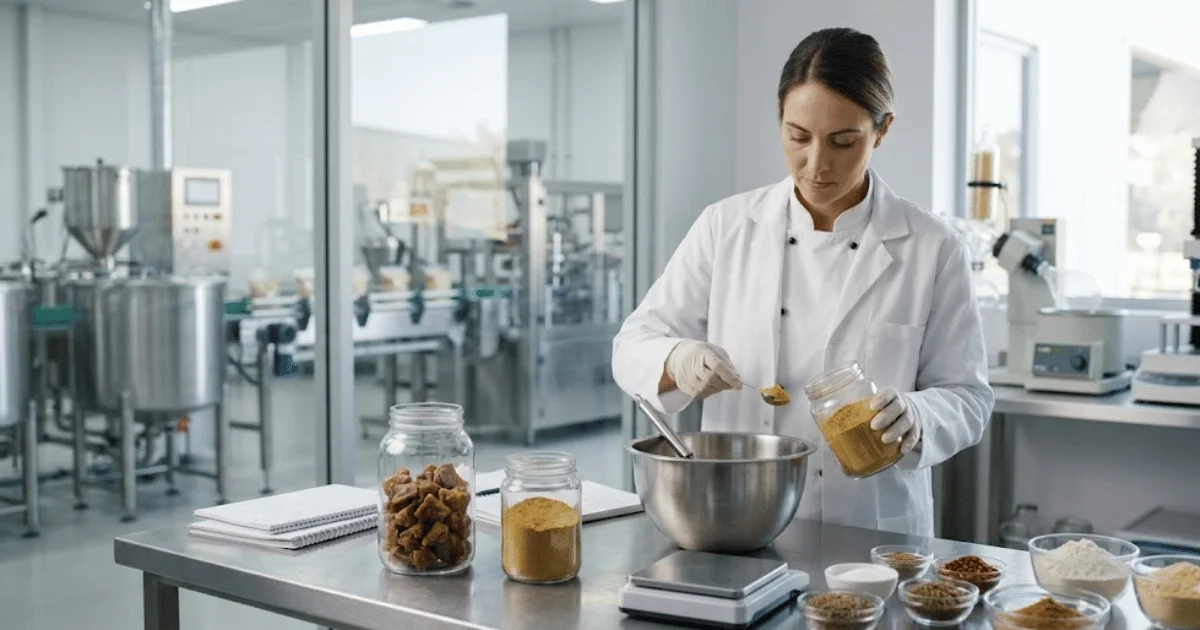
Product Development Using Compound Hing gives food manufacturers a practical way to incorporate the distinctive flavor and aroma of Asafoetida into commercial food products. Unlike using Hing only in traditional recipes, commercial product development requires controlled formulation, dosage testing, sensory evaluation, processing trials, cost analysis, and quality specifications.
Compound Hing can be particularly useful when product developers need a convenient and consistent format that can be incorporated into seasoning blends, ready-to-cook foods, snacks, instant products, sauces, spice mixes, and other commercial formulations. However, choosing the right product is only the beginning.
Successful development requires the R&D team to understand how Compound Hing behaves inside the complete food matrix. Temperature, moisture, fat, particle size, mixing, dosage, processing time, packaging, and storage can all influence the final sensory result.
What Is Product Development Using Compound Hing?
Product Development Using Compound Hing refers to the process of incorporating Compound Hing into a food formulation and optimizing the ingredient for the desired sensory, technical, commercial, and manufacturing requirements.
The process can include:
- Application selection
- Ingredient selection
- Dosage development
- Prototype formulation
- Sensory testing
- Processing trials
- Stability evaluation
- Cost-in-use analysis
- Scale-up
- Final specification approval
The objective is not simply to add Hing to a product. The objective is to make it perform consistently in the finished product.
Why Compound Hing Is Useful for Product Development
Compound Hing can provide practical advantages for food manufacturers that need a manageable commercial ingredient format.
Depending on the formulation, it can offer controlled flavor intensity, easier handling, convenient dosing, and compatibility with different food systems.
These characteristics can make it useful during both laboratory formulation and commercial manufacturing.
Start With the Target Product
Product developers should define the final food product before selecting the Compound Hing specification.
A seasoning blend, snack, curry base, ready-to-cook meal, sauce, instant food, or processed product can require different sensory and physical characteristics.
The intended application should therefore determine the ingredient requirements.
Define the Target Sensory Profile
The first technical step is to define what the finished product should taste and smell like.
The R&D team can establish targets for:
- Hing aroma
- Pungency
- Savory contribution
- Flavor intensity
- Aftertaste
- Overall seasoning balance
Without a defined sensory target, dosage decisions become subjective.
Why the Strongest Hing Is Not Always the Best Choice
A highly concentrated Hing may provide intense aroma, but that does not automatically make it the best ingredient for every product.
The ideal product is the one that delivers the required sensory contribution at the appropriate dosage while fitting the manufacturing process and commercial cost target.
Select the Appropriate Compound Hing Format
Compound Hing can be available in different physical forms depending on supplier formulation and application requirements.
Product developers may evaluate:
- Compound Hing Powder
- Compound Hing Granules
- Other application-specific formats
Physical format can affect handling, mixing, dosing, dispersion, and final product consistency.
Powder Versus Granules in Product Development
Fine powder can disperse rapidly in many seasoning systems.
Granules can provide different flow and handling characteristics and may be suitable for applications where particle control is important.
The right choice depends on the formulation and production equipment.
Understand the Compound Hing Specification
Before beginning formulation trials, the R&D team should understand the supplier’s product specification.
Important information may include:
- Product name
- Physical form
- Ingredient composition
- Target aroma profile
- Particle characteristics
- Storage conditions
- Packaging
- Recommended application information
Clear specifications reduce uncertainty during development.
Why Composition Matters
Compound Hing is a formulated product rather than simply untreated raw Asafoetida resin.
The composition can influence concentration, sensory intensity, physical behavior, and dosage requirements.
R&D teams should therefore formulate according to the actual product specification rather than assuming that every Compound Hing product is equivalent.
Begin With a Small Laboratory Trial
Large production trials should not be the first step.
A small laboratory batch allows the R&D team to compare dosage levels and observe how Compound Hing interacts with the formulation.
This reduces development cost and makes experimentation faster.
Test Multiple Dosage Levels
A single dosage trial provides limited information.
Product developers can test a low, medium, and high inclusion level to understand the sensory response.
This helps identify the point at which Hing changes from subtle background flavor to dominant aroma.
Why Dosage Optimization Matters
Hing is highly aromatic and is normally used in relatively small quantities.
Adding more does not necessarily improve the product.
Too much can overpower other spices and create an unbalanced sensory profile.
The objective is to find the optimum inclusion level.
Use a Control Formula
A control batch without Compound Hing provides a baseline.
The R&D team can then compare each Hing dosage against the control to determine how much the ingredient changes the finished product.
This makes sensory decisions more objective.
Compare Different Compound Hing Samples
When developing a new product, testing multiple supplier samples can reveal differences in aroma intensity, flavor contribution, physical behavior, and cost-in-use.
However, the samples must be compared under equivalent conditions.
Using different dosage levels for different suppliers can produce misleading results.
Evaluate Raw Aroma Carefully
Raw aroma provides useful information about the ingredient.
However, it should not determine the final supplier decision by itself.
The most important question is how the Compound Hing performs in the finished food.
Test Cooked Aroma
Cooking can transform the sensory profile of Hing.
The sharp raw aroma can become more integrated and savory after controlled heating.
Therefore, the R&D team should include cooked aroma in its evaluation.
Temperature During Product Development
Temperature can strongly influence Compound Hing performance.
Heat can increase aroma release, while excessive heat or prolonged exposure can produce undesirable sensory characteristics.
Product developers should record processing temperature and exposure time during trials.
Ingredient Addition Stage Matters
The point at which Compound Hing enters the formulation can influence the final aroma.
Adding it before a long heating stage can expose it to more thermal processing than adding it later.
R&D teams should test different addition points when the process allows it.
Compound Hing in Seasoning Blends
Seasoning systems are one of the natural applications for Compound Hing.
Hing can be combined with salt, chilli, cumin, coriander, garlic, onion, herbs, and other flavoring ingredients.
The objective is to create a balanced seasoning rather than make Hing the dominant component.
Product Development for Snack Seasonings
Snack manufacturers can explore Compound Hing in seasoning blends designed for different flavor profiles.
Application variables may include:
- Seasoning dosage
- Application timing
- Oil level
- Particle size
- Adhesion
- Packaging
- Shelf-life stability
Each variable can influence the final sensory experience.
Product Development for Ready-to-Cook Foods
Ready-to-cook products require the seasoning system to remain stable during storage and perform correctly during consumer preparation.
Compound Hing should therefore be evaluated both before cooking and after the final preparation step.
Product Development for Ready-to-Eat Foods
Ready-to-eat foods can expose Compound Hing to several processing stages, including heating, mixing, cooling, packaging, and storage.
The R&D team should evaluate the ingredient across the complete processing cycle.
Product Development for Instant Foods
Instant food products often depend on carefully balanced seasoning systems.
Compound Hing can contribute a distinctive aromatic layer, but its dosage and addition stage need to be optimized for the preparation method.
Product Development for Sauces and Gravies
Sauces and gravies provide a moist food matrix in which Compound Hing interacts with water, fat, starch, proteins, spices, and other ingredients.
The final aroma may therefore differ significantly from the raw ingredient.
Testing the complete sauce or gravy is essential.
Product Development for Spice Blends
Compound Hing can be included in spice blends designed for household or commercial use.
Uniform mixing becomes particularly important because Hing may be used at a low inclusion level.
Poor dispersion can create inconsistent flavor from one portion of the blend to another.
Mixing Uniformity in Compound Hing Formulations
R&D teams should evaluate whether the ingredient distributes evenly throughout the formulation.
This becomes increasingly important as production volumes increase.
A laboratory blend that appears uniform may require different mixing conditions during commercial manufacturing.
Particle Size and Product Development
Particle size can affect flow, dispersion, mixing, and application behavior.
Fine Compound Hing Powder may behave differently from granulated material.
Therefore, physical specifications should be considered alongside sensory characteristics.
Moisture and Compound Hing Formulations
Moisture can influence powder flow, clumping, mixing, and storage stability.
Products containing Compound Hing should be evaluated under realistic humidity and storage conditions.
Packaging should also protect the formulation from unnecessary moisture exposure.
Fat and Compound Hing Formulations
Fat can influence aroma release and distribution.
In formulations containing oil or ghee, Compound Hing may interact differently with the food matrix than it would in a dry blend.
Application testing should therefore use the actual formulation rather than an unrelated model system.
Why the Food Matrix Matters
Hing does not perform identically in every food.
A dry seasoning, snack, sauce, dal, instant meal, and ready-to-eat product all create different environments.
The same Compound Hing dosage can therefore produce different sensory results across applications.
Sensory Evaluation During Product Development
Sensory evaluation should occur throughout the development process.
The R&D team can evaluate:
- Raw aroma
- Cooked aroma
- Pungency
- Flavor contribution
- Aftertaste
- Overall balance
A standardized evaluation procedure improves comparison between prototypes.
Use a Reference Sample
An approved Compound Hing reference sample can help maintain consistency during product development.
If the R&D project continues for several months, the reference sample provides a stable benchmark for comparing supplier batches.
Why Sensory Scores Should Be Documented
Written observations are more useful than relying on memory.
A simple scorecard can record aroma intensity, flavor contribution, aftertaste, and overall acceptability for each prototype.
This creates a clear development history.
Prototype Optimization
Once the initial dosage range is identified, the R&D team can optimize the formulation.
The objective may be to achieve:
- Target aroma intensity
- Balanced flavor
- Good consumer acceptance
- Reliable processing performance
- Acceptable ingredient cost
These factors should be considered together.
Consumer Testing and Compound Hing
Internal R&D testing can identify technically suitable formulations, but consumer testing may be required before commercial launch.
The final product should be evaluated with the intended target audience and preparation method where appropriate.
Consumer acceptance can differ from expert sensory preference.
Why R&D and Procurement Should Work Together
Product developers may prefer a specific ingredient based on performance, while procurement teams must also consider price, supply capacity, packaging, lead time, and commercial terms.
Both teams should agree on the final specification before supplier approval.
Cost-in-Use Is More Important Than Price Per Kilogram
A Compound Hing product with a higher price per kilogram may still be more economical if it achieves the required flavor at a lower dosage.
R&D teams should calculate cost-in-use rather than comparing only quoted kilogram prices.
How to Calculate Cost-in-Use
A simple approach is to calculate the cost of Compound Hing required for a defined quantity of finished product.
This allows different products and suppliers to be compared on an equivalent basis.
The calculation should use the actual optimized dosage from application testing.
Product Development and Supplier Samples
Supplier samples should be evaluated before commercial approval.
A sample can help the R&D team understand:
- Aroma intensity
- Flavor contribution
- Dispersion
- Processing behavior
- Dosage requirement
- Packaging condition
Sample testing reduces the risk of selecting a product based only on documentation or price.
Sample-to-Bulk Consistency
A successful sample trial does not automatically guarantee successful commercial production.
The supplier must be able to reproduce the approved specification across bulk batches.
This is why batch consistency and traceability matter during supplier qualification.
Compound Hing Specification for Commercial Production
Before scale-up, the manufacturer should establish a final ingredient specification.
The specification can include:
- Product name
- Physical format
- Ingredient composition
- Aroma characteristics
- Particle requirements
- Packaging
- Storage conditions
- Documentation requirements
A clear specification helps protect consistency during future procurement.
Scale-Up From Laboratory to Factory
Scale-up can introduce new variables.
Industrial mixers, heating equipment, batch sizes, residence times, and dosing systems may behave differently from laboratory equipment.
The R&D team should therefore repeat sensory and process checks during pilot and commercial trials.
Why Pilot Trials Matter
Pilot trials provide a bridge between laboratory formulation and full production.
They can identify problems involving:
- Mixing
- Dosing
- Dispersion
- Heating
- Processing time
- Packaging
Resolving these issues before full-scale launch reduces commercial risk.
Production Dosing of Compound Hing
Accurate dosing becomes increasingly important as the product moves to large-scale production.
Small variations can affect flavor because Hing is highly aromatic.
Automated or standardized dosing systems can help improve consistency.
Ingredient Addition Order
Manufacturing teams should document when Compound Hing enters the process.
Changing the addition order can alter its exposure to heat, moisture, and other ingredients.
Process instructions should therefore be standardized after validation.
Compound Hing and Shelf-Life Development
Product development should include shelf-life considerations.
The finished food should be monitored for changes in aroma, flavor, physical condition, and overall acceptability during storage.
This is especially important when Hing contributes significantly to the product’s sensory identity.
Packaging During Product Development
Packaging should be considered before commercialization rather than after the formulation is finalized.
Strong aromatic ingredients require packaging that supports product protection and appropriate aroma containment.
The packaging system should be evaluated under realistic storage and transportation conditions.
Why Aroma Stability Matters
A product can taste excellent immediately after manufacturing but change during storage.
Compound Hing aroma stability should therefore be evaluated as part of the finished product’s shelf-life program.
Quality Control After Commercialization
Product development does not end when the recipe is approved.
Quality teams should continue monitoring incoming Compound Hing batches and finished-product sensory performance.
This helps identify ingredient or process variation early.
Batch-to-Batch Monitoring
Each commercial batch of Compound Hing should be checked against the approved specification.
Depending on the company’s quality system, this may include sensory observations, physical checks, documentation review, and laboratory testing.
Traceability in Compound Hing Product Development
Ingredient traceability connects the finished product to its raw materials and supplier batches.
This can make troubleshooting easier if a finished food develops an unexpected sensory difference.
Batch numbers should therefore be recorded throughout production.
Common Product Development Mistakes
- Selecting Compound Hing based only on price
- Testing only one dosage
- Judging only raw aroma
- Ignoring the food matrix
- Skipping pilot trials
- Failing to document the approved specification
- Ignoring storage stability
- Changing supplier without revalidation
- Ignoring cost-in-use
A structured development process can prevent most of these problems.
How R&D Teams Can Develop a Compound Hing Product
- Define the target food application.
- Define the desired sensory profile.
- Identify suitable Compound Hing formats.
- Review supplier specifications.
- Obtain representative samples.
- Run controlled dosage trials.
- Evaluate raw and cooked aroma.
- Test the complete food formulation.
- Optimize processing conditions.
- Calculate cost-in-use.
- Conduct pilot-scale trials.
- Establish the final ingredient specification.
- Validate shelf-life performance.
- Approve the supplier.
- Standardize the commercial process.
Compound Hing for Private-Label Food Products
Private-label brands often need consistent flavor across multiple production runs.
Compound Hing can be incorporated into private-label seasoning and food formulations where the brand requires a defined sensory profile.
The product specification should be documented clearly before recurring production begins.
Compound Hing for FMCG Product Development
FMCG products require consistency at large production volumes.
Compound Hing can be evaluated as part of seasoning systems for packaged foods, convenience products, spice blends, and other commercial applications.
Supplier reliability becomes particularly important when a product reaches national or international distribution.
Compound Hing for Export Products
Export-oriented food products may require additional attention to packaging, labeling, ingredient disclosure, storage, and documentation.
Compound Hing should therefore be selected according to both formulation requirements and destination-market requirements.
Why Supplier Capability Matters
A product developer needs more than a sample.
The supplier should be able to maintain the approved specification across recurring commercial orders.
Production capacity, quality systems, packaging capabilities, documentation, and communication all contribute to successful long-term sourcing.
Questions to Ask a Compound Hing Supplier
- What is the product composition?
- What formats are available?
- What aroma and flavor profile should we expect?
- What dosage range is typically suitable for our application?
- Can samples be provided?
- Can bulk batches match the approved sample?
- What packaging options are available?
- What storage conditions are recommended?
- Can the supplier support recurring volumes?
- What quality and batch documentation is available?
Why Application Support Adds Value
Ingredient suppliers that understand food applications can help manufacturers make better sourcing decisions.
However, every formulation remains unique.
The final dosage and process should be validated by the food manufacturer’s own R&D team.
RB Industries and Compound Hing for Product Development
RB Industries manufactures and supplies Compound Hing, Asafoetida, Hing Powder, and Hing Granules for food manufacturers, seasoning companies, restaurants, wholesalers, distributors, exporters, retailers, and FMCG brands.
Compound Hing solutions can be evaluated according to the target food application, desired sensory profile, physical format, dosage, packaging, storage requirements, and commercial volume.
RB Industries also supports commercial buyers looking for customized Hing solutions, bulk packaging, private-label requirements, and industry-specific applications.
Conclusion
Product Development Using Compound Hing requires much more than selecting an aromatic ingredient and adding it to a recipe. Successful commercial development starts with a clear target sensory profile and continues through sample evaluation, dosage optimization, food-matrix testing, processing trials, cost-in-use analysis, pilot production, shelf-life evaluation, and supplier qualification.
The biggest mistake is treating Compound Hing as a simple commodity ingredient. Its concentration, physical form, formulation, processing conditions, storage, and addition stage can all influence the final product. A small laboratory trial can therefore save significant cost and production risk later.
For food manufacturers, the strongest approach is to develop the ingredient and the process together. Test the Compound Hing in the actual formulation, document the approved specification, establish a reference sample, and validate the process before moving to full-scale production.
RB Industries supplies Compound Hing, Asafoetida, Hing Powder, and Hing Granules for commercial food applications. Manufacturers, seasoning companies, FMCG brands, distributors, exporters, and foodservice businesses can discuss their product-development requirements, desired sensory profile, packaging needs, and bulk volumes to identify a suitable Hing solution.
Frequently Asked Questions
What is Product Development Using Compound Hing?
Product Development Using Compound Hing is the process of incorporating Compound Hing into a commercial food formulation and optimizing its dosage, sensory performance, processing conditions, physical format, cost, and stability. The goal is consistent performance in the finished product.
Why should food manufacturers use Compound Hing during product development?
Compound Hing can provide a convenient and controllable way to incorporate Asafoetida characteristics into commercial food formulations. Its suitability depends on the specific product, formulation, dosage, processing conditions, and supplier specification.
How do R&D teams determine the right Compound Hing dosage?
R&D teams should test multiple dosage levels under controlled conditions and evaluate the finished food. The optimal dosage is the level that achieves the desired sensory profile without overpowering other ingredients while remaining commercially viable.
Can Compound Hing be used in modern processed foods?
Yes. Compound Hing can be evaluated for seasoning blends, snacks, ready-to-cook foods, instant products, sauces, spice mixes, and other food formulations. The correct product format and dosage should be established through application testing.
What should manufacturers evaluate before approving a Compound Hing supplier?
Manufacturers should evaluate sensory performance, product composition, specifications, batch consistency, physical format, packaging, documentation, supply capacity, and cost-in-use. A representative sample should be tested in the actual application before commercial approval.


