
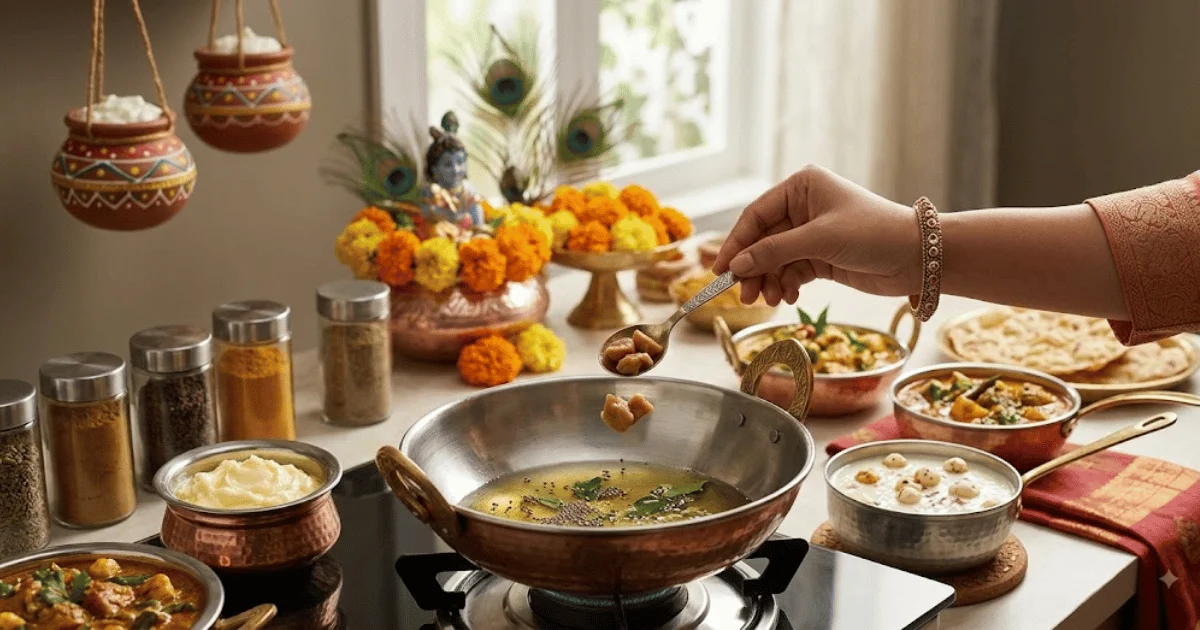
Hing for Janmashtami can be useful in suitable savory preparations when families prepare festive meals around the celebration. Janmashtami food traditions vary considerably between households and regions, especially because many families follow fasting or satvik-style food practices during the festival.
That makes ingredient selection more important than simply adding the same spices to every dish. Hing is a highly aromatic ingredient, so when it is permitted in a particular preparation, only a small amount may be required to create a noticeable flavor contribution.
For households, the focus should be on using Hing appropriately within the chosen recipe. For restaurants, caterers, food businesses, and large family gatherings, the focus should additionally include recipe consistency, product selection, dosage, storage, and advance ingredient planning.
Can Hing Be Used for Janmashtami Food?
Whether Hing is used during Janmashtami depends on the specific food tradition, fasting rules, and ingredients followed by the household or community.
There is no single Janmashtami menu followed throughout India. Some people observe strict fasting, while others prepare satvik meals or eat a regular vegetarian meal after the fasting period.
Therefore, Hing for Janmashtami should always be considered within the specific dietary practice being followed.
Why Hing Can Be Useful in Festive Cooking
Hing contributes a distinctive savory aroma to food. It is commonly used in small quantities during tempering and can work with ingredients such as cumin, ghee, oil, vegetables, lentils, and other suitable seasonings.
For a festive meal, the objective is to create a balanced aroma rather than make Hing the dominant flavor.
This is particularly important because Janmashtami meals can include several mild dishes where excessive Hing may overpower other ingredients.
Understanding Janmashtami Food Traditions
Janmashtami food varies from region to region.
Depending on the household, the celebration may include:
- Fasting foods
- Fruit-based preparations
- Dairy-based foods
- Potato preparations
- Sabudana dishes
- Singhara flour preparations
- Rajgira-based foods
- Regular vegetarian meals after fasting
- Festive snacks and sweets
Not every preparation is suitable for Hing, and not every fasting tradition permits the same ingredients.
Hing for Janmashtami Fasting Food
Fasting rules differ significantly between families and regions.
Some fasting traditions restrict grains, pulses, certain vegetables, common spices, or prepared foods. Others permit a wider selection of ingredients.
Therefore, Hing for Janmashtami should not automatically be added to every fasting recipe.
The correct approach is to first establish the dietary rules being followed and then determine whether Hing fits the preparation.
Why Fasting Rules Matter
Food prepared for religious observances should follow the requirements of the people consuming it.
A recipe may be perfectly acceptable as a regular vegetarian dish but unsuitable for a particular fasting tradition.
For this reason, ingredient selection should come before recipe modification.
Hing in Satvik Janmashtami Cooking
Some families prepare satvik food during religious celebrations.
Satvik cooking varies by tradition, so there is no universal ingredient list that applies to every household.
Where Hing is accepted, it can provide a savory aromatic layer in suitable preparations without requiring large quantities.
Hing in Potato Preparations
Potato-based dishes are common in many Indian fasting and festive food traditions.
Where the recipe permits Hing, a small amount can complement potato with cumin and other appropriate spices.
The quantity should remain controlled because potatoes can absorb seasoning while Hing can remain highly aromatic.
Hing With Cumin
Cumin and Hing are a familiar combination in Indian cooking.
When the ingredients are permitted in the preparation, they can create a warm and savory aroma.
For Hing for Janmashtami applications, the combination should be adapted to the specific food tradition rather than treated as a universal fasting seasoning.
Hing in Sabudana Preparations
Sabudana is commonly associated with fasting menus in many parts of India.
Whether Hing can be included depends on the fasting rules being followed.
When permitted, a very small quantity can be tested in a savory sabudana preparation to determine whether it complements the other ingredients.
Hing in Singhara Flour Preparations
Singhara flour is another ingredient used in various fasting recipes.
Some savory preparations made with fasting flours may use aromatic spices, but ingredient restrictions differ between traditions.
For commercial food preparation, the intended fasting standard should be clearly established before finalizing the formulation.
Hing in Rajgira-Based Foods
Rajgira is also used in several fasting preparations.
For savory versions, the seasoning profile can be kept simple.
If Hing is permitted, the ingredient should be evaluated in a small test batch before being used for a larger Janmashtami production run.
Hing for Janmashtami Savory Snacks
Not every Janmashtami celebration follows a strict fasting menu throughout the day.
Families may prepare savory snacks and regular vegetarian foods for visitors and relatives.
In these preparations, Hing for Janmashtami can be considered where the recipe and dietary requirements allow it.
How Much Hing Should You Use?
Hing is much more concentrated in aroma than many everyday spices.
As a result, the correct quantity is generally small and depends on the product, recipe, batch size, and desired sensory result.
It is better to start with a controlled amount and adjust after tasting than to add a large quantity immediately.
Why More Hing Does Not Mean Better Flavor
Using too much Hing can make a dish smell sharp or overpower the other ingredients.
A well-balanced dish should allow the Hing aroma to support the overall flavor rather than dominate it.
This principle becomes particularly important in festive cooking where several dishes may be served together.
How to Add Hing During Cooking
When the recipe permits Hing, it is commonly introduced during tempering.
A practical method is:
- Heat the cooking oil or ghee.
- Add suitable whole spices.
- Allow them to release their aroma.
- Reduce the flame.
- Add a small quantity of Hing.
- Immediately incorporate the tempering into the food.
Existing Hing cooking guidance on the site also emphasizes low-temperature addition because Hing can burn quickly when exposed to excessive heat. :contentReference[oaicite:1]{index=1}
Why Temperature Matters
Hing reacts quickly to heat.
Adding it to excessively hot oil can produce an unpleasant or bitter result instead of the desired warm aroma.
Controlled heat is therefore an important part of using Hing for Janmashtami cooking.
Hing With Ghee for Festive Cooking
Ghee is commonly used in many festive Indian preparations.
When Hing is permitted in a recipe, ghee can provide a suitable medium for releasing its aroma during tempering.
The amount of ghee should remain appropriate for the recipe, and the Hing should be added at a controlled temperature.
Hing With Oil
Neutral cooking oils can also be used when the recipe calls for them.
The important factor is not simply the choice of oil but the timing and temperature of the tempering.
A consistent method produces more predictable results.
Hing for Janmashtami Family Meals
Family gatherings can involve significantly more food than a normal weekday meal.
When a recipe is scaled for more people, it is important to maintain the same flavor balance.
Hing should therefore be scaled from a tested recipe instead of being estimated by adding extra pinches.
How to Scale Hing for a Large Family
Start with a standard recipe that has already been tested.
Calculate the ingredient quantities according to the number of servings, then prepare a controlled batch and taste it before serving.
If the aroma is too strong or too weak, make a documented adjustment for future batches.
Hing for Janmashtami Catering
Restaurants and caterers may receive additional orders around Janmashtami.
Large-volume production requires greater control over ingredient quantities because a small formulation difference can become significant when multiplied across many servings.
Caterers should therefore establish standardized recipes for recurring festive menus.
Why Caterers Need Consistent Hing
A customer ordering the same dish during different service periods expects a similar taste and aroma.
If Hing is measured differently in every batch, the sensory result can change.
Measured ingredients and standardized preparation procedures reduce this variation.
Hing for Janmashtami Food Businesses
Food businesses preparing seasonal products should consider ingredient supply before demand increases.
Restaurants, caterers, snack manufacturers, and packaged-food companies may require different Hing formats and quantities depending on their applications.
The appropriate product should be selected through application testing rather than simply choosing the strongest-smelling option.
Choosing Hing for Commercial Festive Production
Commercial buyers should evaluate:
- Product specification
- Physical format
- Aroma profile
- Dosage requirements
- Batch consistency
- Packaging
- Storage requirements
- Supply capacity
- Lead time
These factors become more important when the ingredient is being purchased for repeated production.
Hing Powder for Janmashtami Cooking
Hing Powder can be convenient for recipes where a fine ingredient needs to distribute evenly through the preparation.
It can be considered for suitable savory foods when permitted by the dietary practice being followed.
Moisture protection is important because powdered ingredients can change in physical condition when exposed to unsuitable storage conditions.
Compound Hing for Janmashtami Food Businesses
Compound Hing provides a practical format for many commercial food applications.
Its suitability depends on the product specification and the intended recipe.
Commercial buyers should test Compound Hing in the actual application before using it across a large production batch.
Hing Granules for Food Applications
Hing Granules can offer different handling and flow characteristics compared with fine powder.
The best format depends on the manufacturing process, mixing method, packaging, and intended application.
For commercial Janmashtami production, the chosen format should be validated before seasonal production begins.
Common Mistakes When Using Hing During Janmashtami
- Ignoring the fasting rules being followed
- Adding Hing automatically to every dish
- Using too much Hing
- Adding Hing to excessively hot oil
- Changing the Hing product immediately before a major event
- Scaling a recipe without testing
- Ignoring storage conditions
- Failing to standardize large-batch preparation
How to Prepare Better Janmashtami Food With Hing
- Identify the dietary rules being followed.
- Choose recipes where Hing is appropriate.
- Select a consistent Hing product.
- Use a tested recipe.
- Measure the ingredient carefully.
- Control the tempering temperature.
- Taste the preparation before final service.
- Record the successful formulation for future batches.
How to Store Hing Before Janmashtami
Hing should be kept in appropriate packaging and stored according to the product’s recommended conditions.
The container should remain properly closed when the ingredient is not being used.
For powdered products, avoiding unnecessary moisture exposure is especially important.
Why Advance Hing Planning Matters
Seasonal demand can increase suddenly for restaurants, caterers, snack businesses, and food manufacturers.
Ordering at the last minute can create unnecessary pressure on procurement teams.
Businesses with predictable Janmashtami production can estimate their ingredient requirements early and confirm supply before the peak period.
Hing for Janmashtami and Large-Scale Food Preparation
Large-scale preparation requires more than multiplying household recipes.
Cooking time, vessel size, mixing efficiency, ingredient distribution, and tasting procedures can all affect the final result.
Hing should therefore be treated as a controlled formulation ingredient when production volume increases.
Testing Hing Before a Festival Order
Food businesses planning seasonal production should test the selected Hing before placing a large commercial order.
A sample can be evaluated in the intended food application to determine aroma, flavor contribution, dosage, and compatibility.
This reduces the risk of discovering a formulation problem after large-scale production begins.
Why the Right Hing Supplier Matters
For recurring food production, supplier consistency can be as important as product selection.
A food business should know what specification it is purchasing and should be able to compare future batches against the approved product.
This becomes particularly important when a seasonal product is expected to generate repeat customer demand.
RB Industries for Commercial Hing Supply
RB Industries manufactures and supplies Asafoetida, Compound Hing, Hing Powder, and Hing Granules for food manufacturers, restaurants, caterers, wholesalers, distributors, retailers, FMCG businesses, private-label brands, and exporters.
Commercial buyers preparing for Janmashtami or other seasonal demand can discuss their application, product format, estimated quantity, packaging requirements, and expected supply schedule.
Where required, buyers can evaluate samples before moving to larger production quantities.
Planning Hing Supply for Janmashtami
Households generally need only small quantities of Hing, while restaurants, caterers, and food manufacturers may need substantially larger volumes.
The procurement strategy should therefore match the scale of food preparation.
For commercial buyers, advance planning can help ensure that the same approved product is available throughout the seasonal production period.
Conclusion
Hing for Janmashtami can be useful in suitable savory preparations when the ingredient fits the dietary tradition being followed. Because Janmashtami food practices vary between households, regions, and fasting traditions, the first step is always to establish which ingredients are permitted.
Where Hing is appropriate, a small quantity can contribute a distinctive savory aroma to suitable potato dishes, snacks, vegetables, and other preparations. Correct temperature and timing are equally important because Hing can become harsh when overheated.
For family meals, careful measurement and recipe consistency are usually sufficient. For restaurants, caterers, snack manufacturers, and food businesses, the process should also include product selection, application testing, batch consistency, storage, and advance procurement.
RB Industries supplies Asafoetida, Compound Hing, Hing Powder, and Hing Granules for commercial and bulk food applications. Businesses preparing for Janmashtami or other seasonal production can discuss their product requirements, estimated volumes, and packaging needs before finalizing their Hing supply.
Frequently Asked Questions
Can Hing be used in Janmashtami food?
It depends on the fasting or dietary tradition being followed. Some preparations may permit Hing while others may follow stricter ingredient restrictions, so the specific food practice should always be checked first.
What is the best way to use Hing for Janmashtami?
When Hing is permitted, it can be used in suitable savory preparations through controlled tempering. A small quantity added at an appropriate temperature can provide aroma without overpowering the dish.
How much Hing should be used in Janmashtami food?
There is no universal quantity because Hing strength and recipes vary. A tested recipe should be used as the starting point, with the quantity adjusted only after tasting the finished preparation.
Can Hing be used for large Janmashtami gatherings?
Yes, where the dietary rules permit it. Large batches should use standardized recipes and measured ingredients so the aroma remains consistent across the entire production.
Is Compound Hing suitable for commercial Janmashtami food production?
Compound Hing can be suitable for commercial applications when its specification matches the intended recipe. Food businesses should test the product in their actual formulation before committing to large-scale seasonal production.
Should restaurants order Hing before Janmashtami?
Restaurants and caterers expecting higher seasonal demand should plan ingredient requirements in advance. Early procurement allows time for product evaluation, quantity planning, and supply confirmation.

![Top 10 Global Recipes with Hing [Beyond Indian Cuisine]](https://www.asafoetida.co.in/wp-content/uploads/2025/09/ChatGPT-Image-Sep-3-2025-10_13_11-AM.webp "Top 10 Global Recipes with Hing [Beyond Indian Cuisine]")