
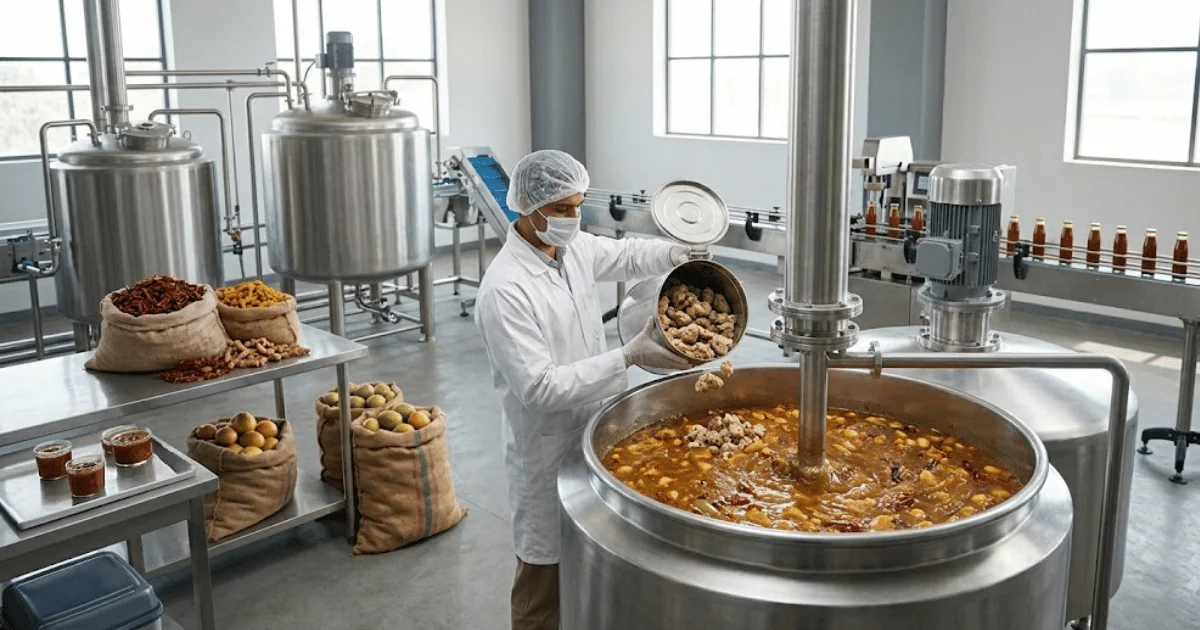
Hing in Chutney Manufacturing can contribute a distinctive savory aroma to suitable chutney and condiment formulations. Chutneys can contain strong ingredients such as chilli, spices, herbs, tamarind, lemon, garlic, ginger, vegetables, fruits, and other flavor components. A controlled amount of Hing can help create greater aromatic depth when it fits the intended recipe.
For home cooking, Hing is usually added in very small quantities. Commercial chutney manufacturing requires a more controlled approach because the ingredient must perform consistently across production batches, packaging formats, storage conditions, and different product formulations.
Manufacturers therefore need to evaluate more than aroma alone. Product format, dosage, mixing, processing conditions, storage, packaging, supplier consistency, and repeat availability can all influence the final result.
Why Hing Is Used in Chutney Manufacturing
The main reason manufacturers consider Hing in Chutney Manufacturing is its ability to contribute a recognizable savory aroma.
Chutneys often combine multiple strong ingredients, and the seasoning system needs to remain balanced. Hing can complement selected spice profiles without becoming the dominant flavor.
Its concentrated aromatic character also means manufacturers can work with relatively small quantities.
However, the correct dosage should always be established through formulation testing rather than assumed from another product.
What Makes Chutney Formulation Different?
Chutneys are not a single food category.
They can be fresh, cooked, fermented, dry, wet, refrigerated, shelf-stable, sweet, spicy, tangy, or designed as a dipping condiment.
Each formulation can behave differently when Hing is introduced.
For this reason, Hing in Chutney Manufacturing should be evaluated within the complete formulation rather than treated as an isolated ingredient.
Which Chutneys Can Use Hing?
Hing may be considered in suitable savory chutney formulations such as:
- Spicy chutneys
- Tomato-based chutneys
- Tamarind chutneys
- Coconut-based savory chutneys
- Mint and herb chutneys
- Chilli chutneys
- Vegetable chutneys
- Dry chutney powders
- Seasoning-based chutney mixes
The appropriate application depends on the recipe and the desired flavor profile.
Hing in Tomato Chutney
Tomato chutneys often combine acidity, chilli, spices, herbs, and other aromatic ingredients.
A small quantity of Hing can complement the savory side of the formulation when the recipe requires it.
Because tomato already has a distinctive flavor, the Hing should remain balanced with acidity and spice.
Hing in Tamarind Chutney
Tamarind contributes a strong sour character that can dominate a chutney if the formulation is not balanced properly.
When suitable, Hing can contribute an additional savory aromatic layer.
Manufacturers should test the ingredient after the complete formulation has been prepared because acidity, sweetness, chilli, and other spices can change the perceived intensity of Hing.
Hing in Coconut Chutney
Coconut-based chutneys already have a distinctive aroma and creamy flavor.
Where the recipe permits it, Hing can be used in a controlled quantity alongside other seasoning ingredients.
The dosage should remain low enough that the coconut and other primary ingredients remain recognizable.
Hing in Mint and Herb Chutneys
Mint, coriander, and other herbs can create fresh aromatic profiles.
Adding too much Hing to such formulations can overpower the fresh character of the herbs.
For Hing in Chutney Manufacturing, this makes application testing especially important for herb-forward products.
Hing in Chilli Chutneys
Chilli-based chutneys already contain strong heat and aroma.
Hing can be considered where the formulation requires additional savory depth.
The correct dosage depends on the chilli variety, other spices, acidity, sweetness, and processing method.
Hing in Dry Chutney Powders
Dry chutney powders require a different approach because the finished product is usually a dry seasoning system.
Hing may be incorporated directly into the powder blend.
Uniform mixing becomes critical because uneven distribution can result in some portions having a noticeably stronger aroma than others.
How Much Hing Is Used in Chutney Manufacturing?
There is no universal dosage for every chutney.
The correct amount depends on:
- Hing concentration
- Product format
- Chutney formulation
- Batch size
- Other seasoning ingredients
- Processing conditions
- Desired aroma intensity
Manufacturers should establish dosage through controlled product trials.
Once the formulation is approved, the dosage should be documented and reproduced consistently.
Why Excessive Hing Can Affect Chutney Flavor
Hing has a powerful aroma.
Excessive use can overpower chilli, herbs, coconut, tomato, tamarind, garlic, ginger, or other ingredients.
The objective should therefore be flavor integration rather than maximum Hing intensity.
A well-formulated chutney should allow customers to experience the complete seasoning profile.
How to Test Hing in Chutney Manufacturing
A practical product-development test can begin with several small batches.
For example, a manufacturer can prepare the same base formulation with different controlled levels of Hing.
The samples can then be evaluated for:
- Aroma
- Taste
- Aftertaste
- Overall balance
- Compatibility with acidity
- Compatibility with chilli
- Flavor after processing
- Flavor after storage
The best-performing formulation can then become the reference batch.
Why Application Testing Matters
Evaluating Hing only by smelling the raw ingredient does not provide enough information for commercial formulation.
The product needs to be tested in the actual chutney.
Processing can change how aroma is perceived, and other ingredients can either strengthen or reduce the apparent Hing contribution.
This is why Hing in Chutney Manufacturing should be approved through finished-product evaluation.
Hing Powder for Chutney Production
Hing Powder can be useful where a fine ingredient needs to disperse evenly through a chutney formulation or dry seasoning blend.
The particle characteristics and product formulation can affect how easily it mixes.
Manufacturers should therefore test the powder using their actual mixing equipment and production process.
Compound Hing for Chutney Manufacturers
Compound Hing can provide a practical option for commercial food manufacturing.
Its controlled formulation and handling characteristics can make it suitable for applications where manufacturers need predictable dosing.
However, the correct Compound Hing specification should be selected according to the chutney formulation.
Hing Granules for Chutney Applications
Hing Granules have different physical characteristics from fine powder.
Depending on the manufacturing system, this can influence handling, storage, dosing, and mixing.
Manufacturers should determine whether granules fit their production process before approving them for regular use.
Hing in Chutney Seasoning Blends
Some commercial chutney products are produced from dry seasoning systems that are later mixed with other ingredients.
In these formulations, Hing becomes one component within a broader spice blend.
Its dosage should therefore be calculated in relation to the complete seasoning system.
Why Mixing Consistency Matters
Uneven mixing can create significant flavor differences between finished units.
If Hing is concentrated in one section of a seasoning blend, some packets may contain stronger aroma than others.
Manufacturers should validate their mixing time, ingredient sequence, equipment, and batch size.
Hing and Chutney Processing
Processing conditions can influence the final aroma of a chutney.
Heating, cooking time, blending, cooling, and storage can all change the way aromatic ingredients are perceived.
For this reason, manufacturers should evaluate Hing after the actual production process rather than only before processing.
Hing and Chutney Heating
If Hing is introduced through tempering, temperature control becomes important.
Excessive heat can affect the desired aroma.
A controlled process can help integrate the ingredient more effectively into the seasoning system.
Hing in Cold Chutney Formulations
Not every chutney is cooked or tempered.
Some fresh formulations may be blended or mixed without prolonged heating.
In these products, the raw characteristics of the Hing product can become more noticeable, making dosage and product selection particularly important.
Hing and Chutney Shelf Life
Manufacturers should evaluate the complete product rather than assuming that Hing alone determines shelf life.
Packaging, moisture, acidity, processing, microbial controls, storage temperature, and the complete formulation all influence finished-product stability.
Hing can contribute to the sensory profile, but shelf-life validation should be conducted for the complete chutney.
Hing and Packaged Chutneys
Packaged chutneys need to maintain their intended aroma and flavor throughout their expected shelf life.
This makes ingredient consistency important.
A product that performs well immediately after manufacturing should also be evaluated after the planned storage period.
Why Aroma Stability Matters
Aroma is one of the first sensory characteristics consumers notice.
If the chutney loses its intended aromatic profile during storage, the finished product may no longer provide the same experience.
Manufacturers should therefore evaluate the Hing contribution at multiple stages of the product’s shelf life.
Choosing the Right Hing Supplier
Commercial chutney manufacturers need more than a one-time ingredient purchase.
They require dependable supply, consistent product characteristics, suitable packaging, and support for repeat production.
The supplier should be able to understand the intended application and commercial quantity.
What Chutney Manufacturers Should Check
- Product consistency
- Aroma profile
- Product format
- Dosage performance
- Packaging
- Storage requirements
- Batch consistency
- Supply capacity
- Lead time
- Quality documentation
These factors can help manufacturers select an ingredient supplier based on production requirements rather than price alone.
Why Consistency Matters in Chutney Brands
Consumers expect a branded chutney to taste the same every time they purchase it.
If the Hing contribution changes between batches, the overall seasoning profile can change as well.
Maintaining a consistent Hing specification helps manufacturers protect their product identity.
Creating a Reference Batch
A manufacturer can maintain an approved reference sample of the finished chutney.
Future production batches can then be compared against the reference for aroma and flavor consistency.
This approach can help identify formulation or ingredient changes before the product reaches consumers.
Hing for Private-Label Chutney Brands
Private-label food brands may outsource chutney production while controlling their own product specifications and packaging.
For these businesses, ingredient consistency remains important because the same branded product may be manufactured repeatedly.
The approved Hing specification should therefore form part of the production documentation.
Hing for FMCG Chutney Manufacturers
FMCG manufacturers may produce large quantities of chutney across several product lines.
Different recipes may require different Hing levels.
Each formulation should therefore be tested independently rather than using one standard dosage for every product.
Hing for Restaurant Chutney Production
Restaurants may prepare fresh chutneys daily or in larger batches for multiple outlets.
A standardized Hing dosage can help maintain the same flavor profile across production cycles.
For multi-location restaurant businesses, documented recipes become even more valuable.
Hing for Chutney Export Products
Food brands exporting chutneys need to consider the requirements of their destination market.
Ingredient specifications, labeling, packaging, documentation, and regulatory requirements may vary by market.
The Hing supplier should be informed about the intended destination before finalizing the commercial product.
Bulk Hing Procurement for Chutney Manufacturers
Commercial chutney producers should estimate their expected Hing consumption before production begins.
Procurement planning should consider current production, expected growth, seasonal demand, packaging requirements, and lead time.
Buying too little can create production pressure, while buying excessive quantities without proper storage can create unnecessary inventory risk.
Why Sample Approval Should Come First
Before placing a large commercial order, manufacturers should evaluate a sample in the actual chutney formulation.
This allows the product-development team to confirm aroma, dosage, mixing behavior, and finished-product performance.
Once approved, the same specification can be used for repeat procurement.
Common Mistakes When Using Hing in Chutney Manufacturing
- Choosing Hing only by raw aroma
- Using excessive dosage
- Using the same dosage for every chutney
- Ignoring mixing consistency
- Changing the Hing product between batches
- Skipping application testing
- Ignoring storage conditions
- Buying without confirming supply capacity
How to Improve Chutney Formulation Consistency
- Define the target flavor profile.
- Select the appropriate Hing format.
- Test several controlled dosages.
- Evaluate the finished chutney.
- Approve the best-performing formulation.
- Document the Hing specification.
- Standardize the mixing process.
- Monitor finished-product consistency.
- Review incoming batches before production.
Why Commercial Buyers Should Think Beyond Price
The lowest Hing price does not necessarily provide the lowest total production cost.
If inconsistent aroma forces manufacturers to change dosage, adjust formulations, or handle customer complaints, the apparent saving can disappear.
Commercial buyers should therefore consider product performance, consistency, supply reliability, packaging, and total operational value.
RB Industries for Chutney Manufacturing
RB Industries manufactures and supplies Asafoetida, Compound Hing, Hing Powder, and Hing Granules for food manufacturers, FMCG brands, restaurants, caterers, wholesalers, distributors, private-label businesses, and exporters.
Chutney manufacturers can discuss their intended application, preferred Hing format, expected quantity, packaging requirements, and production schedule.
Commercial buyers can evaluate samples in their own chutney formulations before moving to larger quantities.
Planning Hing Supply for Chutney Production
Growing chutney brands should estimate their ingredient requirements before production volumes increase.
Forecasting monthly consumption helps procurement teams plan repeat orders and reduce the risk of last-minute sourcing.
It also gives manufacturers enough time to evaluate incoming batches before they enter production.
Conclusion
Hing in Chutney Manufacturing can provide a distinctive savory aromatic layer to suitable tomato, tamarind, coconut, chilli, herb, vegetable, and dry chutney formulations. Because chutneys contain many strong ingredients, the key is not maximum Hing intensity but proper balance.
Commercial manufacturers should establish the right dosage through application testing and then maintain the approved formulation across production batches. Product format, mixing, processing, storage, packaging, and supplier consistency can all influence the final result.
For growing chutney brands, restaurants, FMCG manufacturers, and private-label businesses, advance procurement and supplier evaluation can reduce production uncertainty. A consistent Hing specification can also help protect the recognizable flavor profile of a branded chutney.
RB Industries supplies Asafoetida, Compound Hing, Hing Powder, and Hing Granules for commercial food applications. Chutney manufacturers can discuss their formulation, expected quantity, preferred product format, packaging, and supply requirements to develop a suitable Hing sourcing plan.
Frequently Asked Questions
Why is Hing used in chutney manufacturing?
Hing can provide a distinctive savory aroma and complement selected spice systems in chutneys. The correct amount depends on the formulation and should be established through product testing.
Which chutneys can use Hing?
Depending on the recipe, Hing can be used in suitable tomato, tamarind, coconut, chilli, herb, vegetable, and dry chutney formulations. Not every chutney requires Hing.
How much Hing should chutney manufacturers use?
There is no universal dosage because Hing products and chutney formulations vary. Manufacturers should test controlled quantities and approve the dosage that produces the desired finished-product profile.
Which Hing format is suitable for chutney manufacturing?
Hing Powder, Compound Hing, and Hing Granules can serve different applications. The appropriate format depends on the formulation, mixing process, production equipment, and desired result.
Should chutney manufacturers test Hing before bulk purchasing?
Yes. Application testing allows manufacturers to evaluate aroma, dosage, mixing, processing performance, and finished-product quality before committing to larger quantities.
Can RB Industries supply Hing for commercial chutney production?
Yes. RB Industries supplies Asafoetida, Compound Hing, Hing Powder, and Hing Granules for commercial food businesses. Manufacturers can discuss their application and bulk requirements with the supplier.