
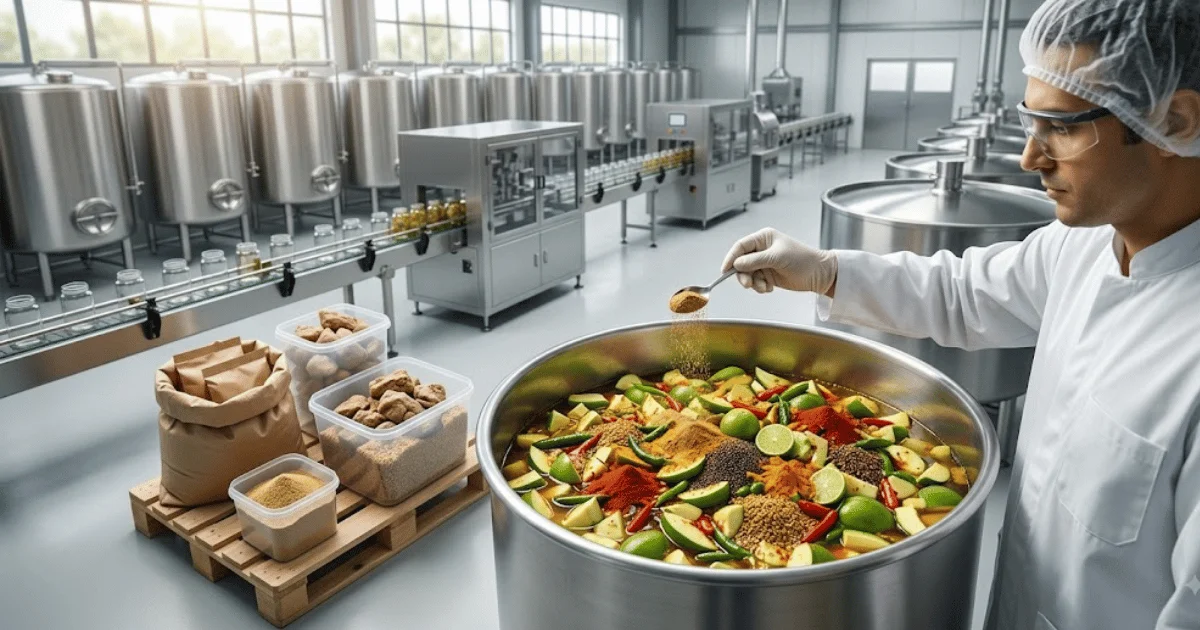
Hing in Pickle Manufacturing can contribute a distinctive savory aroma to suitable pickle formulations. Pickles often contain strong ingredients such as mustard, chilli, spices, oil, salt, vinegar, lemon, tamarind, ginger, garlic, vegetables, or fruits. When used correctly, Hing can complement these ingredients and add another layer to the finished flavor profile.
Commercial pickle production requires much more control than household preparation. Manufacturers need to maintain consistent ingredient quantities, processing conditions, mixing procedures, packaging, and storage practices across production batches.
For this reason, selecting Hing for commercial pickle production should involve application testing rather than simply choosing a product based on its raw aroma or price.
Why Is Hing Used in Pickle Manufacturing?
The main reason manufacturers consider Hing in Pickle Manufacturing is its strong savory aromatic character.
Pickles already contain several intense ingredients, so Hing should work as part of the overall seasoning system.
A controlled quantity can complement spices and acidic ingredients without overpowering them.
The objective is to achieve a consistent finished-product profile rather than simply creating a stronger Hing aroma.
What Makes Pickle Formulation Different?
Pickles are produced using many different recipes and processing methods.
Some are oil-based, while others rely more heavily on vinegar, lemon juice, tamarind, salt, spices, or other preservation systems.
Pickles can also be made from mango, lemon, chilli, ginger, garlic, mixed vegetables, and other ingredients.
Because the formulations vary so widely, Hing in Pickle Manufacturing should always be evaluated within the complete recipe.
Which Pickles Can Use Hing?
Depending on the formulation, Hing can be considered for:
- Mango pickles
- Lemon pickles
- Chilli pickles
- Mixed vegetable pickles
- Ginger pickles
- Garlic pickles
- Tamarind-based pickles
- Spiced vegetable pickles
- Regional savory pickle formulations
Not every pickle requires Hing. The ingredient should be included only when it supports the intended flavor profile.
Hing in Mango Pickle Manufacturing
Mango pickle is one of the most recognized Indian pickle categories.
Its formulation can include raw mango, mustard, chilli, salt, oil, fenugreek, spices, and other ingredients.
Where the recipe calls for it, Hing can complement the strong spice profile.
Because mango pickle already has a powerful combination of sour, salty, spicy, and aromatic notes, the Hing dosage needs to remain controlled.
Hing in Lemon Pickle Manufacturing
Lemon pickles have a distinctive acidic and citrus character.
Hing can provide a savory aromatic layer in formulations where it is appropriate.
Manufacturers should evaluate the finished product because acidity and other spices can influence how the Hing aroma is perceived.
Hing in Chilli Pickle Manufacturing
Chilli pickles can contain significant levels of heat and spice.
Adding Hing to such formulations requires careful balancing.
Too much Hing can compete with the chilli aroma instead of supporting it.
Controlled application testing helps identify the appropriate level.
Hing in Mixed Vegetable Pickles
Mixed vegetable pickles can contain several ingredients with different textures and flavors.
Hing can be considered as part of the seasoning system where the recipe permits it.
The manufacturer should ensure that the ingredient is distributed evenly throughout the batch.
Hing in Ginger and Garlic Pickles
Ginger and garlic already provide strong aromatic characteristics.
When Hing is added, the formulation needs particularly careful sensory evaluation.
The objective should be to create a balanced seasoning profile rather than adding multiple strong aromas at high levels.
How Much Hing Should Be Used in Pickle Manufacturing?
There is no universal dosage for every pickle formulation.
The appropriate quantity depends on:
- Hing concentration
- Product format
- Pickle ingredients
- Batch size
- Acidity
- Salt level
- Spice intensity
- Processing method
- Desired aroma profile
Manufacturers should determine the dosage through controlled formulation trials.
Once approved, the quantity should become part of the documented production specification.
Why Too Much Hing Can Affect Pickle Flavor
Hing has a concentrated aroma.
Excessive use can overpower mustard, chilli, lemon, mango, ginger, garlic, and other ingredients.
This can make the finished pickle taste different from the intended recipe.
The goal should therefore be aromatic balance rather than maximum Hing intensity.
How to Test Hing in Pickle Manufacturing
A manufacturer can prepare several small trial batches using the same base pickle formulation.
Each trial can contain a controlled level of Hing.
The samples can then be evaluated for:
- Initial aroma
- Flavor
- Aftertaste
- Spice balance
- Acidity balance
- Oil compatibility
- Overall sensory profile
- Flavor after storage
The strongest formulation is not necessarily the one with the most Hing. The preferred formulation is the one that provides the desired finished-product profile.
Why Application Testing Matters
Raw Hing aroma alone cannot determine commercial performance.
The ingredient must be evaluated after it has been incorporated into the actual pickle formulation.
Acidity, oil, salt, chilli, spices, and processing conditions can all influence the final perception.
For Hing in Pickle Manufacturing, finished-product testing is therefore more meaningful than a simple raw-ingredient smell test.
Hing Powder for Pickle Production
Hing Powder can be useful when a fine ingredient needs to distribute evenly through a pickle seasoning system.
Its physical characteristics can affect mixing and dispersion.
Manufacturers should test the selected powder using their actual production equipment before approving it for regular manufacturing.
Compound Hing for Pickle Manufacturers
Compound Hing can provide a practical format for commercial food manufacturers.
Its suitability depends on the product formulation and intended application.
Manufacturers should confirm that the selected Compound Hing performs consistently in their pickle recipe before moving to larger production quantities.
Hing Granules for Commercial Pickle Applications
Hing Granules have different physical characteristics compared with fine powder.
Depending on the production process, granules may offer different handling and dosing characteristics.
The right format should be selected according to the manufacturing system and finished-product requirements.
Hing and Pickle Spice Blends
Many commercial pickles use pre-designed spice blends.
In such formulations, Hing becomes one part of a larger seasoning system.
The dosage should therefore be considered alongside mustard, chilli, fenugreek, cumin, coriander, turmeric, salt, and other ingredients.
Changing one ingredient can affect the balance of the entire blend.
Why Mixing Consistency Matters
Uniform ingredient distribution is important in commercial pickle production.
If Hing becomes concentrated in one section of a batch, the final jars may not have the same aroma.
Manufacturers should establish a repeatable mixing procedure and validate it during product development.
Hing and Oil-Based Pickles
Oil-based pickles can provide a suitable environment for aromatic ingredients to distribute through the formulation.
However, the exact behavior depends on the recipe, processing conditions, and ingredient format.
Manufacturers should evaluate the finished product rather than assuming that every Hing format will perform identically in oil-based systems.
Hing in Acidic Pickle Formulations
Acidic pickles can contain lemon juice, vinegar, tamarind, or other acidic components.
These ingredients contribute strong sensory characteristics.
When using Hing, manufacturers should evaluate how the aromatic profile interacts with the acidity and other spices.
Hing and Pickle Processing
Processing conditions can influence the final sensory characteristics of a pickle.
Heating, mixing, maturation, cooling, and storage can all affect how aromatic ingredients are perceived.
For this reason, a Hing formulation should be evaluated after the actual production process.
Hing and Pickle Maturation
Some pickles develop their characteristic flavor over time.
This means a formulation that tastes balanced immediately after production may change during maturation.
Manufacturers should therefore evaluate Hing contribution at appropriate points during the product’s development and storage period.
Why Aroma Stability Matters
Pickle consumers expect the product to retain its characteristic aroma throughout its usable life.
If the aromatic profile changes significantly during storage, the product may no longer match the approved reference sample.
Ingredient quality, packaging, storage conditions, and the complete formulation all need to be considered.
Hing and Packaged Pickles
Commercially packaged pickles need to maintain consistent sensory quality across thousands of units.
The selected Hing product should therefore be compatible with the complete packaging and storage system.
Manufacturers should evaluate the product not only immediately after filling but also during shelf-life testing.
Choosing the Right Hing Supplier
Commercial pickle manufacturers need reliable ingredient supply rather than a one-time purchase.
Important considerations include product consistency, batch-to-batch performance, packaging, documentation, supply capacity, and lead time.
A supplier should also understand the intended application and expected commercial volume.
What Pickle Manufacturers Should Check
- Product specification
- Aroma profile
- Hing format
- Dosage performance
- Batch consistency
- Packaging
- Storage conditions
- Supply capacity
- Lead time
- Quality documentation
These factors can help manufacturers select suppliers based on total production value rather than price alone.
Why Consistency Matters for Pickle Brands
A branded pickle should provide a recognizable flavor profile every time a customer opens a jar.
If the Hing level changes between production batches, the overall aroma can change as well.
Maintaining an approved Hing specification can help manufacturers protect product consistency.
Creating a Reference Batch
Manufacturers can maintain an approved reference batch of the finished pickle.
Future production can then be compared against this reference for aroma, taste, texture, and overall sensory characteristics.
This can help identify unexpected changes in raw materials or processing before large quantities are released.
Hing for Private-Label Pickle Brands
Private-label brands may outsource pickle manufacturing while maintaining control over their product specifications.
For these businesses, consistent ingredient sourcing is particularly important because the same branded product may be manufactured repeatedly.
The approved Hing specification should form part of the manufacturing documentation.
Hing for FMCG Pickle Manufacturers
FMCG manufacturers may operate multiple pickle varieties and package sizes.
Different recipes may require different Hing levels.
Each formulation should therefore be tested independently rather than applying one standard dosage across every pickle.
Hing for Restaurant Pickle Production
Restaurants may prepare pickles for in-house service or packaged retail sales.
A standardized Hing dosage can help maintain the same flavor profile across production batches.
This becomes even more important when the same pickle is prepared across multiple outlets.
Hing for Export Pickle Products
Brands exporting Indian pickles need to consider the requirements of their destination markets.
Ingredient declarations, packaging, labeling, documentation, and regulatory requirements can vary by market.
Manufacturers should communicate the intended destination to their ingredient suppliers when planning export-oriented production.
Bulk Hing Procurement for Pickle Manufacturers
Commercial pickle producers should estimate Hing consumption before production begins.
Procurement planning should consider current production, seasonal demand, future growth, packaging requirements, and expected lead time.
Advance planning provides more time for product testing and approval.
Why Sample Approval Should Come First
Before placing a large order, manufacturers should evaluate a Hing sample in the actual pickle formulation.
This allows the product-development team to confirm aroma, dosage, mixing, processing performance, and finished-product quality.
Once the formulation is approved, the same specification can be used for repeat procurement.
Common Mistakes When Using Hing in Pickle Manufacturing
- Choosing Hing only by raw aroma
- Using excessive dosage
- Using the same dosage for every pickle
- Ignoring spice balance
- Failing to test after maturation
- Changing the Hing product between batches
- Skipping application testing
- Ignoring storage conditions
- Buying without confirming supply capacity
How to Improve Pickle Formulation Consistency
- Define the target flavor profile.
- Select the appropriate Hing format.
- Conduct controlled dosage trials.
- Evaluate the complete pickle formulation.
- Test the product after processing and maturation.
- Approve the final formulation.
- Document the Hing specification.
- Standardize mixing and processing.
- Monitor incoming Hing batches.
Why Commercial Buyers Should Think Beyond Price
The cheapest Hing may not always provide the lowest total production cost.
If inconsistent aroma forces a manufacturer to change dosage, reformulate products, or handle customer complaints, the initial price advantage can disappear.
Commercial buyers should therefore consider product consistency, application performance, packaging, supply reliability, and repeat-order capability.
RB Industries for Pickle Manufacturing
RB Industries manufactures and supplies Asafoetida, Compound Hing, Hing Powder, and Hing Granules for food manufacturers, FMCG brands, restaurants, caterers, wholesalers, distributors, private-label businesses, and exporters.
Pickle manufacturers can discuss their intended application, preferred Hing format, expected quantity, packaging requirements, and production schedule.
Commercial buyers can evaluate samples in their own pickle formulations before moving to larger quantities.
Planning Hing Supply for Pickle Production
Growing pickle brands should estimate their Hing requirements before production volumes increase.
Forecasting monthly consumption helps procurement teams plan repeat orders and reduce last-minute sourcing pressure.
It also provides enough time to evaluate incoming batches before they enter production.
Conclusion
Hing in Pickle Manufacturing can contribute a distinctive savory aroma to suitable mango, lemon, chilli, mixed vegetable, ginger, garlic, and other pickle formulations. Because pickles already contain strong ingredients, the key is balance rather than simply increasing the amount of Hing.
Commercial manufacturers should establish the appropriate dosage through application testing and then maintain the approved formulation across production batches. Product format, mixing, processing, maturation, packaging, storage, and supplier consistency can all influence the final result.
For growing pickle brands, restaurants, FMCG manufacturers, and private-label businesses, advance procurement and supplier evaluation can reduce production uncertainty. A consistent Hing specification can also help protect the recognizable flavor profile of a branded pickle.
RB Industries supplies Asafoetida, Compound Hing, Hing Powder, and Hing Granules for commercial food applications. Pickle manufacturers can discuss their formulation, expected quantity, preferred product format, packaging, and supply requirements to develop a suitable Hing sourcing plan.
Frequently Asked Questions
Why is Hing used in pickle manufacturing?
Hing can provide a distinctive savory aroma and complement selected spice systems in pickles. The correct amount depends on the complete formulation and should be established through product testing.
Which pickles can use Hing?
Depending on the recipe, Hing can be considered for mango, lemon, chilli, mixed vegetable, ginger, garlic, and other savory pickle formulations. Not every pickle requires Hing.
How much Hing should pickle manufacturers use?
There is no universal dosage because Hing products and pickle formulations vary. Manufacturers should test controlled quantities and approve the level that produces the desired finished-product profile.
Which Hing format is suitable for pickle manufacturing?
Hing Powder, Compound Hing, and Hing Granules can serve different commercial applications. The appropriate format depends on the recipe, mixing process, production equipment, and desired result.
Should pickle manufacturers test Hing before bulk purchasing?
Yes. Application testing allows manufacturers to evaluate aroma, dosage, mixing, processing, maturation, and finished-product performance before committing to larger quantities.
Can RB Industries supply Hing for commercial pickle production?
Yes. RB Industries supplies Asafoetida, Compound Hing, Hing Powder, and Hing Granules for commercial food businesses. Manufacturers can discuss their application and bulk requirements for suitable supply planning.