
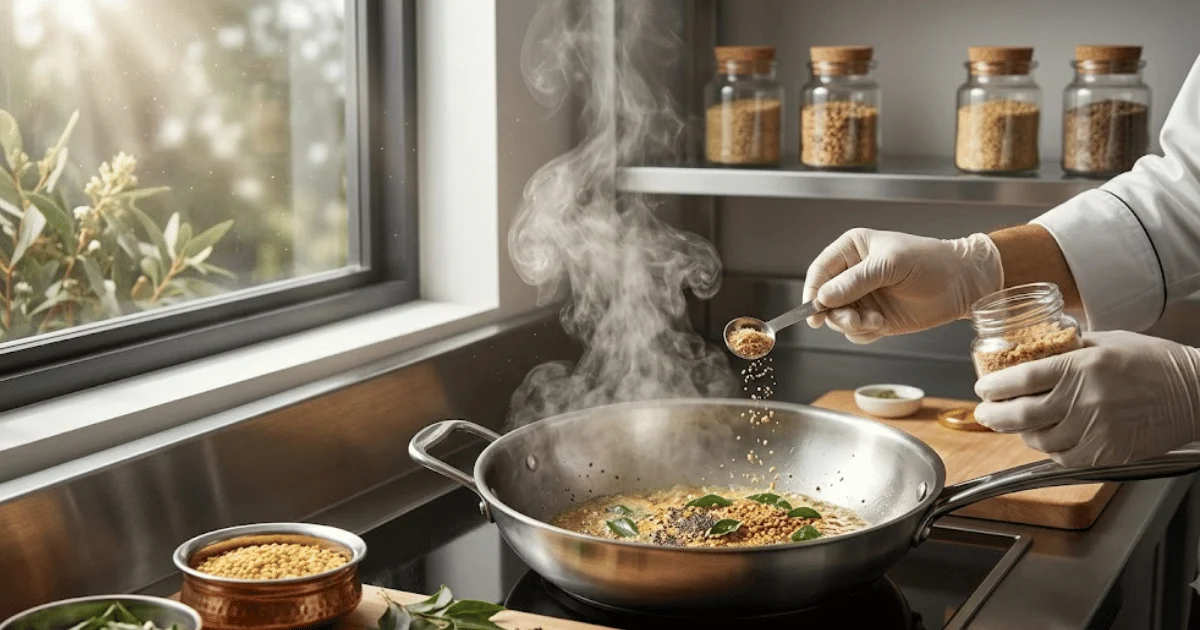
Aroma Stability in Compound Hing is an important consideration for food manufacturers, seasoning companies, restaurants, distributors, retailers, and exporters. Compound Hing is valued for its characteristic Asafoetida aroma, but maintaining that aroma consistently requires attention to formulation, packaging, storage, handling, processing, and batch quality.
A Compound Hing product may have the right sensory profile when manufactured but perform differently if it is exposed to excessive heat, moisture, air, or unsuitable storage conditions. For commercial buyers, this means aroma stability should be considered throughout the complete supply chain rather than only at the time of purchase.
Understanding Aroma Stability in Compound Hing can help businesses select appropriate products, establish storage procedures, evaluate incoming batches, and maintain consistent flavor performance in finished foods.
What Is Aroma Stability in Compound Hing?
Aroma stability refers to the ability of a Compound Hing product to maintain its expected aromatic characteristics over time and under normal handling conditions.
For Compound Hing, this can involve maintaining:
- Characteristic Asafoetida aroma
- Expected aroma intensity
- Clean sensory character
- Consistent batch profile
- Suitable performance during food preparation
Aroma stability does not mean that the product remains completely unchanged forever. Like other aromatic food ingredients, Compound Hing can be affected by environmental and processing conditions.
Why Aroma Matters in Compound Hing
Aroma is one of the primary reasons food manufacturers use Hing.
It can contribute a distinctive savory and pungent character to traditional and modern food products.
If the expected aroma is significantly reduced, the manufacturer may need to adjust dosage or reformulate the product.
Consistent aroma therefore has direct commercial importance.
Why Compound Hing Needs Aroma Protection
Compound Hing contains Asafoetida as part of a formulated product.
The finished product may also contain carriers or other ingredients according to its specification.
Because the sensory profile depends on the formulation, storage and handling conditions can influence how the final product performs.
Protecting the product from unnecessary environmental exposure is therefore an important part of quality management.
What Factors Affect Aroma Stability in Compound Hing?
Several factors can influence aroma stability.
- Temperature
- Moisture
- Air exposure
- Packaging
- Storage duration
- Physical form
- Handling
- Processing conditions
- Batch consistency
These factors can interact with each other, so commercial storage should be managed as a complete system.
Temperature and Compound Hing Aroma
Temperature can influence aromatic ingredients.
Repeated exposure to high temperatures can affect the sensory characteristics of Compound Hing over time.
This is why storage areas should be protected from unnecessary heat.
Keeping Hing away from direct sunlight, hot machinery, and high-temperature storage locations can help maintain product quality.
Why Direct Sunlight Should Be Avoided
Direct sunlight can increase the temperature of packaging and expose the product to unnecessary environmental stress.
For aromatic food ingredients, stable storage conditions are preferable to repeated temperature fluctuations.
Commercial warehouses should therefore store Compound Hing in suitable areas rather than next to heat-generating equipment or exposed loading zones.
Moisture and Aroma Stability
Moisture is another important factor.
Compound Hing should be protected from excessive humidity and direct contact with water.
Moisture can affect physical properties such as flow and texture and may also influence how the product’s aroma is perceived.
Proper packaging and dry storage help reduce unnecessary moisture exposure.
Why Humidity Matters
High-humidity environments can create problems for powdered and granulated food ingredients.
Moisture can contribute to clumping, reduced flow, and changes in physical condition.
For Compound Hing, these changes can also make dosing and mixing less predictable.
Air Exposure and Compound Hing
Air exposure can influence aromatic ingredients over time.
Every time a container is opened, the product is exposed to the surrounding environment.
Repeated opening and closing can therefore be less desirable than keeping the product properly sealed between uses.
Why Tight Sealing Matters
A well-sealed package helps reduce unnecessary exposure to air and moisture.
This is particularly important for strong aromatic ingredients because packaging needs to help protect the product while also managing aroma transfer.
Commercial buyers should follow the storage recommendations supplied for the specific product.
Packaging and Aroma Stability
Packaging is a critical part of maintaining product quality.
The right packaging can help protect Compound Hing from:
- Moisture
- Air
- External odors
- Physical contamination
- Environmental exposure
The appropriate packaging depends on product format, quantity, transportation conditions, storage duration, and market requirements.
Why Bulk Packaging Requires Attention
Bulk Compound Hing can remain in storage for longer periods before being consumed or incorporated into production.
This makes packaging and warehouse conditions particularly important.
Large commercial containers should be properly closed after use and stored according to the product’s recommended conditions.
Compound Hing Aroma During Transportation
Transportation can expose food ingredients to changing temperatures and environmental conditions.
Long-distance transportation may involve warehouses, trucks, shipping containers, and distribution centers.
Protective packaging and appropriate logistics help reduce unnecessary exposure.
Why Export Shipments Need Extra Planning
Export shipments can spend significant time in transit.
Temperature, humidity, packaging integrity, handling, and storage at intermediate locations can all affect the condition of the product.
Export buyers should therefore confirm packaging and storage requirements before shipment.
Aroma Stability and Shelf Life
Shelf life represents the period during which a product is expected to remain suitable under specified storage conditions.
Aroma stability is one component of that broader quality consideration.
A product should be stored according to its specified conditions rather than assuming that shelf life remains unchanged under every environment.
Why Shelf Life and Aroma Stability Are Related
An aromatic ingredient can remain physically usable while experiencing a change in sensory intensity.
This is why food manufacturers may include sensory evaluation in their quality programs.
The objective is not simply to determine whether the product still exists in the container, but whether it continues to perform as expected.
How Storage Time Can Affect Aroma
Storage duration can influence sensory characteristics, particularly when environmental conditions are not well controlled.
Long storage combined with heat, moisture, or repeated air exposure can create greater risk of quality changes.
Good inventory management can help reduce unnecessary storage periods.
First-In, First-Out Inventory
Food manufacturers and distributors can use FIFO inventory practices to manage stock efficiently.
Under FIFO, older approved stock is generally used before newer stock.
This can help prevent unnecessary ageing caused by products remaining unused at the back of a warehouse.
Why Inventory Rotation Matters for Hing
Hing is an aromatic ingredient, so unnecessary long-term storage is not ideal.
Good inventory rotation helps businesses maintain predictable product performance while reducing the risk of old stock remaining unused.
Compound Hing and Batch Consistency
Aroma stability is closely connected with batch consistency.
Even if a product is stored correctly, significant variation between production batches can create differences in the finished food.
Commercial suppliers should therefore maintain controlled product specifications.
Why Approved Samples Matter
An approved sample can provide a practical reference for commercial buyers.
When a new batch arrives, the buyer can compare its aroma and physical characteristics against the agreed reference.
This provides a more reliable evaluation than depending entirely on memory.
Incoming Quality Checks for Compound Hing
Commercial buyers can establish an incoming inspection process.
This may include:
- Packaging inspection
- Batch identification
- Visual inspection
- Aroma assessment
- Physical condition
- Documentation review
- Comparison with approved specifications
The exact inspection program depends on the buyer’s quality requirements.
Why Aroma Should Be Evaluated Consistently
Sensory evaluation can become subjective if every person uses a different method.
Companies can improve consistency by establishing a simple internal aroma evaluation procedure.
The same sample quantity, container, environment, and evaluation time can be used for routine comparisons.
Simple Sensory Evaluation for Compound Hing
A basic evaluation can consider:
- Appearance
- Raw aroma
- Aroma intensity
- Aroma character
- Presence of unusual notes
- Physical condition
For commercial food manufacturers, this can be followed by an application test in the actual product.
Why Raw Aroma Is Not Enough
Compound Hing can smell very different before and after cooking.
The raw material provides useful information, but the final product must be evaluated after processing if the ingredient is intended for a cooked application.
This is particularly important for food R&D teams.
Aroma Stability During Food Processing
Storage is not the only stage where aroma stability matters.
Compound Hing may also experience heat, mixing, moisture, pressure, or other processing conditions after leaving the supplier.
Manufacturers should therefore evaluate the product in the actual application.
Heat and Compound Hing Aroma
Heating can release and transform aromatic compounds.
Controlled heating can create the desired cooked aroma, while excessive or prolonged heat can produce a different sensory profile.
This is why thermal processing should be considered when selecting and dosing Compound Hing.
Cooking Stage and Aroma Retention
The point at which Hing is added can influence the final aroma.
Adding it early can expose the ingredient to longer processing, while adding it later may create a stronger immediate aroma.
The appropriate addition point depends on the recipe and manufacturing process.
Compound Hing in Seasoning Blends
Seasoning manufacturers often combine several ingredients into one blend.
Compound Hing can contribute a distinctive aromatic note within that system.
However, the final sensory result depends on all ingredients and on how the blend is processed and stored.
Why Mixing Uniformity Matters
Hing is often used at a relatively low inclusion level.
If mixing is inadequate, some portions of the product may contain more Hing than others.
This can create inconsistent aroma and flavor across the finished product.
Particle Size and Aroma Stability
Particle size can influence handling, mixing, and exposure to the surrounding environment.
Fine powders and granules can behave differently during storage and production.
The appropriate physical form should therefore be selected according to the application and equipment.
Why Fine Powder Needs Good Handling
Fine powder can have excellent dispersion characteristics but may require careful handling in humid environments.
Proper sealing and dry storage can help maintain physical flow properties.
Manufacturers should follow the specific storage recommendations for the product.
Compound Hing Granules and Storage
Granules can offer different handling characteristics from powder.
They may be useful where controlled flow and dosing are important.
However, granules still need protection from moisture and unsuitable storage conditions.
External Odors and Compound Hing
Strong aromatic ingredients should be stored carefully around other strongly scented materials.
Storage environments with unusual odors can create undesirable sensory concerns.
Segregated and clean storage conditions can help maintain product integrity.
Why Warehouse Cleanliness Matters
Clean storage areas reduce the risk of contamination and environmental exposure.
Food ingredients should be stored according to applicable food-safety procedures and supplier recommendations.
Good warehouse practices support both safety and sensory quality.
Moisture Protection During Warehouse Storage
Warehouse operators should avoid storing Compound Hing in areas exposed to water leaks, steam, condensation, or excessive humidity.
Packages should remain properly sealed and protected from direct contact with wet surfaces.
These simple controls can reduce avoidable quality problems.
Why Repeated Temperature Changes Matter
Repeated movement between hot and cool environments can create unnecessary stress on packaged food ingredients.
Stable storage conditions are generally preferable.
Businesses should therefore avoid placing Hing in areas with large and unnecessary temperature fluctuations.
Aroma Stability and Packaging After Opening
Once a commercial container is opened, storage practices become even more important.
The container should be resealed properly after each use.
Where practical, businesses should avoid leaving large quantities exposed to air during production.
Handling Compound Hing in Production
Production staff should use clean and dry equipment when handling Hing.
The ingredient should be added according to the approved formulation and dosing procedure.
This helps maintain both product consistency and hygiene.
Why Dosing Accuracy Matters
Small dosage changes can have a noticeable sensory effect because Hing is highly aromatic.
Inconsistent dosing can therefore create differences between production batches.
Automated or standardized dosing can help improve consistency in commercial manufacturing.
Aroma Stability and Cost-in-Use
If aroma intensity changes during storage, a manufacturer may attempt to compensate by increasing the inclusion rate.
This can increase formulation cost and potentially change the sensory balance.
Maintaining stable ingredient quality is therefore more efficient than repeatedly adjusting dosage to compensate for avoidable variation.
Why Suppliers Matter for Aroma Stability
Aroma stability begins before the product reaches the customer.
Manufacturing controls, formulation consistency, packaging, storage, and transportation all contribute to the condition of the product delivered to the buyer.
This makes supplier selection an important part of aroma management.
What Food Manufacturers Should Ask Suppliers
Before approving Compound Hing, buyers can ask:
- What is the product composition?
- What physical format is supplied?
- What storage conditions are recommended?
- What packaging options are available?
- How is batch consistency controlled?
- Can samples be provided?
- What documentation accompanies commercial batches?
- Can the supplier support recurring bulk volumes?
These questions can help buyers assess the complete supply solution.
Why Commercial Samples Should Be Tested
A sample should ideally be tested in the actual application.
R&D teams can compare aroma, flavor, dosage, processing performance, and storage behavior before approving a supplier.
This is more reliable than selecting Compound Hing based only on catalogue descriptions.
Aroma Stability Testing Protocol
A food manufacturer can create a simple internal test.
- Select an approved Compound Hing sample.
- Record its batch information.
- Store it under defined conditions.
- Evaluate aroma at predetermined intervals.
- Compare with the initial reference.
- Run an application test when required.
- Document any sensory differences.
This creates useful historical information for supplier and product management.
Why Reference Samples Improve Quality Control
Without a reference, sensory evaluation can become subjective.
A retained approved sample gives the quality team a physical benchmark.
New batches can then be compared against a known standard.
Aroma Stability and Product Development
R&D teams should consider aroma stability during formulation development rather than after product launch.
A formulation that performs well immediately after manufacturing may change during storage.
Early stability testing can identify these issues before commercial production.
Shelf-Life Testing for Compound Hing Applications
When Compound Hing is used in a finished food, the R&D team should consider how the ingredient performs throughout the product’s expected shelf life.
This may involve evaluating the finished food at different storage intervals.
The objective is to determine whether the target aroma remains acceptable throughout the intended market life.
Why Finished-Product Testing Matters
Compound Hing does not exist independently after it is added to a food.
It interacts with the rest of the formulation.
Therefore, a stable ingredient does not automatically guarantee identical aroma performance in every finished food.
Aroma Stability in High-Moisture Foods
High-moisture foods can provide a different environment from dry seasoning systems.
The presence of water, cooking conditions, acidity, fat, and other ingredients can influence aroma perception.
Application-specific testing is therefore important.
Aroma Stability in Dry Seasonings
Dry seasonings depend heavily on packaging and moisture control.
Hing aroma can become less predictable if the seasoning absorbs moisture or remains exposed to air for extended periods.
Proper packaging and storage help maintain consistency.
Aroma Stability in Ready-to-Eat Foods
Ready-to-eat products may undergo cooking, cooling, packaging, transportation, and extended storage.
All these stages can influence the final sensory profile.
Food manufacturers should therefore test the complete product lifecycle.
Aroma Stability in Ready-to-Cook Products
Ready-to-cook products may require aroma to remain stable during storage and then release effectively during final preparation.
This makes both storage stability and application performance important.
Aroma Stability in Snack Seasonings
Snack seasonings may be applied after frying or baking.
This can reduce direct thermal exposure compared with ingredients incorporated before processing.
However, storage and packaging become especially important because the seasoning remains exposed to the product environment.
Why Packaging and Formulation Must Work Together
Packaging cannot compensate for an unsuitable formulation, and a good formulation can still suffer if packaging allows excessive environmental exposure.
Stable aroma requires both appropriate product design and appropriate storage protection.
How Manufacturers Can Improve Aroma Stability
Manufacturers can improve consistency by focusing on several areas:
- Use a qualified supplier.
- Define clear specifications.
- Approve reference samples.
- Control storage temperature.
- Control humidity.
- Use suitable packaging.
- Minimize unnecessary air exposure.
- Rotate inventory.
- Standardize dosing.
- Perform application testing.
These controls work together rather than independently.
Common Mistakes That Reduce Compound Hing Aroma Stability
- Leaving containers open
- Storing Hing near heat sources
- Allowing moisture exposure
- Using damaged packaging
- Keeping old stock for too long
- Ignoring batch variation
- Changing dosage without testing
- Evaluating only the raw ingredient
Most of these problems are preventable with basic quality and storage procedures.
Does Stronger Compound Hing Have Better Aroma Stability?
Not automatically.
Concentration and stability are different characteristics.
A highly aromatic product still needs appropriate formulation, packaging, storage, and handling to maintain its expected sensory profile.
Does Colour Affect Aroma Stability?
Colour and aroma are separate product characteristics.
A colour difference does not automatically indicate a difference in aroma stability.
Commercial buyers should evaluate each characteristic according to its own specification.
Does Compound Hing Lose Aroma After Opening?
Exposure to air, moisture, heat, and unsuitable storage can contribute to changes in aromatic quality over time.
Proper resealing and storage can help reduce unnecessary exposure.
The actual shelf-life performance depends on the product and storage conditions.
Why Aroma Stability Matters for Export Buyers
Export buyers often need ingredients that remain consistent throughout longer supply chains.
Transit time, climate, warehouse conditions, and packaging can influence product performance.
Clear storage specifications and appropriate commercial packaging therefore become important parts of export supply.
Why Aroma Stability Matters for FMCG Brands
FMCG products require consistent consumer experiences across large production volumes.
If the aroma contribution of Hing changes significantly between batches, consumers may notice differences in the finished product.
Stable sourcing and supplier qualification help reduce this risk.
Why Aroma Stability Matters for Restaurants
Restaurants also benefit from consistent ingredients.
A standard recipe depends on predictable ingredient characteristics.
Variation in Hing aroma can affect the flavor profile of repeated dishes.
Proper storage and consistent purchasing can therefore improve recipe consistency.
Why Aroma Stability Matters for Distributors
Distributors may store Hing before supplying it to retailers, restaurants, or manufacturers.
The distributor’s warehouse conditions therefore become part of the product’s quality chain.
Proper stock rotation, dry storage, sealed packaging, and temperature control can help maintain product condition.
Commercial Specification for Aroma
Businesses can include sensory requirements in their product specifications.
A specification may describe the expected aroma profile or require comparison against an approved sample.
This provides a more practical quality benchmark than vague claims such as “very strong aroma.”
Why Objective Documentation Matters
Documented specifications reduce misunderstandings between buyers and suppliers.
Both parties can agree on what the product should look, smell, and perform like before regular commercial orders begin.
This becomes especially important for long-term supply contracts.
RB Industries and Compound Hing Supply
RB Industries manufactures and supplies Compound Hing, Asafoetida, Hing Powder, and Hing Granules for food manufacturers, seasoning companies, restaurants, wholesalers, distributors, exporters, retailers, and FMCG brands.
For commercial buyers, Compound Hing should be evaluated according to the intended formulation, aroma profile, concentration, physical format, packaging, storage conditions, batch consistency, and production requirements.
Businesses can evaluate samples and specifications before approving a product for recurring bulk supply.
Conclusion
Aroma Stability in Compound Hing depends on the complete journey of the ingredient—from formulation and manufacturing to packaging, transportation, storage, handling, and final food processing. Temperature, moisture, air exposure, packaging, storage duration, physical form, and batch consistency can all influence the sensory performance of the product.
For food manufacturers, maintaining aroma stability is not simply a storage issue. It is also a formulation and quality-control issue. The right product specification, approved sample, controlled storage conditions, consistent dosing, and application testing can help maintain predictable performance.
For distributors, exporters, restaurants, and FMCG brands, good inventory management and appropriate packaging are equally important. The objective is to ensure that Compound Hing reaches the final application with the expected sensory characteristics.
RB Industries supplies Compound Hing, Asafoetida, Hing Powder, and Hing Granules for commercial food applications. Food manufacturers and bulk buyers can discuss their required formulation, packaging, specifications, and volume requirements to identify a suitable product for their application.
Frequently Asked Questions
What is Aroma Stability in Compound Hing?
Aroma Stability in Compound Hing refers to the ability of the product to maintain its expected aromatic characteristics during storage, handling, transportation, and application. Proper formulation, packaging, storage, and batch control all contribute to stable aroma performance.
What causes Compound Hing to lose aroma?
Excessive heat, moisture, prolonged air exposure, unsuitable packaging, poor storage, and extended storage periods can contribute to changes in aroma. The exact effect depends on the product formulation and environmental conditions.
How should Compound Hing be stored?
Compound Hing should generally be stored in a suitable dry environment away from unnecessary heat, moisture, direct sunlight, and strong external odors. The specific storage conditions provided by the manufacturer should always be followed.
Does packaging affect Compound Hing aroma stability?
Yes. Appropriate packaging helps protect Compound Hing from moisture, air, contamination, and environmental exposure. Packaging should be selected according to the product format, quantity, transportation requirements, and storage conditions.
How can food manufacturers test Compound Hing aroma stability?
Manufacturers can retain an approved reference sample and evaluate commercial batches at defined intervals under controlled storage conditions. Application testing in the finished food can then determine whether the desired aroma and flavor performance remains consistent.


