
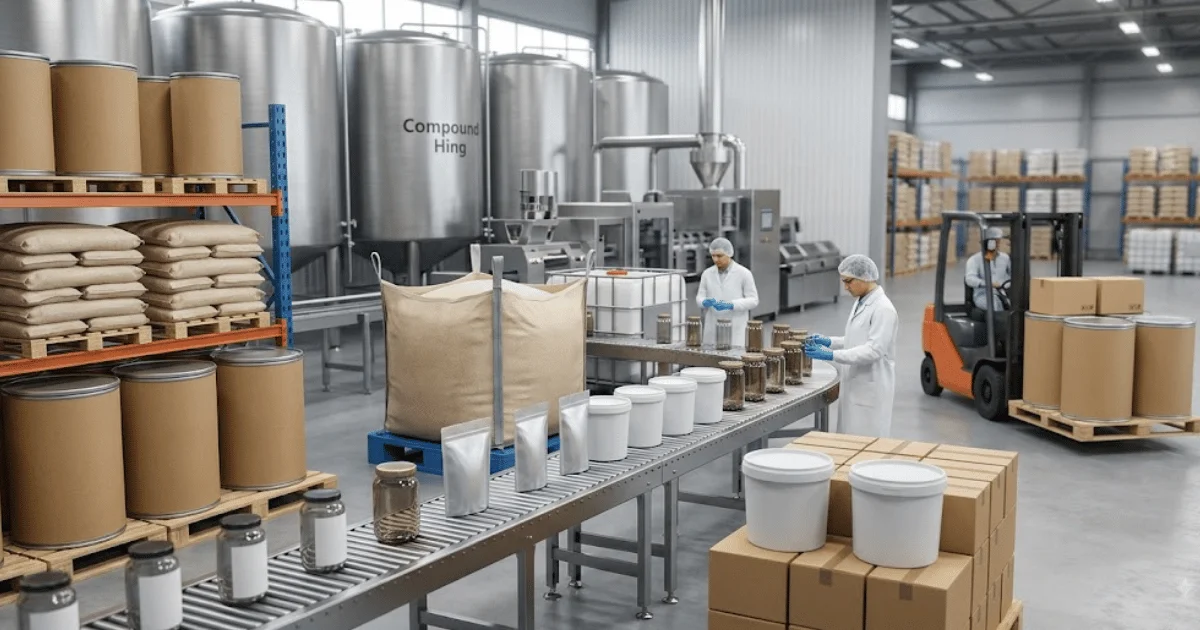
Compound Hing for Private Label Food Brands can help retailers, spice companies, food manufacturers, distributors, and emerging FMCG brands create their own Hing products without building an entire manufacturing operation from scratch. However, private-label sourcing involves much more than putting a brand name on an existing pack.
The buyer needs to select the right Compound Hing specification, confirm the desired aroma and strength, decide the product format, establish packaging requirements, review labeling information, evaluate samples, confirm quality documentation, and ensure that the supplier can maintain consistency across commercial batches.
For a growing food brand, the right private-label partner can turn Compound Hing into a scalable product line. The wrong supplier can create inconsistent flavor, packaging problems, delayed production, or unnecessary reformulation costs.
What Is Compound Hing for Private Label Food Brands?
Compound Hing for Private Label Food Brands refers to Compound Hing supplied specifically for a food company’s own branded product. The manufacturer or supplier produces the required Hing product while the buyer sells it under its own brand identity.
Depending on the commercial arrangement, the buyer may specify:
- Compound Hing strength
- Product format
- Ingredient requirements
- Pack size
- Packaging design
- Label information
- Target market
- Order volume
- Quality requirements
This gives brands more control over how their Hing product is positioned in the market.
Why Private Label Hing Is Attractive to Food Brands
Private labeling allows a company to build a branded product without necessarily investing in its own Hing manufacturing infrastructure.
A brand can focus on marketing, distribution, retail relationships, customer acquisition, and product positioning while an experienced manufacturer handles production.
This can be particularly useful for businesses entering the spice or food-ingredient market.
Who Can Use Private Label Compound Hing?
Private-label Compound Hing can be relevant to several types of businesses:
- Spice brands
- FMCG companies
- Retailers
- Supermarket brands
- Online food brands
- Distributors
- Wholesalers
- Restaurant supply companies
- Exporters
- Food manufacturers
The required product specification will vary according to the target market and distribution model.
Why Compound Hing Works Well for Private Label Products
Compound Hing is designed to provide a practical, measurable, and manageable form of Asafoetida.
Compared with handling raw resin, a properly formulated Compound Hing product can be easier to dose, package, transport, and incorporate into commercial food products.
Its formulation should still be evaluated carefully because different Compound Hing products can have different compositions and sensory performance.
Start With Your Target Customer
Before selecting the product, a private-label brand should define who will buy it.
A premium retail customer may expect a different aroma profile and packaging format from a value-focused mass-market customer.
Similarly, a foodservice product may require larger packs and different handling characteristics.
Define the Positioning of the Hing Product
The brand should decide how the product will compete.
Possible positioning can include:
- Premium Hing
- Everyday cooking Hing
- Strong-aroma Hing
- Foodservice Hing
- Value Hing
- Export-oriented Hing
- Specialized Compound Hing
Positioning influences formulation, packaging, pricing, and target customers.
Choose the Right Compound Hing Specification
One of the most important decisions in Compound Hing for Private Label Food Brands is choosing the correct product specification.
Brands should not select a product simply because another company sells a similar-looking Hing.
The formulation needs to match the intended application and target sensory profile.
Why Composition Matters
Compound Hing can contain Asafoetida resin along with other food ingredients used to create a practical commercial format.
Carrier selection and formulation can affect aroma intensity, flow, dosing, and overall product behavior.
Buyers should therefore request and review the complete product specification before final approval.
Decide Between Powder and Granules
Private-label brands may choose between different physical formats depending on the intended market.
Hing Powder can be suitable for conventional retail packs and seasoning applications, while Hing Granules can offer different flow and handling characteristics.
The decision should be based on product positioning, packaging, consumer usage, and manufacturing requirements.
Test Samples Before Private Label Production
Sample evaluation should happen before final packaging is produced.
The brand should test the proposed Compound Hing in the way customers are expected to use it.
This can include raw aroma, cooking performance, dosage, flavor contribution, and overall acceptability.
Why Sample Approval Matters
A packaging design can be changed relatively easily. Reformulating a product after thousands of units have been manufactured is much more expensive.
Approving the actual product before committing to large-scale packaging reduces this risk.
Evaluate Aroma and Flavor
Hing is primarily purchased for its sensory contribution.
The private-label buyer should therefore establish a reference profile covering aroma intensity, cooked aroma, pungency, flavor contribution, and aftertaste.
This reference can later be used to compare commercial batches.
Do Not Choose Only by Aroma Strength
The strongest-smelling Compound Hing is not necessarily the best choice for a private-label product.
The product needs to provide the right balance between aroma, flavor, dosage, consumer preference, consistency, and cost.
A controlled sensory profile is more useful than simply maximizing intensity.
Private Label Packaging Options
Packaging is a major part of private-label development.
Depending on the market, brands may consider:
- Small retail jars
- Pouches
- Large foodservice packs
- Bulk bags
- Custom printed packaging
- Retail-ready cartons
The appropriate format depends on the distribution channel and customer usage.
Why Packaging Matters for Hing
Hing is highly aromatic and can be sensitive to moisture and storage conditions.
Packaging therefore needs to protect the product while also supporting the brand’s retail presentation.
Weak packaging can affect both product quality and customer perception.
Custom Labeling for Private Label Hing
Private-label brands need packaging that clearly represents their own identity.
Depending on the market, labeling may need to include product name, net quantity, ingredient information, batch details, manufacturing information, storage instructions, dates, and other required declarations.
Label requirements should be reviewed for the specific market before commercial printing.
Ingredient Transparency Matters
Compound Hing is not necessarily a single-ingredient product.
Private-label brands should understand the complete formulation and ensure that the ingredient declaration accurately represents the product.
This becomes particularly important when selling through modern retail, marketplaces, or international distribution.
Private Label Hing for Indian Retail
Indian retail brands can use private-label Compound Hing to build products under their own brand identity.
Pack sizes can be developed according to the target customer and distribution channel.
Retail positioning can range from everyday household Hing to premium specialty products.
Private Label Hing for Export Markets
Export-focused brands need to consider destination-market requirements from the beginning.
Product composition, labeling, documentation, packaging, shelf life, and importer requirements can differ between countries.
A supplier that understands export-oriented sourcing can reduce avoidable delays during product development.
Private Label Hing for Foodservice
Restaurants, caterers, cloud kitchens, and foodservice distributors may require larger pack sizes than retail consumers.
The product specification can remain consistent while the packaging format changes according to usage volume.
Bulk Compound Hing for Private Label Brands
Some brands may prefer to purchase Compound Hing in bulk and manage their own final packing.
This model can provide greater control over packaging operations but requires suitable filling, sealing, storage, and quality-control capabilities.
The supplier should be informed about the intended bulk format before commercial production begins.
How MOQ Affects Private Label Projects
Minimum order quantity is an important commercial consideration.
A new brand may want to start with a small quantity to test the market, while an established FMCG company may require significantly larger volumes.
The buyer should confirm MOQ before finalizing packaging and pricing.
Why Small Initial Runs Can Be Useful
When commercially feasible, an initial controlled production run allows the brand to test:
- Customer response
- Packaging performance
- Product acceptance
- Retail movement
- Repeat purchase
Future production can then be adjusted based on real market feedback.
Private Label Hing and Cost-in-Use
Private-label brands should calculate the total product cost rather than looking only at the Hing ingredient price.
Total cost can include:
- Compound Hing
- Packaging
- Labels
- Filling
- Cartons
- Quality testing
- Transport
- Storage
This provides a more realistic basis for retail pricing.
Why the Cheapest Supplier May Not Be the Best
A low ingredient price can become expensive if the product requires higher dosage, creates inconsistent flavor, causes packaging problems, or produces frequent quality complaints.
Private-label buyers should evaluate total commercial value rather than purchasing price alone.
Supplier Evaluation for Private Label Compound Hing
A private-label manufacturer should be evaluated across several dimensions.
Important areas include:
- Product quality
- Batch consistency
- Manufacturing capability
- Packaging options
- MOQ
- Lead time
- Documentation
- Customization capability
- Bulk capacity
- Communication
A supplier that performs well across these areas can become a long-term production partner.
Ask for a Product Specification
Before approving a private-label Compound Hing product, request the relevant specification.
The specification should make clear what product is being supplied and what quality characteristics the buyer can expect.
This reduces ambiguity between sample approval and commercial production.
Ask for Batch Documentation
Commercial buyers may require batch-specific documentation such as a Certificate of Analysis and other quality records depending on their internal requirements and destination market.
Documentation also supports traceability and supplier accountability.
Establish a Reference Sample
After approving the private-label Compound Hing, retain an approved reference sample.
Future batches can be compared against this reference for sensory and physical consistency.
This is particularly important when the product becomes a recurring retail SKU.
Why Batch Consistency Matters
A private-label brand is responsible for the customer’s experience regardless of which manufacturing batch produced the product.
If one batch tastes significantly different from another, consumers may perceive the brand as unreliable.
Consistent sourcing is therefore essential for brand trust.
Private Label Hing and Quality Control
Quality control should cover the entire process from incoming raw materials through final packed goods.
Depending on the product and buyer requirements, checks may include physical characteristics, sensory evaluation, documentation, packaging integrity, and batch traceability.
Private Label Hing and Shelf Life
The finished product should be evaluated under appropriate storage conditions.
Hing’s aroma is an important part of its value, so packaging and storage should help preserve the intended sensory profile throughout the product’s commercial life.
Why Storage Should Be Considered Early
Storage conditions should be incorporated into the product-development plan rather than addressed after manufacturing.
Heat, moisture, transport conditions, warehouse environment, and repeated opening can all influence product performance.
Private Label Hing for Online Brands
Online food brands can use private labeling to launch Hing products without operating their own manufacturing facility.
This model can be particularly attractive for brands selling through their own website, marketplaces, social commerce, or subscription-based food businesses.
Packaging and product presentation become especially important because the customer may judge the product before physically experiencing it.
Private Label Hing for Supermarket Brands
Retail chains and supermarket brands may use private-label Hing as part of their broader spice portfolio.
These projects usually require clear specifications, dependable supply, professional packaging, consistent quality, and predictable replenishment.
Private Label Hing for Distributors
Distributors can create their own branded Hing products instead of selling only third-party brands.
This can provide greater control over positioning, pricing, packaging, and customer relationships.
Private Label Hing for Exporters
Exporters can use private-label manufacturing to create branded Hing products for overseas retailers, distributors, restaurants, and specialty food businesses.
The supplier should be able to support the product specification, packaging, batch information, and documentation required for the intended market.
Private Label Hing Development Process
A practical Compound Hing for Private Label Food Brands project can follow these steps:
- Define the target market.
- Identify the customer segment.
- Define product positioning.
- Select the required Hing format.
- Define the desired sensory profile.
- Request product specifications.
- Obtain samples.
- Conduct application and sensory testing.
- Approve the product.
- Finalize packaging.
- Review labeling requirements.
- Confirm MOQ and commercial terms.
- Conduct pilot production if required.
- Approve the first commercial batch.
- Begin recurring production and quality monitoring.
Common Private Label Hing Mistakes
- Choosing a supplier based only on price
- Skipping sample approval
- Not defining the target sensory profile
- Ordering packaging before approving the formulation
- Ignoring ingredient disclosure
- Failing to confirm MOQ
- Not establishing a reference sample
- Changing suppliers without revalidation
- Ignoring export-market requirements
- Failing to plan for repeat production
How to Reduce Private Label Sourcing Risk
The safest approach is to treat the project as a product-development process rather than a simple packaging exercise.
Approve the formulation first. Then validate the packaging, documentation, commercial terms, and manufacturing process.
This sequence reduces the risk of expensive changes after production begins.
Questions to Ask a Private Label Hing Manufacturer
- Can you manufacture Compound Hing under our brand?
- What product formats are available?
- Can you provide samples before commercial production?
- Can the formulation be matched to our target application?
- What packaging formats are available?
- What is the minimum order quantity?
- Can you support recurring bulk production?
- What quality documentation is available?
- Can you provide batch traceability?
- Can you support export-oriented packaging?
- What is the expected production lead time?
Why Manufacturer Experience Matters
Private-label brands need more than a supplier who can fill a packet.
The manufacturer should understand the product itself, its formulation, sensory performance, packaging requirements, quality control, and commercial production requirements.
This makes the supplier a more valuable long-term partner.
RB Industries for Private Label Compound Hing
RB Industries manufactures and supplies Asafoetida, Compound Hing, Hing Powder, and Hing Granules for food manufacturers, spice brands, retailers, wholesalers, distributors, exporters, restaurants, and FMCG businesses.
RB Industries supports customized Hing solutions, including private labeling, bulk packaging, export-oriented products, and application-specific requirements. The company’s existing content also identifies private labeling and customized Hing solutions as part of its commercial offering. :contentReference[oaicite:1]{index=1}
Private-label buyers can discuss their target market, product format, desired sensory profile, pack size, estimated monthly volume, and packaging requirements before finalizing a commercial specification.
How to Start a Private Label Hing Project
The process should begin with the product requirement rather than the packaging design.
Share the intended market, preferred pack size, expected volume, product positioning, and application with the manufacturer. The supplier can then identify a suitable Compound Hing specification for sampling and evaluation.
After sample approval, the brand can move toward packaging, commercial pricing, production planning, and recurring supply.
Conclusion
Compound Hing for Private Label Food Brands offers a practical route for companies that want to launch their own branded Hing products without building a dedicated manufacturing operation. However, successful private-label sourcing requires careful product selection, sample testing, specification approval, packaging planning, labeling accuracy, quality control, and reliable long-term supply.
The most important decision is not simply finding the lowest-priced Compound Hing. The product must deliver the desired aroma and flavor at a commercially viable dosage while remaining consistent across production batches. Packaging must also protect the product and support the brand’s positioning.
For new brands, a controlled first production run can provide valuable market feedback before larger volumes are committed. Established brands, distributors, and exporters should focus on long-term batch consistency, documentation, supply capacity, and repeat-order reliability.
RB Industries supplies Compound Hing, Asafoetida, Hing Powder, and Hing Granules for commercial and private-label requirements. Food brands, retailers, FMCG companies, distributors, restaurants, wholesalers, and exporters can discuss their product specifications, packaging requirements, target market, and bulk volume to develop a suitable private-label Hing solution.
Frequently Asked Questions
What is Compound Hing for Private Label Food Brands?
Compound Hing for Private Label Food Brands is Compound Hing manufactured or supplied for sale under a buyer’s own brand name. The project can include product selection, sample approval, custom packaging, labeling, quality specifications, and commercial bulk production.
Can a small food brand launch private-label Hing?
Yes, subject to the manufacturer’s minimum order requirements and commercial terms. A small brand can begin by defining its target market, selecting a suitable Compound Hing product, testing samples, and confirming the required packaging and production volume.
What should I check before choosing a private-label Hing manufacturer?
Check product consistency, specifications, sample quality, manufacturing capability, MOQ, packaging options, documentation, lead times, batch traceability, and the supplier’s ability to support repeat orders. Price should be evaluated alongside total cost and product performance.
Can Compound Hing be customized for private-label brands?
Depending on the manufacturer and project requirements, private-label programs can support different product formats, packaging configurations, and application-specific requirements. The exact customization should be confirmed during product development.
Should I test a Compound Hing sample before placing a bulk order?
Yes. Sample testing allows the brand to evaluate aroma, flavor, dosage, physical characteristics, packaging, and application performance before committing to commercial production. The approved sample can then become a reference for future batches.
Can private-label Hing be supplied for export markets?
Yes, private-label Hing can be developed for export-oriented businesses, but labeling, documentation, packaging, ingredient disclosure, and other requirements depend on the destination market. These requirements should be established before production.