
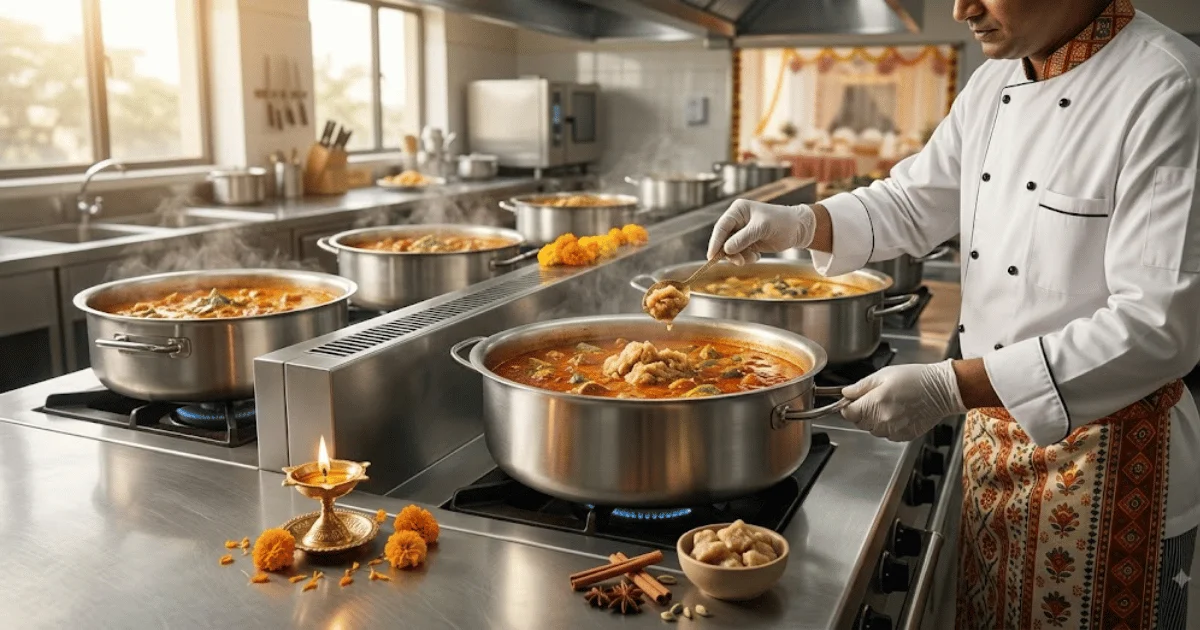
Hing for festive cooking becomes especially important when food is prepared in large quantities for family gatherings, restaurants, caterers, hotels, community events, and seasonal food production. A small amount of Hing can contribute a distinctive savory aroma, but scaling that ingredient from a household recipe to a large batch requires more care than simply multiplying the quantity.
During India’s festive season, kitchens often prepare dal, vegetables, snacks, gravies, lentil dishes, and other savory foods in much larger volumes than usual. When production increases, dosage, temperature, mixing, storage, and ingredient consistency all become more important.
The goal is not to make the food smell strongly of Hing. The goal is to create a balanced aroma that remains consistent from the first batch to the last.
Why Hing for Festive Cooking Needs Special Attention
Hing for festive cooking behaves differently when a recipe is prepared for a few people compared with hundreds of servings.
In a household kitchen, a cook may add a small pinch of Hing to a tempering and adjust the seasoning by taste. In a commercial kitchen, that approach can create variation between batches.
Large-scale festive cooking requires a more controlled process. The product, dosage, cooking temperature, mixing method, and recipe should remain consistent.
Why Large-Batch Cooking Changes the Way Hing Is Used
Scaling a recipe changes more than the quantity of ingredients.
A large cooking vessel distributes heat differently. Mixing takes longer. Ingredients may not spread as evenly. Tempering may also be prepared separately and distributed across several containers.
These factors can affect how aroma develops.
Therefore, Hing for festive cooking should be treated as a controlled ingredient when the batch size increases.
Why More Hing Does Not Mean Better Festive Food
Hing has a naturally powerful aroma.
Adding more Hing does not automatically produce better food. In fact, excessive Hing can overpower vegetables, lentils, spices, ghee, oil, coconut, or other ingredients.
A good festive recipe should allow Hing to support the overall flavor rather than dominate it.
This becomes particularly important when several dishes are served together.
How Hing Adds Aroma to Festive Meals
Hing is commonly used as an aromatic seasoning in Indian cooking.
When introduced correctly into heated oil or ghee, its raw pungency changes and develops into a more integrated savory aroma.
This transformation is one reason the correct cooking technique matters so much.
For large festive meals, the same technique should be repeated consistently across batches.
The Importance of the Tempering Stage
Tempering is one of the most practical ways to use Hing in many Indian dishes.
A typical process involves heating oil or ghee, adding suitable whole spices, reducing the flame, adding a small amount of Hing, and then incorporating the tempering into the main preparation.
The exact sequence depends on the recipe.
However, the principle remains the same: controlled heat helps the aroma develop without burning the ingredient.
Temperature Control for Hing
Hing can react quickly to high temperatures.
If it is exposed to excessive heat for too long, the desired aroma can change and the final preparation may develop an unpleasant or bitter character.
Existing RB Industries cooking guidance also emphasizes using Hing at a controlled temperature rather than exposing it to excessive heat. :contentReference[oaicite:1]{index=1}
For Hing for festive cooking, this becomes even more important because a mistake in a large batch can affect hundreds of servings.
How Much Hing Should You Use in Large-Batch Cooking?
There is no universal dosage that applies to every recipe or Hing product.
The correct quantity depends on:
- Hing concentration
- Product format
- Recipe composition
- Number of servings
- Cooking method
- Other spices used
- Desired aroma intensity
The safest approach is to establish the dosage from a tested recipe and scale it systematically.
Start With a Tested Base Recipe
Before preparing a large festive batch, establish a reliable smaller formulation.
Record the exact Hing quantity used, along with the cooking temperature, tempering method, oil or ghee quantity, and other major seasoning ingredients.
This creates a reference point for larger production.
Without a reference recipe, different cooks may use different quantities and produce inconsistent results.
How to Scale Hing for 50, 100 or More Servings
Start with a recipe that has already been tested for a known number of servings.
Calculate the ingredient requirement for the larger batch instead of estimating it visually.
Prepare the larger batch using the same relative formulation and then conduct a controlled tasting.
If an adjustment is necessary, record it before the next production batch.
Why Visual Measurement Can Cause Problems
In busy kitchens, cooks sometimes measure strong spices by eye.
This can create significant variation when different people prepare the same dish.
For Hing for festive cooking, measured dosing is particularly useful because the ingredient is highly aromatic and small quantity differences can become noticeable.
Hing for Festive Cooking in Family Gatherings
Large family gatherings may require food for dozens of people.
Even when cooking at home, it is useful to scale recipes systematically rather than simply adding extra pinches of Hing.
A tested recipe makes it easier to maintain the familiar flavor that guests expect.
Hing for Festive Cooking in Restaurants
Restaurants can experience higher demand during festivals.
Kitchen teams may prepare the same dishes multiple times during a service period.
When production volume increases, maintaining consistent Hing dosage helps keep the aroma and taste of the dish stable.
Pre-measured ingredients can make this process easier.
Hing for Festive Cooking in Catering
Catering operations may prepare hundreds or thousands of servings for weddings, religious events, community celebrations, and festive gatherings.
At this scale, even a small difference in seasoning can affect a large amount of finished food.
Standardized recipes and controlled ingredient measurement therefore become essential.
Hing for Hotels and Large Commercial Kitchens
Hotels and institutional kitchens often operate with multiple cooks and several production stations.
Without clear recipe standards, one shift may use more Hing than another.
A documented formulation can help reduce this variation.
The same approved product should also be used whenever possible.
Which Festive Foods Can Use Hing?
Hing can be considered in many suitable savory preparations, including:
- Dal
- Lentil preparations
- Vegetable curries
- Dry vegetables
- Potato dishes
- Legume preparations
- Namkeen
- Savory snacks
- Chutneys
- Pickles
- Seasoning blends
The actual application should always follow the recipe.
Hing does not need to be included in every dish on a festive menu.
Hing in Large-Batch Dal
Dal is one of the most practical applications for Hing in large-scale cooking.
Because dal generally has a relatively mild flavor base, a controlled amount of Hing can contribute noticeable aroma.
For large batches, the tempering should be prepared consistently and distributed evenly.
Hing in Large-Batch Vegetable Cooking
Vegetable preparations can vary significantly in their spice profiles.
Some dishes benefit from Hing, while others already have enough aromatic ingredients.
Before using Hing for festive cooking across a large vegetable batch, test the complete formulation first.
Hing in Festive Namkeen Production
Festive seasons often increase demand for namkeen and savory snacks.
For manufacturers, Hing can become part of the seasoning system rather than a simple household spice.
The manufacturer needs to control dosage, mixing, distribution, and batch consistency.
Why Seasoning Distribution Matters
In large-scale snack production, even distribution is important.
If Hing becomes concentrated in one portion of the seasoning mix, the finished product can have inconsistent aroma.
Proper mixing and an appropriate product format can help improve uniformity.
Choosing the Right Hing Format for Large Batches
Different applications may benefit from different Hing formats.
Businesses may evaluate:
- Hing Powder
- Compound Hing
- Hing Granules
- Other application-specific formulations
The right format depends on the production process, mixing method, desired dosage, packaging, and finished product requirements.
Hing Powder for Festive Production
Hing Powder can be useful when a fine ingredient needs to disperse evenly through a seasoning or recipe.
It can work well in selected tempering and dry seasoning applications when the formulation is properly controlled.
Moisture protection becomes important during storage because powdered ingredients can change in handling characteristics when exposed to humidity.
Compound Hing for Large-Scale Food Preparation
Compound Hing can provide a practical option for commercial kitchens and food manufacturers.
Its suitability depends on the formulation and intended application.
For Hing for festive cooking, commercial buyers should test Compound Hing in their actual recipe before committing to a major seasonal production run.
Hing Granules for Commercial Applications
Hing Granules have different physical characteristics from fine powder.
Depending on the production system, granules may provide useful handling and flow properties.
The decision should be based on actual application requirements rather than simply the appearance of the product.
How to Test Hing Before Festive Production
A food business should ideally test the selected Hing before large-scale production.
The application test can evaluate:
- Raw aroma
- Cooked aroma
- Dosage
- Flavor contribution
- Mixing behavior
- Batch consistency
- Storage behavior
- Compatibility with the final recipe
This provides more useful information than judging Hing only by its raw smell.
Why Raw Aroma Is Not Enough
A strong raw aroma does not automatically mean a product will perform best in a finished recipe.
What matters commercially is how the ingredient performs after processing.
A good Hing product should provide the required aroma and flavor at a practical dosage while remaining consistent across production batches.
Hing and Aroma Consistency
Festive food businesses often need to produce the same product repeatedly.
If the first batch has a balanced aroma but the next batch uses a different quantity or product, customers may notice the difference.
Maintaining an approved Hing specification helps reduce this risk.
Creating a Hing Reference Standard
Food manufacturers can keep an approved sample or reference batch for comparison.
New incoming Hing can then be evaluated against the established standard.
This can help procurement and quality teams identify unexpected changes before the ingredient enters full-scale production.
Storage of Hing During the Festive Season
Festive production often means the same ingredient is opened repeatedly throughout the day.
Hing should therefore remain properly sealed whenever it is not being used.
Moisture exposure should be minimized, particularly for powdered products.
RB Industries’ existing storage guidance also recommends keeping bulk Hing tightly sealed and using a smaller daily-use container when appropriate. :contentReference[oaicite:2]{index=2}
Why Bulk Hing Needs Better Storage Control
Bulk packs are opened more frequently in commercial kitchens.
Repeated exposure to air, humidity, heat, and kitchen steam can affect handling and aroma.
A practical system is to keep the main bulk pack sealed and transfer only the required amount into a clean daily-use container.
Common Large-Batch Hing Mistakes
- Adding Hing without measuring
- Increasing dosage too aggressively
- Overheating the tempering
- Changing the Hing product during production
- Failing to test a new batch
- Ignoring moisture exposure
- Using inconsistent measuring tools
- Not standardizing the recipe
- Buying the required quantity at the last moment
How to Improve Hing Consistency in Festive Kitchens
- Choose an approved Hing product.
- Create a tested base recipe.
- Record the exact Hing dosage.
- Standardize the tempering process.
- Control cooking temperature.
- Use consistent measuring tools.
- Test the first large batch.
- Keep the product properly sealed.
- Record any approved formulation changes.
Planning Hing Procurement Before Festival Demand
Seasonal demand can increase quickly for restaurants, caterers, hotels, snack manufacturers, and food brands.
Waiting until production is already underway can create unnecessary procurement pressure.
Businesses that know their expected festive production volume can estimate their Hing requirement in advance.
What Commercial Buyers Should Consider
- Required quantity
- Hing format
- Product specification
- Expected dosage
- Packaging
- Lead time
- Batch consistency
- Storage requirements
- Quality documentation
Considering these factors helps buyers choose a supply solution based on actual production needs.
Hing for Food Manufacturers During Festival Season
Food manufacturers may experience higher demand for packaged foods, snacks, spice blends, ready-to-eat products, and other seasonal items.
For these businesses, Hing should be evaluated as part of the complete product formulation.
The supplier should understand the intended application so the appropriate product format and specification can be selected.
Hing for Namkeen and Snack Manufacturers
Namkeen manufacturers can use Hing in seasoning systems for selected products.
Because seasoning needs to be distributed evenly across a large production volume, the mixing process is critical.
Manufacturers should establish a repeatable dosage and mixing procedure before increasing seasonal output.
Hing for Restaurants and Caterers
Restaurants and caterers can benefit from pre-measured Hing portions for recurring dishes.
This makes it easier for different kitchen staff members to reproduce the same recipe.
It also reduces the risk of accidentally using too much Hing during busy festival service.
When Should Businesses Order Hing for Festivals?
Businesses should ideally finalize their product and estimated quantity before their main seasonal production begins.
This provides enough time for sample testing, supplier confirmation, packaging arrangements, and delivery planning.
Last-minute procurement can force businesses to change ingredients or accept products without sufficient application testing.
Why Sample Testing Matters
A commercial sample should be tested in the actual recipe rather than evaluated only as a raw ingredient.
This allows the buyer to determine whether the aroma, dosage, mixing behavior, and final flavor meet the required standard.
For high-volume festive production, this step can prevent expensive formulation problems.
RB Industries for Festive Hing Supply
RB Industries manufactures and supplies Asafoetida, Compound Hing, Hing Powder, and Hing Granules for restaurants, caterers, food manufacturers, wholesalers, distributors, FMCG brands, private-label businesses, and exporters.
Businesses preparing for festive production can discuss their intended application, estimated volume, preferred product format, packaging requirements, and supply schedule.
Commercial buyers can evaluate samples in their own recipes before moving to larger quantities where required.
Why Manufacturer-Direct Supply Can Help Large Buyers
Large food businesses often need more than a product delivered on time.
They need predictable specifications, repeat availability, appropriate packaging, and communication around production requirements.
Working directly with a manufacturer can make it easier to discuss these requirements before placing recurring orders.
Festive Cooking Requires Consistency, Not Just Quantity
The biggest mistake in large-scale festive cooking is focusing only on how much food needs to be produced.
The same attention should be given to how consistently each batch tastes and smells.
Hing for festive cooking should therefore be planned as part of the complete recipe and production process.
Conclusion
Hing for festive cooking can help create a distinctive savory aroma in dal, vegetables, snacks, lentil preparations, and other suitable foods. However, successful large-batch cooking depends on much more than adding the correct quantity.
Temperature control, recipe scaling, accurate measurement, product consistency, mixing, storage, and application testing all influence the final result. These factors become particularly important when restaurants, caterers, hotels, and food manufacturers prepare hundreds or thousands of servings.
The best approach is to start with a tested recipe, establish an approved Hing dosage, standardize the cooking process, and evaluate the product in the actual application before large-scale production.
RB Industries supplies Asafoetida, Compound Hing, Hing Powder, and Hing Granules for commercial kitchens, food manufacturers, wholesalers, distributors, FMCG brands, private-label businesses, and exporters. Businesses preparing for festive demand can discuss their application, quantity, packaging, and supply requirements to plan their Hing procurement in advance.
Frequently Asked Questions
How much Hing should be used in large-batch festive cooking?
The quantity depends on the Hing product, recipe, batch size, and desired aroma. The best approach is to scale a tested recipe rather than estimate the amount by eye.
Why does Hing sometimes smell too strong after cooking?
Excessive dosage or overheating can create a harsh aroma. Controlled quantity and low-temperature tempering can help the Hing develop a more balanced cooked aroma.
Which Hing is suitable for large-scale festive cooking?
The right product depends on the application, formulation, processing method, and required dosage. Hing Powder, Compound Hing, and Hing Granules can serve different commercial requirements.
Can restaurants and caterers buy Hing in bulk for festivals?
Yes. Restaurants, caterers, hotels, and food manufacturers can plan bulk Hing requirements according to expected production volume. Advance procurement also provides time for sample testing and product approval.
How can food businesses maintain consistent Hing aroma across batches?
Use an approved Hing product, standardized dosage, consistent cooking temperature, measured ingredients, and a documented recipe. Comparing incoming batches with an approved reference sample can also help maintain consistency.
How should bulk Hing be stored during festival production?
The main bulk pack should remain tightly sealed and protected from unnecessary heat and moisture. A smaller daily-use container can be useful for busy commercial kitchens.


