
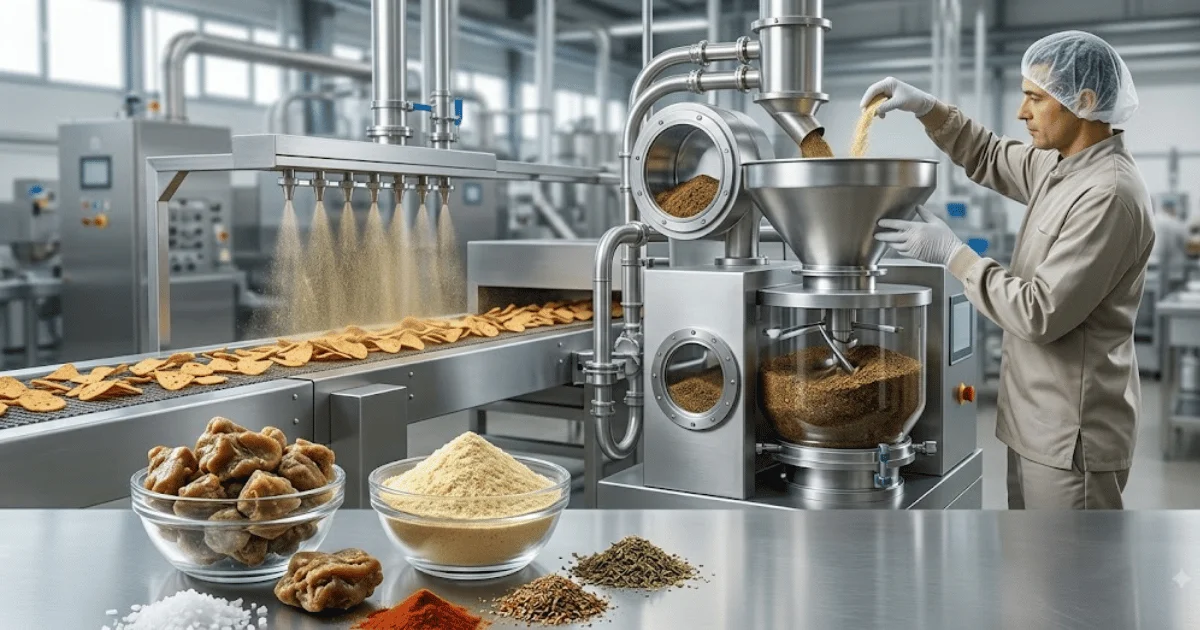
Hing in Seasoning Systems plays an important role in modern food manufacturing, especially in products that require distinctive aroma, savory flavor, and consistent sensory performance. Also known as Asafoetida, Hing has been used for centuries in traditional Indian cooking. Today, its applications have expanded into commercial seasoning blends, snacks, convenience foods, instant products, ready-to-cook meals, and other processed food categories.
Seasoning systems allow food manufacturers to combine multiple ingredients into carefully balanced formulations that deliver a specific taste and aroma. Within these systems, Hing can provide a distinctive flavor contribution while working alongside spices such as cumin, coriander, turmeric, chili, mustard, and black pepper.
For commercial food production, however, simply adding Hing to a formulation is not enough. Manufacturers must consider ingredient quality, concentration, consistency, particle characteristics, storage, processing, and supplier reliability to achieve predictable results.
What Are Seasoning Systems?
Seasoning systems are formulated combinations of spices, herbs, flavor ingredients, salt, and other food components designed to create a specific sensory profile.
Food manufacturers use seasoning systems because they provide greater control over flavor consistency. Instead of adding individual ingredients separately during every production cycle, manufacturers can develop standardized seasoning formulations that are easier to reproduce.
Seasoning systems are widely used in:
- Snack foods
- Instant food products
- Ready-to-cook meals
- Soup mixes
- Spice blends
- Convenience foods
- Packaged meal products
- Regional food formulations
The effectiveness of a seasoning system depends on how well its individual ingredients work together.
Why Is Hing Used in Seasoning Systems?
Hing has a highly distinctive aroma and flavor profile. Even a relatively small amount can influence the sensory character of a food formulation.
Its primary value in seasoning systems comes from its ability to contribute savory and aromatic notes while complementing other spices.
Hing does not necessarily need to dominate a seasoning blend. Instead, it can work as a supporting ingredient that adds depth and complexity to the overall flavor.
This makes Asafoetida particularly useful for manufacturers developing Indian-inspired, regional, and traditional flavor profiles.
How Hing Works With Other Spices
The performance of Hing depends on the complete seasoning formulation. Every ingredient contributes a particular sensory characteristic, so manufacturers must create a balance between the individual components.
Hing can be combined with a wide range of spices depending on the desired application.
Hing and Cumin
Cumin provides warm, earthy, and aromatic notes, while Hing can add additional savory depth. Together, they are commonly associated with traditional Indian flavor profiles.
Hing and Coriander
Coriander contributes earthy and citrus-like characteristics. Hing can complement these notes and help create a fuller seasoning profile.
Hing and Chili
In spicy seasoning formulations, Hing can provide additional complexity alongside chili and other aromatic ingredients.
Hing and Turmeric
Turmeric contributes earthy flavor and color, while Hing can strengthen the overall traditional character of the spice formulation.
Hing in Seasoning Systems for Snack Manufacturing
Snack manufacturers operate in a highly competitive market where flavor is one of the most important factors influencing consumer preference.
Seasoning systems are widely used for products such as savory snacks, namkeen, chips, extruded snacks, roasted products, and flavored snack mixes.
Hing can be incorporated into these systems to create distinctive Indian-inspired flavor profiles.
For large-scale snack production, consistency is particularly important. Consumers expect the same product to deliver a familiar taste every time they purchase it.
Consistent Hing quality therefore becomes an important part of maintaining the final seasoning profile.
Hing in Seasoning Systems for Convenience Foods
The growth of convenience foods has created increasing demand for effective seasoning ingredients. Ready-to-eat and ready-to-cook products must deliver appealing flavor while requiring minimal preparation.
Hing can be incorporated into seasoning systems used in instant meals, packaged curries, lentil preparations, soup mixes, rice products, and other convenience food applications.
Its association with traditional Indian cooking also helps manufacturers create products that combine modern convenience with familiar culinary flavors.
Role of Hing in Spice Blends
Spice blends depend on carefully controlled ratios of multiple ingredients. A small variation in one component can change the overall sensory profile.
Hing is often used as part of these blends to contribute aroma and flavor complexity.
Manufacturers must therefore understand the characteristics of the Hing they are using before finalizing a commercial formulation.
Consistent ingredient specifications help reduce formulation variability and support predictable production results.
Importance of Hing Quality in Seasoning Formulation
The quality of Hing directly influences the performance of a seasoning system. Differences in aroma strength, flavor intensity, composition, moisture, and processing can affect the final product.
For this reason, manufacturers should evaluate Hing based on both quality and application performance rather than purchasing decisions based only on price.
Important quality considerations include:
- Aroma profile
- Flavor intensity
- Batch consistency
- Ingredient composition
- Particle characteristics
- Moisture control
- Packaging quality
- Supplier reliability
A reliable ingredient specification gives food manufacturers greater control over the final seasoning system.
Why Batch Consistency Matters
Batch consistency is one of the most important considerations when using Hing in commercial seasoning systems.
If the aroma or flavor intensity of Hing changes significantly from one batch to another, the complete seasoning formulation may also change.
This can create problems for food manufacturers that produce products according to fixed specifications.
Consistent Hing helps manufacturers maintain predictable flavor outcomes and reduce the need for repeated formulation adjustments.
It also supports more efficient production planning and quality control.
Hing Concentration and Seasoning Performance
The amount of Hing used in a seasoning system can significantly influence the final sensory result. Because Hing has a strong aroma and flavor profile, manufacturers must determine the appropriate concentration according to the product application.
The ideal level may differ between a snack seasoning, soup mix, spice blend, or ready-to-cook formulation.
Application testing is therefore important before commercial production begins.
Manufacturers can evaluate different formulation levels to determine how Hing interacts with the other ingredients and how the final product performs after processing.
Hing Powder in Commercial Seasoning Applications
Hing powder is particularly useful in commercial seasoning systems because powdered ingredients can be incorporated into dry blends with relative ease.
For industrial food production, manufacturers need ingredients that can be measured, mixed, stored, transported, and distributed consistently.
Particle size, flow properties, moisture control, and uniform distribution can influence how effectively Hing powder performs within a dry seasoning blend.
These characteristics should be considered during ingredient selection and formulation development.
Customized Seasoning Systems Using Hing
Different food products require different flavor profiles. A seasoning designed for a traditional snack may require a different Hing intensity from one developed for an instant meal.
Customized seasoning systems allow manufacturers to adjust ingredient proportions according to their target product, consumer preferences, and processing requirements.
Hing can therefore be used as part of both traditional and innovative formulations.
This flexibility creates opportunities for manufacturers to develop unique products without losing the recognizable characteristics of regional cuisine.
How Food Manufacturers Select Hing
Before approving Hing for commercial production, food manufacturers typically evaluate several factors.
The selection process may include:
- Reviewing technical specifications
- Evaluating aroma and flavor
- Checking batch consistency
- Testing application performance
- Reviewing quality documentation
- Assessing supplier capabilities
- Evaluating packaging and storage requirements
This process helps manufacturers identify ingredients capable of delivering reliable performance throughout production.
Importance of a Reliable Hing Supplier
A seasoning formulation depends on consistent ingredient supply. If the quality of Hing changes frequently or supply becomes unreliable, manufacturers may face production delays and formulation challenges.
A reliable supplier can help maintain consistent product specifications and support long-term manufacturing requirements.
For B2B buyers, supplier evaluation should therefore consider more than product price. Manufacturing capability, quality control, documentation, production capacity, and supply reliability are equally important.
Benefits of Hing in Seasoning Systems
When properly selected and formulated, Hing can provide several benefits to food manufacturers.
- Distinctive aroma contribution
- Enhanced flavor complexity
- Support for authentic regional flavors
- Compatibility with multiple spices
- Versatility across food categories
- Customized formulation opportunities
- Product differentiation
- Support for traditional flavor development
These characteristics make Hing a valuable ingredient for manufacturers developing both established and new food products.
Challenges of Using Hing in Commercial Seasonings
Hing offers strong flavor characteristics, but this also means manufacturers must formulate it carefully.
Using too much or too little Hing can change the intended balance of a seasoning system. Its performance can also be influenced by the quality and composition of the product being used.
Storage and packaging require attention as well because aroma retention is important to the overall value of Hing.
Manufacturers can manage these challenges through application testing, standardized specifications, quality control, and reliable sourcing.
Future Demand for Hing in Seasoning Systems
The food industry continues to move toward distinctive flavor experiences, regional cuisines, convenience foods, and innovative seasoning solutions.
This trend is creating opportunities for traditional ingredients that can deliver recognizable and authentic flavors in modern formats.
Snack manufacturers, seasoning companies, food processors, and convenience food brands are likely to continue exploring Hing as part of their product development strategies.
As international consumers become more familiar with Indian and regional cuisines, the commercial applications of Asafoetida may expand further.
Why Hing Is Valuable for Food Manufacturers
Hing provides a combination of traditional culinary identity and commercial formulation flexibility. Manufacturers can use it in familiar recipes while also incorporating it into new product concepts.
This makes Asafoetida relevant to both established food categories and emerging flavor trends.
For companies seeking to differentiate their products through authentic flavor, Hing can be a valuable component of a well-designed seasoning system.
Conclusion
Hing in Seasoning Systems provides food manufacturers with a versatile ingredient for developing distinctive aroma and flavor profiles across snacks, convenience foods, spice blends, ready-to-cook products, and regional food formulations.
However, commercial success depends on more than simply adding Hing to a recipe. Ingredient quality, concentration, batch consistency, formulation balance, storage, application testing, and supplier reliability all influence the final result.
Manufacturers that select consistent, application-ready Hing can develop seasoning systems that deliver reliable flavor while supporting product differentiation and consumer expectations.
RB Industries manufactures and supplies high-quality Asafoetida products for food manufacturers, seasoning companies, wholesalers, distributors, exporters, and retail brands seeking reliable ingredient solutions for commercial food production.
Frequently Asked Questions
What is the role of Hing in seasoning systems?
Hing contributes distinctive aroma and savory flavor while complementing other spices within a seasoning formulation. It can add depth and help create authentic regional flavor profiles.
Can Hing be used in commercial snack seasonings?
Yes. Hing can be incorporated into seasoning systems for snacks, namkeen, savory products, roasted foods, and other commercial applications. The formulation should be tested carefully to achieve the desired flavor balance.
What should food manufacturers consider when buying Hing?
Manufacturers should evaluate aroma, flavor intensity, batch consistency, ingredient specifications, supplier reliability, packaging, storage requirements, and application performance.
Why is batch consistency important when using Hing?
Variations in Hing quality or intensity can affect the flavor and aroma of the entire seasoning system. Consistent ingredient performance helps manufacturers maintain the same product quality across production batches.
Can Hing be used in customized seasoning formulations?
Yes. Hing can be adjusted according to the target product, desired flavor profile, and formulation requirements. This makes it suitable for both traditional and innovative seasoning systems.