
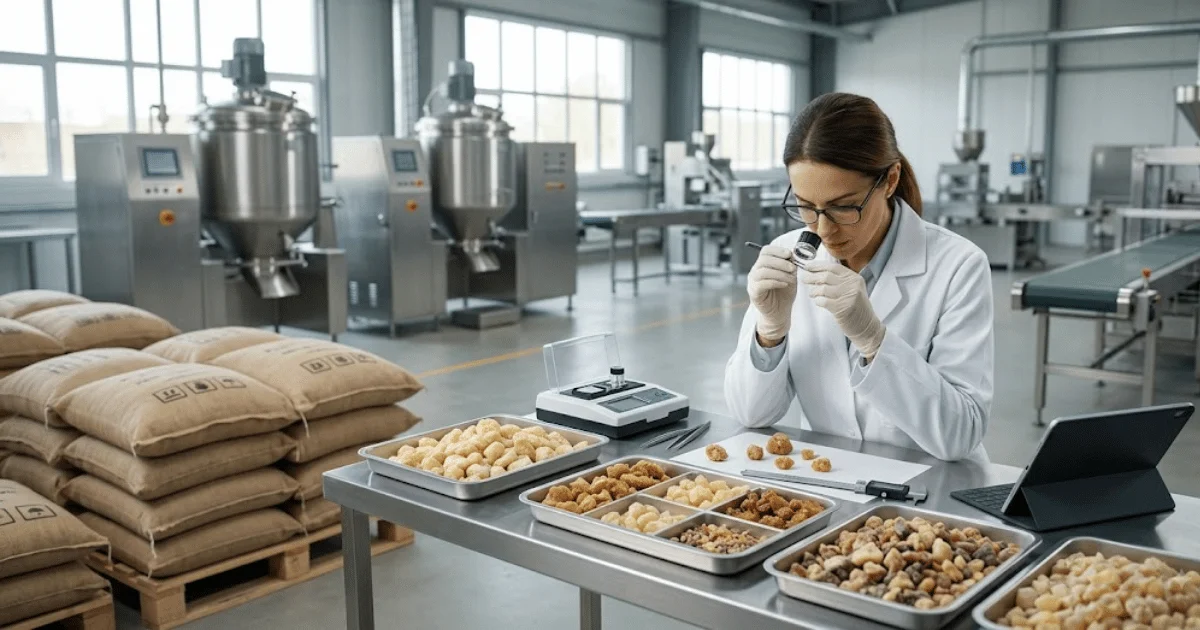
Raw Material Risk Assessment is an important part of commercial Hing manufacturing because the quality of finished Asafoetida products begins with the quality of the raw material entering the production process. Raw Asafoetida resin is a natural agricultural-derived ingredient, so its characteristics can vary depending on source, harvesting, handling, transportation, storage, and processing.
For food manufacturers, seasoning companies, spice businesses, and commercial Hing suppliers, identifying these risks before production is more effective than trying to correct problems after the material has already entered the manufacturing process.
A structured Raw Material Risk Assessment helps procurement and quality teams identify potential problems, evaluate their seriousness, establish acceptance criteria, and decide whether a particular raw-material lot is suitable for production.
What Is Raw Material Risk Assessment?
Raw Material Risk Assessment is a systematic process used to identify, evaluate, and control potential risks associated with ingredients before they are accepted for manufacturing.
For Hing, the assessment can examine both the raw Asafoetida resin itself and the supply chain through which it reaches the manufacturer.
A practical assessment may consider:
- Source and supplier reliability
- Raw material identity
- Physical condition
- Purity
- Moisture-related risks
- Contamination risks
- Natural variability
- Storage history
- Transportation conditions
- Documentation
- Previous supplier performance
The purpose is not to assume that every raw-material lot is unsafe or unsuitable. The objective is to make acceptance decisions using defined and repeatable criteria.
Why Raw Material Risk Assessment Matters for Hing
Raw Material Risk Assessment matters because Asafoetida directly influences the aroma, flavor, and performance of many finished products.
If incoming raw material varies significantly, manufacturers may experience differences in finished Hing or in food products that use Hing as an ingredient.
Potential consequences can include:
- Variation in aroma
- Changes in flavor intensity
- Processing difficulties
- Inconsistent finished batches
- Additional formulation adjustments
- Production delays
- Customer complaints
- Rejected material
Identifying these risks at the incoming-material stage gives manufacturers an opportunity to manage them before they affect production.
Start With Raw Material Source Assessment
The first stage of Raw Material Risk Assessment is understanding where the raw material comes from and how it reaches the manufacturer.
Asafoetida resin is sourced from producing regions outside India and then enters processing and manufacturing supply chains.
The source itself does not automatically determine quality. However, origin, supplier practices, harvesting methods, transportation, and storage history can all influence the condition of incoming resin.
Manufacturers should therefore maintain clear sourcing information and evaluate suppliers based on their ability to provide consistent raw material.
Assess Supplier Reliability
Supplier performance is an important part of Raw Material Risk Assessment.
A supplier with a history of inconsistent raw material can create repeated quality problems even when individual shipments appear acceptable.
Procurement and quality teams can review:
- Previous batch performance
- Delivery reliability
- Documentation accuracy
- Complaint history
- Specification compliance
- Corrective-action performance
- Supply continuity
Past performance can provide useful evidence when evaluating future procurement risk.
Raw Material Identity Verification
Before production, the manufacturer should confirm that the incoming material matches the material that was ordered and approved.
Identity verification can include checking:
- Product description
- Supplier information
- Lot number
- Packaging labels
- Purchase order details
- Documentation
- Physical characteristics
This simple step can prevent incorrect materials from entering production.
Physical Condition of Raw Asafoetida
Physical inspection is an important part of Raw Material Risk Assessment.
Quality teams can inspect incoming resin for visible characteristics that may indicate storage, handling, or contamination problems.
Depending on the material, inspection may consider:
- Appearance
- Colour
- Texture
- Odour
- Foreign material
- Unusual physical changes
- Packaging condition
Physical inspection does not replace appropriate laboratory testing, but it can provide an early indication of whether a lot requires further investigation.
Moisture-Related Risk
Moisture is an important consideration when assessing spice and ingredient raw materials.
Unsuitable moisture conditions can affect handling, storage stability, clumping, and other product characteristics depending on the ingredient and processing method.
During Raw Material Risk Assessment, manufacturers should consider whether the raw material has been exposed to unsuitable environmental conditions during storage or transportation.
Where applicable, moisture-related parameters should be evaluated according to the established product specification.
Contamination Risk Assessment
Food ingredients must be evaluated for potential contamination risks according to their nature, source, intended application, and applicable requirements.
For raw Asafoetida, risk evaluation may consider potential physical, chemical, and microbiological concerns.
Examples of areas that may require consideration include:
- Foreign matter
- Heavy metals
- Microbiological parameters
- Adulteration
- Undeclared materials
- Environmental contaminants
The exact testing requirements should be determined according to the product specification, customer requirements, applicable standards, and target market.
Heavy Metal Risk in Raw Material Assessment
Heavy metals can become a relevant quality consideration for food ingredients depending on the source and applicable regulatory requirements.
Lead, arsenic, cadmium, and mercury are among the metals commonly considered in food-safety testing programs.
A Raw Material Risk Assessment should determine whether heavy-metal testing is appropriate for the raw material and intended market.
When testing is required, results should be connected to the appropriate lot or batch and evaluated against the applicable limits.
Buyers should not rely on generic or unrelated laboratory reports when evaluating a specific commercial lot.
Microbiological Risk
Natural food ingredients can require microbiological evaluation depending on their characteristics, processing, storage, and intended application.
A risk-based approach considers whether the raw material, processing environment, and final application create a meaningful microbiological concern.
Where testing is required, manufacturers should define the relevant parameters and acceptance limits as part of their quality system.
The objective of Raw Material Risk Assessment is to determine the appropriate level of control rather than testing every parameter without considering actual risk.
Adulteration and Authenticity Risk
Authenticity is another important area of Raw Material Risk Assessment.
Food ingredients can be vulnerable to economically motivated adulteration when differences in quality or composition create financial incentives.
Manufacturers can reduce authenticity risk by:
- Approving reliable suppliers
- Maintaining clear specifications
- Reviewing supplier history
- Conducting appropriate testing
- Maintaining traceability
- Comparing incoming material with approved references
For commercially important ingredients, supplier transparency and documented controls can provide additional confidence.
Natural Variability in Asafoetida Resin
Natural variability is different from contamination or adulteration.
Asafoetida resin originates from natural biological sources, so differences can occur between lots because of agricultural conditions, geographic origin, harvesting, storage, and other factors.
Raw Material Risk Assessment should recognize this natural variation and establish acceptable ranges rather than assuming that every batch will be identical.
The objective is to identify meaningful variation that could affect manufacturing performance.
Assess Aroma and Sensory Characteristics
Aroma is particularly important for Asafoetida because it contributes directly to the ingredient’s commercial value.
Quality teams may compare incoming material against an approved reference sample or established sensory specification.
During Raw Material Risk Assessment, noticeable differences in aroma can trigger further investigation before the material is released for production.
Sensory evaluation should follow a consistent procedure wherever it is used as part of the quality system.
Check Raw Material Storage History
The condition of a raw material can be influenced by how it was stored before reaching the manufacturer.
Long periods of unsuitable storage, excessive environmental exposure, poor packaging, or repeated handling can increase quality risks.
Manufacturers should therefore consider storage history when evaluating high-value or sensitive raw materials.
Supplier communication can help clarify how the material was stored and transported before receipt.
Transportation Risk
Transportation is another stage where raw-material quality can be affected.
During Raw Material Risk Assessment, manufacturers can consider the length of transportation, packaging condition, environmental exposure, handling practices, and potential delays.
Packaging should be capable of protecting the raw material during its expected transportation conditions.
Long-distance supply chains require particular attention because more handling points can create additional opportunities for damage or exposure.
Packaging Condition at Receipt
Incoming packaging should be inspected before the raw material is accepted.
Quality teams can look for:
- Damaged bags or containers
- Broken seals
- Moisture exposure
- Unusual odour outside the expected product profile
- Incorrect labels
- Missing batch information
- Signs of contamination
Damaged packaging does not automatically mean the raw material is unusable, but it should trigger appropriate investigation according to the company’s procedures.
Documentation Risk
Documentation is an important part of Raw Material Risk Assessment because incomplete or inconsistent information can make it difficult to verify what has been received.
Depending on the supply arrangement, documentation may include:
- Purchase records
- Product specifications
- Batch or lot information
- Certificates of Analysis
- Supplier declarations
- Transport information
- Traceability records
Documentation should correspond to the actual lot being received wherever batch-specific documentation is required.
How to Score Raw Material Risk
A practical Raw Material Risk Assessment can use a simple risk-ranking system.
For example, each risk can be evaluated according to:
- Likelihood of occurrence
- Severity of impact
- Ability to detect the problem
Higher-risk materials or suppliers may require stronger controls, additional testing, or more frequent monitoring.
This allows quality teams to allocate resources according to actual risk rather than treating every raw material identically.
Low, Medium and High Risk Categories
A simple risk model can divide incoming materials into three broad categories.
Low Risk
Low-risk materials may come from established suppliers with strong historical performance and consistent specifications.
Routine incoming inspection and normal quality controls may be sufficient, depending on the company’s quality system.
Medium Risk
Medium-risk materials may involve a new supplier, a change in source, inconsistent historical results, or a product with greater variability.
Additional sampling, testing, or supplier monitoring may be appropriate.
High Risk
High-risk materials may involve significant quality concerns, unknown sourcing, previous failures, damaged shipments, or serious specification deviations.
Such material should be investigated before being released into production.
Supplier Qualification and Raw Material Risk
Supplier qualification reduces raw-material risk by evaluating the source before regular purchasing begins.
During qualification, manufacturers can assess:
- Supplier manufacturing capability
- Raw material sourcing
- Quality systems
- Historical consistency
- Documentation
- Production capacity
- Traceability
- Complaint handling
A strong supplier qualification program reduces the probability of repeatedly receiving unsuitable raw materials.
Raw Material Risk Assessment Before Production Release
Raw material should not automatically enter production simply because it has arrived at the warehouse.
Depending on the company’s quality procedures, the material may need to remain in a controlled status until required inspections, documentation reviews, or tests are completed.
This prevents unapproved material from entering a production batch before its suitability has been confirmed.
Clear status identification can also reduce the risk of accidental use.
Reference Samples for Risk Control
Approved reference samples can provide a practical benchmark for evaluating future lots.
During Raw Material Risk Assessment, quality teams can compare new material with a previously approved reference for relevant sensory and physical characteristics.
This is particularly useful for natural ingredients where some variation is expected but excessive variation is undesirable.
Reference samples should be stored appropriately so that they remain useful for their intended comparison period.
What Happens When Raw Material Fails Assessment?
If an incoming raw material does not meet the established requirements, the manufacturer should follow its documented non-conformance procedure.
Possible actions can include:
- Hold the material
- Conduct additional testing
- Investigate the cause
- Contact the supplier
- Request clarification or replacement
- Approve under a documented deviation where appropriate
- Reject the material
The correct action depends on the nature and severity of the deviation.
Corrective Action After a Raw Material Problem
Repeated raw-material failures should trigger more than a one-time rejection.
Procurement and quality teams should investigate why the problem occurred and whether similar failures could happen again.
Corrective actions may include:
- Supplier review
- Specification clarification
- Additional supplier controls
- Increased inspection frequency
- Additional testing
- Supplier replacement
This turns Raw Material Risk Assessment into a continuous improvement process.
Importance of Traceability
Traceability allows manufacturers to connect finished products with the raw-material lots used during production.
This becomes important when investigating quality complaints, production deviations, or supplier issues.
A traceability system should allow the manufacturer to identify relevant raw-material lots and production batches efficiently.
Good traceability reduces investigation time and supports better quality management.
Raw Material Risk Assessment for Food Manufacturers
Food manufacturers using Hing as an ingredient should establish risk-based controls according to the product’s intended use and customer requirements.
The level of control may vary between a small foodservice operation and a large FMCG manufacturer.
Large-scale manufacturers may require more detailed supplier qualification, specifications, batch documentation, testing, and traceability.
The key is to match the control system to the actual business and product risk.
Raw Material Risk Assessment for Hing Manufacturers
For Hing manufacturers, raw Asafoetida resin is a critical input because it directly influences the characteristics of finished products.
A strong Raw Material Risk Assessment process can help manufacturers control incoming resin quality before processing begins.
This can support more consistent Compound Hing, Hing Powder, Hing Granules, and other commercial Asafoetida products.
Controlling the raw material at the beginning of the process is generally more effective than attempting to correct major variation after manufacturing.
How RB Industries Approaches Raw Material Quality
RB Industries treats raw-material control as an important part of its Hing manufacturing process.
The company states that incoming Asafoetida is sourced through trusted channels and that lots are checked before moving into warehouse and production processes. Its manufacturing operations also include controlled processing, storage, quality checks, and final inspection before dispatch. :contentReference[oaicite:1]{index=1}
These controls help create a stronger foundation for consistent finished Hing products across different commercial applications.
Benefits of a Strong Raw Material Risk Assessment
A structured Raw Material Risk Assessment can provide several business benefits.
- Earlier identification of quality problems
- Better supplier control
- Reduced production variability
- Improved batch consistency
- Better purchasing decisions
- Reduced rejection risk
- Stronger traceability
- More reliable finished products
These benefits become increasingly valuable as production volumes and customer expectations increase.
Common Mistakes in Raw Material Risk Assessment
Some businesses make the mistake of treating incoming inspection as a quick visual check.
Other common mistakes include:
- Relying only on supplier reputation
- Using outdated specifications
- Ignoring supplier history
- Failing to link documents to batches
- Skipping application-related evaluation
- Ignoring transportation conditions
- Accepting unexplained deviations
- Failing to monitor repeat supplier problems
A risk-based system should combine supplier information, physical inspection, documentation, testing where required, and historical performance.
Building a Practical Raw Material Risk Assessment Checklist
A practical checklist can make incoming-material decisions more consistent.
Before releasing raw Asafoetida for production, a quality team can verify:
- Supplier approved
- Correct material received
- Lot number recorded
- Packaging intact
- Product appearance acceptable
- Aroma acceptable
- Required documentation available
- Required tests completed
- Specification requirements met
- Traceability recorded
- Material formally released
The exact checklist should be customized to the product, manufacturing system, customer requirements, and applicable food-safety standards.
Future of Raw Material Risk Management
Food manufacturers are increasingly using data, supplier performance records, laboratory testing, traceability systems, and digital quality-management tools to improve raw-material control.
These systems can make it easier to identify recurring supplier problems and detect changes in ingredient performance.
For natural ingredients such as Asafoetida, this type of monitoring can help manufacturers distinguish normal variation from meaningful quality risk.
As food supply chains become more complex, proactive risk assessment will become increasingly important.
Conclusion
Raw Material Risk Assessment provides a structured way for Hing manufacturers and food businesses to identify potential problems before raw Asafoetida enters production. The process can cover sourcing, supplier performance, identity, physical condition, contamination risks, natural variability, storage, transportation, documentation, and traceability.
The objective is not to eliminate every natural variation. Instead, the goal is to understand the risks, establish appropriate controls, and ensure that only suitable raw material enters the manufacturing process.
For commercial Hing production, this approach can support better batch consistency, more reliable finished products, stronger supplier relationships, and reduced production risk.
RB Industries manufactures and supplies Asafoetida, Compound Hing, Hing Powder, and Hing Granules for food manufacturers, restaurants, wholesalers, distributors, exporters, retailers, and FMCG brands. Businesses can discuss product specifications, bulk requirements, quality expectations, and supply requirements when evaluating commercial Hing solutions.
Frequently Asked Questions
What is Raw Material Risk Assessment?
Raw Material Risk Assessment is the process of identifying and evaluating potential quality, safety, sourcing, storage, and supplier risks associated with an ingredient before it enters production.
Why is Raw Material Risk Assessment important for Hing?
Hing is a natural ingredient, and raw Asafoetida resin can vary between lots. Risk assessment helps manufacturers identify unsuitable material early and reduce the possibility of quality problems affecting finished products.
What risks should be considered when assessing raw Asafoetida?
Manufacturers can consider source reliability, natural variability, physical condition, moisture-related concerns, contamination, authenticity, storage, transportation, documentation, and supplier history. The exact controls should be based on the product and applicable requirements.
How can manufacturers reduce raw material risk?
Manufacturers can reduce risk through supplier qualification, clear specifications, incoming inspection, appropriate testing, reference samples, batch traceability, controlled storage, and documented release procedures.
What should happen if a raw Hing batch fails assessment?
The material should be placed under appropriate control while the deviation is investigated. Depending on the issue, the manufacturer may conduct additional testing, request supplier corrective action, approve a documented deviation where appropriate, or reject the material.


