
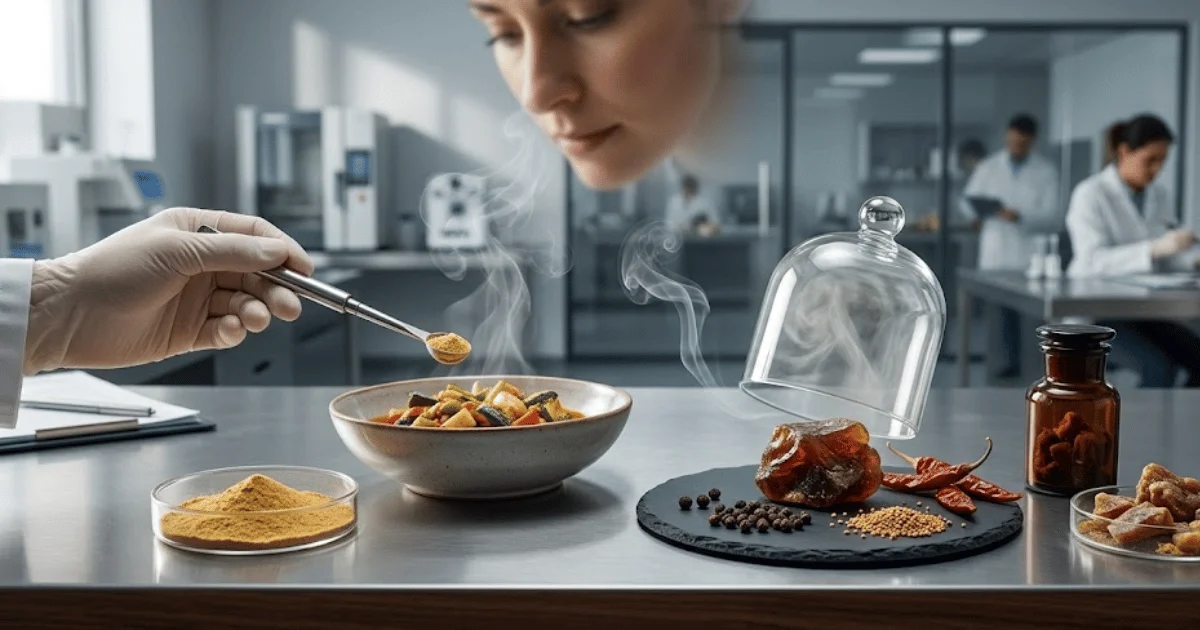
Sensory Properties of Hing explain why Asafoetida can have such a noticeable effect on food even when used in very small quantities. Its characteristic aroma, pungency, flavor contribution, cooked character, and overall sensory intensity make it different from many other culinary spices.
Hing does not have one identical sensory profile in every situation. The way it smells and tastes can change depending on its concentration, physical form, cooking method, temperature, food matrix, dosage, storage condition, and formulation. Raw Hing can be extremely pungent, while properly cooked Hing can contribute a more integrated savory character.
Understanding these sensory properties is useful for home cooks, chefs, food manufacturers, seasoning companies, restaurants, FMCG brands, distributors, exporters, and R&D teams developing products that use Asafoetida.
What Are the Sensory Properties of Hing?
The sensory properties of Hing are the characteristics that can be perceived through the senses when the ingredient is examined or used in food.
These can include:
- Aroma
- Pungency
- Flavor
- Taste contribution
- Cooked aroma
- Aftertaste
- Texture
- Physical appearance
- Overall sensory intensity
Different Hing products can show different characteristics depending on their formulation and intended application.
Why Hing Has a Distinctive Sensory Profile
Asafoetida contains aromatic compounds that give it its characteristic pungent smell.
These compounds are responsible for much of the ingredient’s recognizable sensory identity.
Because Hing is highly aromatic, even a small amount can influence an entire dish.
This concentration is one reason precise dosage matters.
The Aroma of Hing
Aroma is arguably the most immediately recognizable sensory property of Hing.
Raw Asafoetida can have a very strong, sharp, sulfurous, and pungent aroma.
This smell can seem surprisingly intense when the container is opened.
However, the raw aroma should not be confused with the final aroma of properly cooked Hing.
Why Raw Hing Smells So Strong
The characteristic raw aroma comes from volatile compounds present in Asafoetida.
These compounds can become noticeable at very low concentrations.
This explains why Hing is generally used in small quantities compared with many other spices.
Raw Aroma and Cooked Aroma Are Different
One of the most important Sensory Properties of Hing is the transformation that occurs during cooking.
Raw Hing can smell sharp and highly pungent.
Controlled heating can transform this character into a warmer, more rounded, and integrated savory aroma.
This transformation is central to many traditional applications.
What Is Hing Pungency?
Pungency refers to the strong sensory intensity associated with Hing’s aroma and flavor.
It is different from simple sweetness, saltiness, sourness, or bitterness.
Hing’s pungent character is primarily experienced through its distinctive aromatic impact.
Why Pungency Matters in Hing
Pungency determines how noticeable Hing becomes in a food.
A small amount may add a subtle aromatic background, while a larger amount can dominate the formulation.
Food developers therefore need to balance pungency against the other ingredients.
Strong Aroma Does Not Automatically Mean Better Quality
A common mistake is assuming that the strongest-smelling Hing is always the best.
That is not necessarily correct.
A good product should provide a suitable and characteristic sensory profile for its intended application.
Excessive sharpness or harshness can be less useful than a clean and controllable aroma.
Hing Flavor
Hing contributes more than smell.
After cooking, its aromatic character becomes integrated with the other ingredients and contributes to the overall flavor experience.
The exact flavor contribution depends on the food matrix and preparation method.
How Cooking Changes Hing Flavor
Controlled cooking reduces the sharpness of the raw ingredient and changes the way its aromatic compounds are perceived.
This can create a more savory and integrated character.
However, excessive heating can produce harsh or burnt notes.
The Role of Temperature in Hing Sensory Properties
Temperature strongly influences Hing’s sensory behavior.
Heat can increase aroma release and change the perception of the ingredient.
At the same time, prolonged or excessive heating can reduce the desired sensory balance.
This is why Hing should be evaluated under controlled cooking conditions.
The Role of Cooking Time
Cooking time works together with temperature.
A short exposure to heat can produce a different result from prolonged heating at the same temperature.
Food manufacturers and chefs should therefore consider both variables.
Hing in Tempering
Tempering provides a practical example of how Hing’s sensory properties can be developed.
Hing is often added to heated oil or ghee, where the aroma is released rapidly before the seasoned fat is incorporated into the food.
The technique helps distribute a small amount of Hing efficiently.
Why Hing Is Often Added Near the End of Tempering
Hing can respond quickly to heat.
Adding it after other tempering ingredients have cooked allows the aroma to develop without unnecessarily exposing the ingredient to prolonged high heat.
This can help preserve the desired cooked character.
Hing Aroma and Fat
Fat can act as a medium for distributing aromatic ingredients.
Oil or ghee can help spread Hing throughout a dish after the ingredient is added during tempering.
The type of fat can also influence the overall sensory experience.
Hing in Oil Versus Ghee
Oil and ghee have different sensory characteristics.
Neutral oil can allow the Hing profile to remain relatively prominent, while ghee contributes its own rich aroma and flavor.
The same Hing can therefore produce different sensory impressions depending on the fat system.
Hing Aroma and Moisture
Moisture also influences how Hing behaves.
In wet foods, the ingredient becomes part of a water-containing food matrix.
In dry seasoning blends, the aroma may remain associated with the dry mixture until the product is prepared or consumed.
This creates different release patterns.
Sensory Properties of Hing in Dry Seasonings
Dry seasoning systems can provide a concentrated aromatic environment.
Hing may be combined with salt, spices, herbs, and other ingredients.
The sensory result depends on the balance of the complete seasoning rather than Hing alone.
Sensory Properties of Hing in Wet Foods
In dal, curries, gravies, soups, and sauces, Hing interacts with water, fat, spices, salt, acids, and other ingredients.
These interactions can soften the initial pungency and create a more integrated flavor.
The final sensory result depends on the complete recipe.
The Importance of Food Matrix
The same quantity of Hing can produce different sensory results in different foods.
A dry snack, liquid soup, thick curry, seasoning blend, and frozen meal all have different physical and chemical environments.
This is why application-specific sensory testing is important for commercial food development.
Hing and Taste Perception
Hing is not primarily valued as a basic taste such as saltiness or sweetness.
Its main contribution is aromatic and flavor-related.
However, aroma strongly influences overall flavor perception, so Hing can affect how the complete food is experienced.
Why Aroma Influences Flavor
Flavor perception involves multiple sensory systems.
The aroma released from food contributes significantly to what people perceive as flavor.
Because Hing has a strong aromatic profile, it can influence the overall sensory identity of a dish even at low dosage.
Hing and Savory Character
When properly cooked, Hing can contribute a distinctive savory background.
It can help connect other spices and ingredients within a traditional flavor system.
This is one reason it appears in many Indian culinary preparations.
Hing and Flavor Layering
Hing can act as one layer within a larger seasoning profile.
It does not need to dominate the formulation to have an effect.
In many recipes, the desired result comes from balancing Hing with cumin, coriander, chilli, ginger, garlic, salt, and other ingredients.
Why Dosage Changes Sensory Intensity
Increasing the dosage generally increases the sensory impact, but not always in a desirable way.
Too much Hing can overwhelm the other ingredients.
The optimal level depends on concentration, product format, recipe, processing conditions, and target flavor profile.
Why There Is No Universal Hing Dosage
Different Hing products can have different concentrations and formulations.
A highly concentrated Asafoetida product may require a very small quantity, while a formulated Compound Hing product may require a different dosage.
Manufacturers should establish dosage through controlled trials.
Sensory Properties of Asafoetida Resin
Asafoetida resin is highly concentrated and has an intense characteristic aroma.
Its strong sensory profile means it needs careful handling and dosing.
The resin can be appropriate for applications where high aromatic concentration is required.
Sensory Properties of Compound Hing
Compound Hing combines Asafoetida with other ingredients or carriers according to its formulation.
This can change the sensory intensity and handling characteristics compared with concentrated resin.
Compound Hing can be useful when manufacturers need controlled dosing and practical distribution.
Sensory Properties of Hing Powder
Hing Powder provides a fine physical format that can disperse efficiently in suitable formulations.
Its sensory performance depends on concentration, particle characteristics, storage, and application conditions.
Sensory Properties of Hing Granules
Hing Granules provide a larger physical format.
Granules can have different flow and dosing characteristics compared with fine powder.
The appropriate format depends on the production equipment and desired application behavior.
Hing Texture and Physical Properties
Texture becomes particularly relevant when evaluating powdered or granulated products.
Evaluators can consider:
- Flow
- Particle uniformity
- Clumping
- Granule integrity
- Powder fineness
Physical characteristics can influence handling and dosing.
Why Clumping Can Affect Sensory Performance
Clumping can make a product more difficult to distribute evenly.
If Hing is not dispersed uniformly, one portion of a food may receive more ingredient than another.
This can create inconsistent flavor.
Hing Aroma and Storage
Storage conditions can affect aromatic ingredients.
Heat, moisture, air exposure, and unsuitable packaging can contribute to sensory changes over time.
Proper storage helps preserve the expected aroma and physical condition.
Why Packaging Matters for Hing Aroma
Packaging helps protect Hing from environmental exposure.
Good packaging can reduce unnecessary contact with moisture and air while helping contain the strong aroma.
Commercial packaging should be selected according to the product, quantity, transportation conditions, and storage requirements.
Hing and Aroma Stability
Aroma stability refers to how consistently the expected aromatic profile is maintained during storage and handling.
For commercial food manufacturing, stable aroma can be important because finished products depend on predictable ingredient performance.
Raw Aroma Versus Sensory Quality
A very strong raw aroma is not sufficient to determine overall sensory quality.
The ingredient should also be evaluated after cooking or in the intended application.
This is especially important when comparing suppliers.
Why Cooking Tests Are Useful
Cooking tests reveal how Hing behaves under practical conditions.
A controlled test can compare:
- Raw aroma
- Aroma after heating
- Flavor contribution
- Aftertaste
- Overall balance
This gives a more complete picture than raw smelling alone.
Organoleptic Evaluation of Hing
Organoleptic evaluation uses sensory observations to assess the ingredient.
For Hing, this can include appearance, aroma, texture, flavor, cooked bloom, and aftertaste.
Existing RB Industries guidance recommends using a retained reference sample when comparing commercial Hing batches rather than relying on memory. ([asafoetida.co.in](https://www.asafoetida.co.in/blog/hing-asafoetida-quality-testing-coa-aroma-checks-import-qc-for-usa-canada-australia-2026-guide/?utm_source=chatgpt.com))
Why a Reference Sample Matters
Human sensory memory is limited.
A buyer may remember that a previous batch was “strong,” but that description is not precise enough for commercial quality control.
A retained approved sample creates a physical benchmark for comparison.
Sensory Consistency Between Batches
Food manufacturers depend on consistent ingredients.
If Hing aroma changes significantly between batches, the finished food can also change.
Batch comparison therefore forms an important part of ingredient quality management.
Sensory Properties and Food R&D
R&D teams can use sensory properties to select the most suitable Hing product for a new formulation.
They can compare different concentrations, physical formats, suppliers, and dosage levels.
The goal is to identify the combination that provides the desired sensory result at an acceptable cost.
Sensory Testing During Product Development
A structured trial can evaluate Hing at several inclusion levels.
For example, the R&D team can compare low, medium, and high dosages while keeping all other formulation variables constant.
This helps identify the point where Hing contributes positively without becoming overpowering.
Sensory Properties and Cost-in-Use
Ingredient price alone does not determine value.
A concentrated Hing may have a higher price per kilogram but require less material to achieve the desired sensory result.
Similarly, a Compound Hing product may offer practical dosing advantages.
Commercial buyers should therefore calculate cost-in-use.
Sensory Properties in Seasoning Manufacturing
Seasoning manufacturers need to balance Hing against multiple aromatic ingredients.
Hing can provide a distinctive background note, but excessive levels may overpower the blend.
Consistent mixing and dosage control are therefore important.
Sensory Properties in Ready-to-Eat Foods
Ready-to-eat products can expose Hing to heat, cooling, packaging, and storage.
The sensory profile should therefore be evaluated both immediately after processing and throughout the intended shelf life.
Sensory Properties in Ready-to-Cook Foods
Ready-to-cook foods may contain Hing in a dry seasoning system before the consumer performs the final cooking step.
The manufacturer needs to understand how the sensory profile changes during both storage and final preparation.
Sensory Properties in Snacks
Snack applications can use Hing in seasoning systems applied before or after the main thermal process.
Application timing can therefore change the final aroma and flavor.
R&D teams should compare the available approaches during development.
Sensory Properties in Traditional Indian Foods
Hing is particularly associated with Indian culinary preparations where it is used in dals, curries, vegetable dishes, spice blends, and tempering.
In these applications, its role is usually subtle despite its strong raw aroma.
It contributes to the overall flavor architecture rather than acting as the dominant ingredient.
Why Hing Can Be Hard to Describe
Hing has a distinctive aroma that does not fit neatly into one simple sensory category.
Words such as pungent, sulfurous, sharp, savory, earthy, and aromatic may all describe different parts of the experience.
For commercial evaluation, a reference sample and defined scoring system are therefore useful.
Building a Hing Sensory Profile
A professional sensory profile can record several dimensions.
- Raw aroma intensity
- Cooked aroma intensity
- Pungency
- Savory contribution
- Aftertaste
- Physical uniformity
- Overall acceptability
The scoring system should be consistent across all samples.
Why Sensory Language Should Be Standardized
Different evaluators may interpret the same words differently.
For example, “strong” may mean intense aroma to one person and harsh aroma to another.
Training and reference standards can make sensory evaluation more consistent.
Using Multiple Evaluators
Individual sensory perception varies.
When making important commercial decisions, involving more than one trained evaluator can reduce reliance on one person’s perception.
The results can then be discussed against the established product standard.
Common Mistakes When Evaluating Hing
- Judging quality only by colour
- Selecting the strongest raw aroma
- Ignoring cooking performance
- Using different dosage levels
- Comparing different Hing formats directly
- Ignoring storage conditions
- Relying on memory instead of a reference sample
- Ignoring the finished food application
A standardized evaluation process reduces these errors.
How Food Manufacturers Can Evaluate Sensory Properties
- Define the target sensory profile.
- Select comparable Hing samples.
- Record product and batch information.
- Evaluate raw appearance and aroma.
- Conduct a standardized cooking test.
- Evaluate the finished food.
- Compare samples against a reference.
- Record sensory observations.
- Calculate cost-in-use.
- Select the appropriate supplier and specification.
Why Application-Specific Evaluation Is Important
A Hing product can perform differently in different foods.
Therefore, supplier selection should be based on the actual application whenever possible.
A sample that works well in dal may not automatically provide the same result in a snack seasoning, sauce, or ready-to-eat meal.
Sensory Properties and Supplier Selection
Food manufacturers should evaluate suppliers on more than sensory intensity.
Important commercial considerations include:
- Product consistency
- Specifications
- Documentation
- Production capacity
- Packaging
- Storage requirements
- Supply reliability
- Application support
A strong sensory sample is useful, but commercial supply requires consistency over time.
Why Sample-to-Bulk Consistency Matters
A supplier sample may perform well during initial product development.
The real test is whether future bulk batches maintain comparable sensory characteristics.
This is why buyers should establish clear specifications and retain approved samples.
Sensory Properties and Quality Control
Sensory evaluation can be included alongside documentation and laboratory testing.
When a new batch arrives, the quality team can compare its sensory characteristics against the approved standard.
Unexpected differences can then be investigated before the ingredient enters large-scale production.
Why Sensory Testing Does Not Replace Laboratory Testing
Sensory evaluation is useful but limited.
It cannot independently confirm every aspect of food safety, chemical composition, microbiological quality, or regulatory compliance.
Professional buyers should combine sensory observations with appropriate technical documentation and testing.
How Temperature Changes Hing Sensory Properties
Temperature can change the way Hing smells and tastes.
Controlled heating can increase aroma release and develop the cooked profile.
Excessive heat can produce harsh or burnt characteristics.
This is why processing temperature should be included in application testing.
How Storage Changes Hing Sensory Properties
Heat, moisture, air exposure, and unsuitable packaging can affect aromatic ingredients during storage.
Good storage practices help preserve the intended sensory profile.
Commercial buyers should follow the product-specific storage recommendations supplied by the manufacturer.
How Packaging Influences Sensory Quality
Packaging helps protect Hing from environmental exposure.
For strongly aromatic products, packaging also helps manage aroma transfer and protect the product from external odors.
Commercial packaging should therefore be selected according to the product and supply-chain requirements.
RB Industries and Hing for Commercial Food Applications
RB Industries manufactures and supplies Asafoetida, Compound Hing, Hing Powder, and Hing Granules for food manufacturers, seasoning companies, restaurants, wholesalers, distributors, exporters, retailers, and FMCG brands.
Commercial buyers can evaluate the appropriate Hing format according to their desired aroma profile, formulation, dosage, processing conditions, packaging requirements, and production volume.
Samples can be evaluated in the intended application before approving a product for regular commercial supply.
Conclusion
Sensory Properties of Hing extend far beyond its famous pungent smell. Aroma, pungency, cooked flavor, savory contribution, aftertaste, texture, physical form, and overall sensory intensity all influence how Asafoetida performs in food.
The most important point is that Hing does not have one fixed sensory experience. Temperature, dosage, food matrix, cooking method, storage, concentration, and physical format can all change the final result.
For consumers and chefs, understanding these properties helps explain why a tiny amount of Hing can transform a dish. For food manufacturers, the sensory profile becomes a measurable commercial requirement that should be tested against approved samples and actual formulations.
The best Hing is therefore not simply the strongest-smelling product. It is the product that consistently delivers the required sensory contribution in the intended application while meeting the buyer’s quality, formulation, and supply requirements.
RB Industries supplies Asafoetida, Compound Hing, Hing Powder, and Hing Granules for commercial food applications. Manufacturers, distributors, exporters, restaurants, retailers, and FMCG brands can discuss their required sensory profile and bulk supply requirements to identify a suitable Hing product.
Frequently Asked Questions
What are the main Sensory Properties of Hing?
The main Sensory Properties of Hing include aroma, pungency, flavor contribution, cooked aroma, aftertaste, texture, physical appearance, and overall sensory intensity. These characteristics can vary depending on the Hing formulation and application.
Why does Hing smell stronger before cooking?
Raw Hing contains highly noticeable volatile aromatic compounds that create its characteristic pungent smell. Controlled cooking changes the sensory profile and can transform the sharp raw aroma into a more integrated savory character.
Does stronger-smelling Hing mean better quality?
Not necessarily. Aroma intensity is only one sensory characteristic, and a commercially useful Hing product should also provide the appropriate aroma character, consistency, dosage performance, and application suitability.
Do Compound Hing and pure Asafoetida have the same sensory properties?
No. Compound Hing contains Asafoetida along with other ingredients or carriers according to its formulation, so its sensory intensity and handling characteristics can differ from concentrated Asafoetida resin. Each product should be evaluated according to its own specification.
How should manufacturers evaluate Hing sensory quality?
Manufacturers should compare equivalent samples under standardized conditions, evaluate raw and cooked aroma, test the ingredient in the actual food application, compare against an approved reference, and combine sensory findings with technical specifications and appropriate laboratory documentation.

![Asafoetida in Ayurveda – Ancient Remedies Backed by Modern Science [2025 Guide]](https://www.asafoetida.co.in/wp-content/uploads/2025/09/ChatGPT-Image-Sep-3-2025-09_58_13-AM.webp "Asafoetida in Ayurveda – Ancient Remedies Backed by Modern Science [2025 Guide]")
